Showing posts with label Bruno Mattei. Show all posts

Tuesday, March 11, 2025

HELL OF THE LIVING DEAD - 4K UHD / BD REVIEW

Translation of an original Italian newspaper ad: “An overwhelming threat to all humanity.”  

During the ’Eighties, Bruno Mattei’s HELL OF THE LIVING DEAD (1980) was readily available as shelf-filler in the “horror” sections of virtually every video store in North America thanks to Vestron Video’s VHS and Beta videocassettes. While initially conceived as a cash-in on George A. Romero’s DAWN OF THE DEAD, this film’s U.S. theatrical and home video release as NIGHT OF THE ZOMBIES was promoted as a highly-ostensible companion-piece to Lucio Fulci’s ZOMBIE (1979), whose marketing campaign even promised “They Eat the Living!”, a cheeky tribute to Jerry Gross’ original “We Are Going to Eat You!” ad copy. Bearing some rudimentary - if key – similarities to Romero’s then-recent smash-hit, including that film’s Goblin score, which is brazenly pilfered here, HELL OF THE LIVING DEAD’s dark vision shall arguably stand as one of Mattei’s finest moments within the sphere of Italian horror.


Commencing the film in fine gloomy style, no sooner have the opening titles ended than several scientists and workers at Hope Center One have been contaminated by a mysterious green vapour and turned into flesh-eating zombies, a gruesome side-effect of ‘Operation Sweet Death.’ Developed by Professor Barrett (Joaquín Blanco), this experimental project is quickly deemed a “complete failure” when he reveals that “some kind of degenerative process has begun, which may by catastrophic for everybody!” This contamination also results in another violent altercation at the U.S. consulate in Port Moresby in Papua New Guinea where a gang of terrorists have taken one of “the highest-ranking magistrates in the city” hostage in the hopes of shutting down the Hope Centers, which, much like Romero’s film, also introduces our quartet of S.W.A.T. team members. Led by Lt. Mike London (“Robert O’Neill”/ José Gras), this tightly-knit foursome soon finds themselves in a jungle hell on a top-secret mission, but when their rendezvous at a native graveyard fails to materialize, they reluctantly team up with famed French journalist Lia Rousseau (Margit Evelyn Newton) and her cameraman Max (Gaby Renom). Amidst the usual strained psychological warfare and in-fighting, the group encounters hordes of the living dead as they venture to Hope Center One, only to learn the highly ironic truth behind the apocalypse…


Unlike its inspiration, HELL OF THE LIVING DEAD accents pulpy action and lots of gore over credible human drama with Mattei wasting no time getting down to the nitty-gritty, which includes zombie attacks, gut-spilling, and a lengthy shootout within the film’s first 15 minutes. Despite several potent ideas interspersed within Claudio Fragasso’s and Rossella Drudi’s script (who goes uncredited here), their original and much-grander treatment (which has finally been revealed in Brad Carter’s novelisation of the “mega-budget screenplay edition” of said film) was unfortunately never realized due to budgetary constraints. Behind Goblin’s dynamic orchestrations (which even includes tracks from Luigi Cozzi’s CONTAMINATION [1980] and Joe D’Amato’s BEYOND THE DARKNESS [1979]), and its generally grim outlook, Mattei attempts some pointed and pertinent commentary about world politics and societal malaise (“The apocalypse is bearing down upon us!” Exclaims Lia), but he never takes the time to fully develop these ideas and soon slips back into more familiar territory with lots of killing and lots of blood spilled, but not before he and his scriptwriters deliver the film’s exceedingly cynical development.


Considering the picture’s obvious limitations and strictly Spanish locales, Mattei and his crew also manage to come up with some decent tropical settings (the lush Vallvidrera woods near Barcelona filling in nicely for Papua New Guinea), which are chock-full of zombie extras, some of which are decked-out in undeniably gruesome zombie make-up. However, the whole careful illusion is immediately shattered by the inclusion of painfully obvious stock footage, most of which usually includes innocuous shots of various wild animals, but in a possible nod to Italian cannibal films (which were also popular at the time), Mattei even includes long stretches of solemn, real-life tribal funerals, which are easily the most harrowing, stomach-churning moments in the entire film. Of course, this cut-and-paste technique was nothing new to signor Mattei who also employed this highly-dubious practice for his various surrealistically ‘authentic’ sex-themed mondo films such as PORNO NIGHTS OF THE WORLD (1977).


As Lt. Mike London, tough-talking José Gras exhibits less sanctity for human life than the zombies themselves, and is only interested in completing his mission no matter the cost. Initially galaxies apart from Margit Newton’s character Lia in both profession and personality, his hatred for his purely coincidental ‘enemy’ accounts for most of the film’s dramatic conflict, but like most of Mattei’s filmography, much of the film’s interesting ideas are also drowned in over-the-top histrionics and hilarious English dubbing. While not without its share of decent lines (“Why should nature begin breaking its own rules?”), dialogue also incorporates several – um – jewels (e.g., “You shit-faced bastards!”) to keep trash movie fans suitably entertained. As the wide-eyed perspirant Zantoro, frequent character actor Franco Garofalo (who also appeared in Mattei’s and Fragasso’s nunsploitation two-fer THE TRUE STORY OF THE NUN OF MONZA [1980] and THE OTHER HELL [1980] the same year) chews the scenery and swallows it whole without passing for breath, so logically he gets most of the best lines (“Whoa! These mothers have got more lives than a cat!”), but even he admits (in an interview located elsewhere on the disc) that Mattei allowed the actors to “ham it up” a little too much. 


While most critics were generally unkind to this shameless, cobbled together rip-off of DAWN OF THE DEAD, it has nonetheless remained in print throughout the history of home video, and in the UK as ZOMBIE CREEPING FLESH, the film was also caught up in the video nasties furor where it was classified as a Section 2 video nasty. Although never released on Laserdisc, it did receive a nice widescreen videocassette release in Japan courtesy of TDK Super Video, which remained the optimal release for English-speaking fans of the film until it hit DVD in 2002 via Anchor Bay. Given this was the early days of the format, AB's disc turned out to be a one hell of an upgrade over its analogue brethren, which also included an interview with Mattei entitled Hell Rats of the Living Dead (8m38s), a poster and still gallery, cast and crew biographies, filmographies, the film’s English-language export trailer (3m48s), and a 4-page liner notes booklet, which included a conversation with director Scooter McCrae and former Fangoria editor Michael Gingold. Of course, other DVDs from around the world soon followed including a Blue Underground re-release in 2007, and later in 2014, a BU Blu-ray double feature paired up with Mattei’s RATS: NIGHT OF TERROR (1984). 


Taken from the film’s original camera negative, BU’s new HD transfer was another huge leap forward in terms of picture quality and the DTS-HD master audio 2.0 mono track was likewise nice and clear, which allowed viewers to better to appreciate the off-the-wall English dubbing, which includes such voice talent stalwarts as Edward Mannix voicing José Gras, and a truly manic Frank Von Kuegelgen having loads of fun as the voice of Zantoro. However, it should be noted this Blu-ray was very slightly – almost imperceptibly – edited due to some unorthodox splices in the OCN, which required the removal of some frames, a fact which was revealed on numerous forums. Extras included the previously-seen Hell Rats of the Living Dead featurette, the English export trailer, and the film’s Italian trailer (3m47s) as well. The disc also included Bonded by Blood (50m14s), one of the very best and entirely unique making-of documentaries, which has Severin’s David Gregory casually interviewing Fragasso and Drudi at an Italian restaurant where they prepare dinner whilst Fragasso discusses his career, the film’s in question, his directing work, and even the subtleties of Italian cooking. Other turnouts in the doc also include Margit Evelyn Newton, Franco Garofalo, and actors / stunt performers Ottaviano Dell’Acqua and Massimo Vanni as they visit an aging De Paolis Studios where Rats was shot. Great stuff!


In the UK, 88 Films released this former video nasty on both Blu-ray and 4K UHD in 2017 and 2023, respectively, and while the 2017 Blu looked virtually identical in terms of picture quality to BU’s earlier release (including the subtle edits), 88 Films did include both the English and Italian audio tracks in LPCM 2.0 mono audio (with optional English subtitles on the latter) alongside a set of new special features including an interview with Margie Newton entitled Margie Among the Living Dead (22m06s), and Welcome to Hell (26m11s), yet another conversation with Fragasso wherein he talks about his entire career including his working period with Mattei. The film’s English-language export trailer was also present as was an 8-page liner notes booklet with writing from Marek Zarcharkiw. Unfortunately, 88 Films’ initial print run of their 4K UHD/BD combo was met with a good deal of controversy, but after loads of online grumbling, a replacement program was eventually put in place, and while not having the time to check these corrected discs, it has since been confirmed that not only do they look terrific, these new transfers also reinstated many of the cuts which plagued both the earlier BU and 88 Films Blu-rays. For the record, the 2023 edition also included a newly-recorded audio commentary with authors and film historians Eugenio Ercolani and Troy Howarth, further interviews with Newton (26m36s), Fragasso (39m02s) and Drudi (22m56s), and a featurette detailing the film's place within the Video Nasty era (27m52s). The film’s trailer, a fold-out poster (including newly-commissioned art from Graham Humphreys which also adorns the slipcover) and a 12-page liner notes booklet with writing from Francesco Massaccesi finish off the extras. 


Given the film’s on-going popularity on the home video market, it was inevitable that a 4K UHD would eventually hit North American shores, and who better to release this beloved Italian horror film and former Section 2 video nasty but Severin Films. “Scanned in 4K from the original camera negative,” their new 4K UHD (with Dolby Vision) looks and sounds outstanding, which has superior detail that accents plenty of luminous highlights like glistening gore, and an overall richness (especially in terms of the film’s colour palette) missing from previous editions. While the numerous instances of stock footage still stick out like a sore thumb, even these haphazardly inserted scenes also seem improved with Severin’s superb transfer, and like the 88 Films disc, this new printing also includes the full uncut version with all of the previously-mentioned edits restored. The DTS-HD master audio 2.0 mono tracks, which include both English and Italian (with optional English subtitles on the latter) likewise sound nice and crisp with most of the aggression centred around the film’s many bursts of machine gun fire and Goblin’s pounding score. Closed captions are also included. 


As expected, Severin have loaded their 2-disc set with several fabulous special features not seen on previous editions beginning with Go To Hell – A Talk with Bruno Mattei(12m29s), an archival interview with the late director where he talks about his love for horror movies, how this project came to fruition, his love of improvisation, Fragasso’s patience with actors, and how the two men formed a “perfect symbiosis.” In The Beauty and the Zombies – A Talk with Margie Newton (11m21s), she goes over her surprise of getting the lead role (“It was a mix of joy and fear!”) who was chosen because the directors wanted an “international face” and not Italian. She also goes on to talk about the production and the “open-ended hours” of the shoot, which allowed her to do plenty of sightseeing around Barcelona, her shyness about the nudity in the film, Fragasso’s and Mattei’s working relationship, and the arduous make-up required for the film. Next up, Franco Garofalo is interviewed in My Big Chance (21m40s), a lengthy sit down with the charismatic actor who reminisces about his many early roles and his time on said film, which was “an adventure inside an adventure” due to the production’s limited means. Despite feeling “a bit uncomfortable” within this genre of film, Fragasso gave him a lot a space, which allowed for a lot of improvisation whereas Mattei “brought a lot of energy” to the set. In what turns out to be a nice surprise, the once elusive José Gras appears for an on-camera interview in the aptly-titled Lt. Mike London is Back (26m35s) wherein he discusses how he obtained the role, Fragasso’s involvement in the picture, the production itself and his many co-stars including Victor Isreal and Franco Garofalo (“He had a quality. I liked him.”), the film’s premiere in Stiges, the origin of his ‘Robert O’Neill’ pseudonym, and how he eventually fell out of acting as roles began to dry up. Spanish character actor Bernard Seray is up next in I Will Never Be A Zombie (10m55s) in which he also talks about his early career as a fashion model, which led to his meeting with Spanish director Ignacio F. Iquino and his subsequent role in the director’s LOS VIOLADORES DEL AMANECER (1978). As for HELL OF THE LIVING DEAD, he signed on for the role with the clear intention of “not going to be a zombie” because he was a staunch vegetarian and didn’t want to eat raw meat, and despite his small role, he enjoyed his time on the picture, which he regards as a “real cinematographic feat.” And for those interested in such trivia, he reveals the zombie child in the film is the grandson of Spanish director José Antonio de la Loma! Lastly, Pep Ballester is interviewed in My Son Is A Zombie (8m05s) who also goes over his early start and how his career changed after the death of dictator Generalissimo Francisco Franco, and in an interesting bit of minutiae, he alludes to some possibly alternate scenes, which were shot for his death scene at the hands of his zombified son. 


Taking a break from the many actors who appear in the film, producer José María Cunilles steps in front of the camera next in Producing the Apocalypse (5m39s), where he reveals this was a project initiated by Italian producer Roberto Di Girolamo, the film’s “complicated shoot” due to the many locations used throughout the production, and the film’s distribution. Even though the picture “sold well in many countries” at a “fixed price” and went mostly straight to video, the shifty U.S. distributors at Motion Picture Marketing released it to theatres without his knowledge. Next up, Xavi Sánchez Pons and José Gras guide us through the many locations used in the film in Papua New Guinea in Barcelona (42m24s) beginning with the Teknon Clinic, which doubled for the U.S. consulate in the film, the aforementioned – and still operational - power plant at the end of the fast-flowing Besembocadura del Besòs river, the Merendero Font de las Planes in Collserola, a now popular camping destination, which has changed significantly over the last 40 years since it was seen in the film as the abandoned mission, and of course, they also visit the lush forests of Vallvidrera. Last but not least, in Peter and the Test Tube Babies – Zombie Creeping Flesh (17m40s), frontman Peter Bywaters of the British punk rock band is interviewed wherein he talks about why he got involved in punk music, his early gigs (including lots of footage of them performing), some of their wonderfully absurd lyrics, his numerous albums such as “Pissed and Proud,” and of course their 1983 single Zombie Creeping Flesh is discussed at length. Finally, the film’s English-language export trailer (3m45s) concludes the extras. And for anyone that orders directly from Severin Films, their limited edition 3-disc 4K UHD/BD also includes the film’s soundtrack CD (13 tracks, 39m11s) and an exclusive slipcover.


Despite some momentary flashes of ingenuity and an energetic, gore-filled narrative, Bruno Mattei’s HELL OF THE LIVING DEAD shall, if nothing else, forever remain noteworthy for its sheer, lowbrow audacity, and now more than ever, there’s no better way to watch this fan-favourite than via Severin Films' stunning must-own 4K UHD.

Sunday, December 10, 2023

THE SENSUAL WORLD OF BLACK EMANUELLE - BLU-RAY REVIEW PART 3

Like his earlier nunsploitation twofer, THE OTHER HELL (1980) and THE TRUE STORY OF THE NUN OF MONZA (198), disc six features Bruno Mattei’s VIOLENCE IN A WOMEN’S PRISON (1982) and EMANUELLE IN PRISON (1983), which were helmed jointly alongside each other with frequent collaborator Claudio Fragasso. VIAWP follows the standard WIP template to a tee without ever straying outside the lines. Sent to prison for an unspecified stretch for drugs and prostitution, Laura Kendall (Laura Gemser) is soon witness to the usual acts of humiliation, subjugation, beatings and other such ‘niceties’ common to the women-in-prison genre; which are, more often than not, instigated by the head prison guard Rescaut (Franca Stoppi from BEYOND THE DARKNESS [a.k.a. BUIRED ALIVE, 1979]) and the quietly authoritarian warden, Delores (Lorraine De Selle). At first, Laura merely calmly observes the brutality on display from the sidelines, but she herself eventually becomes drawn into and embroiled in the prison milieu too, and in one of the film’s more memorably disgusting scenes, she dumps a bucket of excrement over a prison guard’s head (“I gave you an order! Obey it!”), resulting in a truly one-of-a-kind, shit-strewn scuffle on the prison floor. Thrown into solitary confinement, she is soon hungrily chewed upon by nasty red-eyed rats during a scene where Gemser appears to be squirming in all-too-genuine discomfort, which only adds extra exploitation verisimilitude to an already sleazy, downbeat scenario. The requisite sympathetic doctor (Gabriele Tinti), himself also an inmate at the men’s prison located – handily – right next door (!?), naturally comes to Laura’s rescue, but, sure enough, one of the prison snitches (Italian porn starlet Françoise Perrot) soon discovers Laura’s covert true identity and motivations, which as a result sees still more indignities being heaped upon her…


While ostensibly an unofficial Emanuelle entry, Mattei’s film is far removed from Joe D’Amato’s rather playful, globetrotting skinflicks. Shot in-and-around what appears to be a large abandoned villa, VIAWP is steeped in a morbid sense of decay and hopelessness. Even the sparsely-decorated DePaolis Studios sets are suitably grubby, another aspect that further augments the overall depressing atmosphere. Of course, being a Mattei film, it never fails to entertain, really piling-on the sexploitation staples throughout its almost 100-minute running time. The director also inserts plenty of sleaze in-between all the violence and, in one of film’s more stylish sequences, cons seek solace in each other’s arms during a montage of Sapphic couplings set to appropriate synth-’n’-sax ‘mood muzak’ courtesy of Luigi Ceccarelli. At the time of the film’s release, Gemser had been an established presence in Italian cinema for a number of years already, and she gives a committed performance (once again dubbed by English voice-talent Pat Starke) as the bruised-and-battered heroine and, as with their earlier co-starring roles, she and Tinti generate plenty of believable onscreen chemistry. As expected, Franca Stoppi also puts in another lively, over-the-top performance, adding to the film’s delirious temperament. 


Released theatrically and on video simultaneously in the U.S. as CAGED WOMEN in 1984 by both MPM and Vestron Video, respectively, VIAWP film made its official DVD debut in 2002 courtesy of Shriek Show, and was for the time, a nice-looking disc. In 2018, Severin decided to revisit Mattei’s squalid little film with a new “2K scan from an uncensored inter-positive”, which still retains the adequate amount of natural film grain and some surprising colourfully-composed shots, which nonetheless doesn’t take away from the filthy atmosphere on display in abundance. The DTS-HD Master Audio 2.0 also sounds very good, with all of the post-synched dialogue coming through loud-’n’-clear. Extras included Brawl in Women’s Block (29m03s), an on-camera interview with Claudio Fragasso and his wife and frequent collaborator Rosella Drudi, who discuss their humble beginnings working together when they “learned to do everything” on a film set, their initial collaboration with Mattei on the two-pack of aforementioned nun films, and the “successful formula” of shooting their films back-to-back, their mutual admiration for Gemser, as well as many of the other actors in the film… and, be ready for their camera-hungry cat, Milo, who photo-bombs the proceedings to share some unexpected screen time with its humans! The disc also included an archival (and re-edited) interview with Mattei (2m47s) which originally appeared on Shriek Show’s DVD, the film’s 30-second radio spot (“A bizarre world of violence where anything goes!”) and reversible cover art featuring two quite striking choices. 


For Severin’s present restoration on Blu, another 2K scan was prepared, which is surprising as their previous Blu looked very good, indeed. Brawl in Women’s Block, the Mattei interview, and the radio spot are once again included, but Severin have also secured an interview with producer Roberto Di Girolamo in Two for One (11m50s) who shares his thoughts on his and Mattei’s numerous collaborations and the director’s professionalism, Mattei and Fragasso’s relationship, and the film’s continued popularity. The film’s original Italian trailer (with optional English subtitles, 3m49s) is also included. 


Not content to make just one women-in-prison picture, Gemser is back behind bars in EMANUELLE IN PRISON, an unrelated, but structurally similar companion film. After threatening to expose a highly-corrupt District Attorney (Jacques Stany), intrepid reporter Emanuelle (Laura Gemser) finds herself in prison due to a trumped-up drug possession charge. In prison, Emanuelle must not only contend with the usual bull-dykes and sadistic female guards, but in furtherance of the District Attorney’s sly schemes, he orders the prison’s equally corrupt warden (Lorraine De Selle) to try and make her disappear with the help of Albina (a scene-stealing Ursula Flores), the prison’s bitchy top dog and underhanded snitch. However, four extremely violent male prisoners led by the psychotic Crazy Boy (Gabriele Tinti) take control of the prison during a routine transfer resulting in strained psychological warfare and bloody violence…


Incorporating several ingredients from VIOLENCE IN A WOMEN’S PRISON, the film’s opening credits are a real eye-catcher, which combines arty, expressionist-styled lighting with existential monologues from several of the film’s prisoners. Set to a sombre, piano-driven synth score from Luigi Ceccarelli, the film’s gloomy, downbeat scenario if firmly established, but in a unique first for an Italo trash film, this jailhouse stage show also takes great pains to try and humanize it’s cast of women behind bars. That being said, director Fragasso (the film’s true director despite the film’s on-screen credit attributed to Frenchman Gilbert Roussel) introduces all the standard women-in-prison elements like lesbianism, catfights, numerous cellblock riots, and lots of lurid dialogue (“I’d like to bite your nipples off! exclaims Emanuelle). Further (in)human behavior between captors and captives ensues when the prison is taken over by Crazy Boy and his accomplices including rape, switchblade stand-offs, Russian roulette (!), and plenty of bloody shotgun blasts. Cutting back and forth at predictably regular intervals between all the extreme violence, a battalion of Italo starlets lounge around in constant states of partial undress, while cries of ecstasy or agony reverberate down the penitentiary halls, in what amounts to a perfect mix of softcore sex pic and skeevy actioner. 


Released on VHS in 1987 by the ubiquitous Vestron Video (“Maximum security. Maximum terror.”) as WOMEN’S PRISON MASSACRE, this was eventually issued on DVD twice by Shock-O-Rama Cinema. The first edition was heavily edited, but then in 2008, a 2-disc set included a newly-remastered uncut version paired up with CAGED WOMEN. In 2015, it quietly surfaced on Blu-ray as WOMEN’S PRISON MASSACRE courtesy of Scream Factory in an excellent – but bare-bones – release, which makes Severin’s extras-laden Blu-ray all the more welcome. Severin’s David Gregory confirmed on the Severin Films Podcast that this 2K scan from the film’s original camera negative was the same source used for Scream’s earlier Blu, which by the way, looks quite impressive with nicely-balanced textures and a richness to the, at times, exaggerated colour schemes. Once again, the DTS-HD Master Audio 2.0 English audio track features all the usual voice-talent including Carolyn De Fonseca, Ted Rusoff, Susan Spafford, and Pat Starke who voices Gemser yet again. 


There are plentiful extras beginning with an audio commentary from Bleeding Skull’s Annie Choi and film editor Perri Pivovar who share their thoughts on the film’s odd opening, it’s “different sensibilities” and slow burn approach to the material, it’s tenuous connection to the other film’s in the series, Mattei’s and Fragasso’s directing style, and their general admiration for the film. Composer Luigi Ceccarelli is then interviewed in Jailhouse Rock (39m02s) who goes over the “academic aspects of studying music”, his fortuitous meeting and long-time collaboration with Mattei, Fragasso, and Fragasso’s wife and writing partner Rossella Drudi, the intricacies of scoring a film, the technological advances within the business, and of course, scoring WOMEN’S PRISON MASSACRE. In Razor Blade Smile (14m00s), actor Pietro Angelo Pozzato talks about his entry into the business and his first films with director D’Amato, and how Fragasso “let him go all over the place” in what amounts to one of the film’s most hilariously histrionic performances. The great Franca Stoppi is then interviewed in Matron of Hell (17m13s) wherein she discusses her lengthy theatrical career, her numerous film roles, her marriage to fellow screen actor Simone Matteoli (who appeared in Andrea Bianchi’s zombie gutmuncher BURIAL GROUND [1980]), and how she is best remembered for her numerous “unhinged performances.” The film’s original English export trailer (3m53s) under its BLADE VIOLENT title is also included. 


With disc six concluding the official Black Emanuelle films proper, disc seven commences with the many “apocryphal” films starring Laura Gemser. These titles (which comprise the rest of the box set) were more often than not erroneously credited as a Black Emanuelle picture to help capitalize on Gemser’s growing popularity, and one of the more widely-seen examples was Joe D’Amato’s BLACK COBRA (1976). Arriving in Hong Kong for one of her famous snake-themed stage shows, exotic dancer Eva (Laura Gemser) is befriended at the airport by Jules Carmichael (Gabriele Tinti), who promises to show Eva the Hong Kong she doesn’t know. Jules’ brother Judas (Jack Palance), an eccentric industrialist living in Hong Kong, just happens to have an unhealthy obsession with snakes (“I think you really prefer those damn snakes to people!”) whose luxurious apartment is filled with a variety of slithery reptiles. When Jules and Judas catch one of Eva’s infamous shows, Judas is immediately smitten (“I like the scent of you.”) and invites her to stay at his place, showering her with gifts and his odd sense of affection. However, just when everything seems settled, Eva’s predilection for the female form, and Jules’ duplicitous behaviour gradually erode this short-lived – and somewhat strained - arrangement…


Seldom having looked more radiant than she does here, it’s no wonder that Palance’s character idolizes her, even if, only as another objectified female fantasy figure (“It’s nice to be appreciated, rather than collected!” remarks Eva). Casually moving along to the sounds of Piero Umiliani’s mellow rhythms, what begins as typical softcore titillation with several highly-charged erotic tableaus (including a lengthy soapy shower scene), soon develops into a treacherous powerplay when Eva’s new girlfriend Gerri (Michele Starck) and Jules’ jealousy threatens the odd status quo, all of which leads to an unforgettable ending where other films of this ilk dare to venture. 


Although released on VHS in 1987 by Video Gems (“Deadly passions… Exotic desires.”), this was a difficult title to track down during the DVD era with only cheap bootlegs haunting every bargain bin imaginable. In 2018, Code Red released the film on Blu-ray as the cheekily retitled EMMANUELLE AND THE DEADLY BLACK COBRA (notice the double “M” spelling), which was quite the revelation after suffering through several cruddy versions over the years. The disc included a DTS-HD Master Audio 2.0 English audio track that was tolerable, but there was some very noticeable pops and hiss, which probably meant the audio was taken from an inferior source. Once again, it was confirmed by David Gregory on the Severin Films Podcast that this HD transfer on Severin’s new Blu-ray was taken from the same source, but some additional clean-up and colour-grading was done. Thankfully, the DTS-HD Master Audio 2.0 tracks sound far cleaner than Code Red’s earlier Blu, and are included in English and Italian (with optional English SDH subtitles). 


Further enriched with several noteworthy extra features, Severin’s disc begins with a highly-entertaining audio commentary from film historian Samm Deighan, wherein she discusses the film’s various titles and releases, it’s similarities to D’Amato’s other Hong Kong-lensed film EMANUELLE IN BANGKOK, it’s “exoticism”, the massive popularity of the series as a whole, the numerous differences between the French Emmanuelle films and the “countless Italian ones”, the film’s strange plot and “exploitation movie set-up”, D’Amato’s long career, and much more besides. Next up, D’Amato is interviewed by Mark Ashworth in Joe D’Amato at Eurofest (11m57s) wherein the director talks about his extreme cinema, his various pseudonyms, the “professionalism of working in the United States, and how BEYOND THE DARKNESS is his personal favourite among his films. In From Prague to Hong Kong (12m58s), actor Michele Stark, of Czech and French parents, talks about her migration to Italy and her work on BLACK COBRA, where she reveals that Jack Palance was really “arrogant.” The film’s original English export trailer (3m14s), which includes some different music cues, is also included.


Although the co-feature on disc seven ideally epitomizes all the necessary elements expected of your prototypical Black Emanuelle picture, Brunello Rondi’s BLACK VELVET (a.k.a. BLACK EMMANUELLE, WHITE EMMANUELLE, 1976) clearly sacrifices narrative transparency in favour of a more free-wheeling ‘experience’; consider this an erotic film for the arthouse crowd. The minimal plot centres around a disparate group of people in Egypt, which includes Laura (Laura Gemser) “the world’s most famous model” and her incredibly abusive photographer Carlo (Gabriele Tinti), the emotionally bankrupt Crystal (Susan Scott), her spunky daughter Pina (Annie Belle), and Horatio (Al Cliver), an indifferent mystic who promises some sort of spiritual reawakening for his wannabe disciples (“When will you take us to the Holy Place?”). Virtually plotless, this is a mesmerizing oddity where high art and lowly sleaze co-exist in a kind of disharmonious imbalance. Supported by an attractive cast and some stunning locations, the sex scenes are plentiful (including one very surprising ‘in-your-face’ moment), but interestingly, are punctuated by a seemingly abject loneliness. Elsewhere, in one of the film’s most memorably revolting scenes, Laura is forced to pose in front of a rotting animal carcass, and later, in an even more sensationalistic photo shoot, several recently discovered corpses. Couched in enigmas, the overall tone is as cryptic, cold and unlikable as most of the character’s in the picture, which is not to say it isn’t compelling, just confounding.
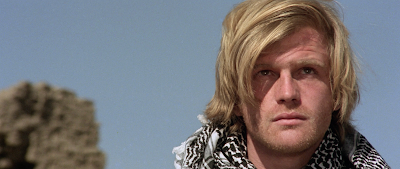
 

Although released multiple times onto VHS, including a 1983 release from Cult Video as SMOOTH VELVET RAW SILK (it was subsequently rereleased by Continental Video in 1986 as EMANUELLE IN EGYPT), the film’s scope photography was severely compromised in all of its analogue incarnations. In 2008, as part of their Black Emanuelle’s Box Volume 2, Severin’s DVD not only featured the uncut version, but also restored the film’s proper 2.35:1 framing giving further depth to Gastone Di Giovanni’s lush cinematography. Audio options included both English (with some scenes still in Italian with English subtitles) and Italian (with optional English subtitles), which sounded fine. Extras included Black Velvet (18m28s), an interesting featurette highlighted by an on-camera interview with star Al Cliver and additional audio interviews with Gemser and Belle, who chronicle the confusing nature of making all these movies at the same time, the film’s locations, Rondi’s lack of direction, and much more. The film’s original Italian trailer (3m46s) was also included.


Severin’s new Blu-ray is another very pleasing upgrade whose boost in resolution improves detail considerably, and looks appropriately robust with stronger colour reproduction. The DTS-HD 2.0 Master Audio once again features the same audio options as the DVD, which come through with audible vigour, especially when Dario & Alberto Baldan Bembo’s sumptuous score takes over. Outside of the aforementioned Black Velvet featurette, newly-produced extras include an interview with biographer Alberto Pezzotta in The Roots of Evil (17m14s) where he provides plenty of insightful context including the film’s deceiving marketing by producer Alfredo Bini, the film’s similarities to Pier Paolo Pasolini’s ARABIAN NIGHTS (1975), how Rondi pushed the limits of censorship, and much more in this rather illuminating glimpse into the film, which should help viewers garner a better understanding of its odd appeal. In A Relationship of Confusion (17m16s), critic Joseph Fahim explores this unique film from an Egyptian perspective and how its “an artifact of its time”, Egypt’s limited European productions and how it would be impossible to make a film such as this today, and lastly how censorship was put into place in Egypt soon after the film’s release; given the lack of comprehensive history on the Egyptian film industry, this was a very pleasant and eye-opening surprise. The disc also includes the film’s English opening credits (1m48s), which were taken from Miracle Films’ UK pre-cert VHS, as well as the film’s rare English export trailer as SMOOTH VELVET WHITE SILK (which includes alternate music cues, 3m46s), and the aforementioned Italian trailer.

Tuesday, July 30, 2019

ROBOWAR - BLU-RAY REVIEW

Reviewed by Steve Fenton.
Let’s get one thing straight right at the start: coming as it did from 1988 (i.e., during the ‘last gasp’ of Italo trash cinema), as well as from low-end exploitationeer Bruno Mattei (using his infamous “Vincent Dawn” pseudonym), ROBOWAR is pure, undiluted exploitation mindrot that makes absolutely no bones about who and what it’s exploiting. Over the course of its brisk 88-minute runtime, it succeeds in—well, triesto, at least—ripping-off elements from ROBOCOP (as the title most obviously suggests), PREDATOR (especially that film!), the entire Rambo series, ALIENS, and also Arnold Schwarzenegger’s then-recent campy combat actioner COMMANDO, with a dash of Oliver Stone’s PLATOON thrown in for good measure.
Whole segments from ROBOWAR’s principal influence source PREDATOR are lifted almost verbatim and given the low-budget rerun-through. There are skinned human carcasses hung in trees and a bit where our mucho-macho ‘heroes’ use their arsenal of big guns like high-calibre Weed-Whackers in order to rout the hidden menace possibly lurking in the bush (“Whoever it was, it ain’t no more!”); indeed, as if to belabor this obvious nod to PREDATOR, there are numerous scenes of the heroes shooting wildly into the undergrowth elsewhere throughout, so obviously the minimal budget at least allowed for an unlimited amount of ammo to be fired-off! Playing one Major Murphy Black (“...better-known as ‘Kill-Zone’!”), Reb Brown leads a ‘crack’ expeditionary force of mercenaries somewhere deep in a Latin-American (or is it Southeast Asian?) jungle. Amongst others under Brown-as-Black’s command is well-seasoned spaghetti stunt-grunt Romano Puppo, who appears highly credible as the outfit’s grizzled, grim-faced senior member, Corporal Neil Corey (“Expert heavy weapons, top marksman rating…”), while Massimo Vanni, better-known to some as “Alex McBride”, plays Private Larry Guarino, alias “Diddy-Bopper” (?!) or just plain “Diddy” for short. As the squad’s shortest member and (quote) “crack reconnaissance man”, “McBride”/Vanni does a loose impression of Chuck Norris (circa that worthy’s Missing in Action stints), with mirror-shades, erect triceps, unkempt facial growth and all. Like Puppo an experienced fall guy in his own right, Vanni—best-known for his work on ’70s/’80s Italocrimers—also served as the film’s stunt coordinator (utilizing local Filipino stuntmen, who had plenty of experience in this sort of thing, as, not only were many European and American ‘tourist’ productions being shot in the Philippines at the time, but the nation simultaneously had its own then-thriving action movie industry too). Receiving plentiful screen-time herein, physically imposing (roughly 6-foot-5-inch) Pinoy actor Max Laurel (who played the titular snake/man-monster in both Jun Raquiza’s ZUMA [1985] and Ben Yalung’s sequel ANAK NI ZUMA [1987]) appears as Quang, the squad’s sole Asian (as in South Vietnamese) member and laconic pointman.
Collectively nicknamed BAM, an acronym for “Big-Assed Motherfuckers” (in our opinion, “BadassMofos” has a much better ring to it, but I guess something got lost in translation), our ‘dirty half-dozen’ are there to track down a renegade, gone-AWOL military cyborg as well as battle token revolutionary guerillas (who are present merely to up the gratuitous body-count during loads of chaotic combat scenes). Him—er, it?—known as “Omega I” is a bionic half-man/half-robot super-soldier invented by an unscrupulous techie named Mascher (played by Mel Davidson, wildly under- and overacting by turns) for use in militarily difficult theatres of war. To add some extra ‘dramatic tension’ to the proceedings, it develops that Omega incorporates various leftover bits-’n’-pieces of Reb’s ex-’Nam vet buddy, who was blown apart by a ’Cong land-mine.
Catherine Hickland (playing a chick named “Virgin” [yeah, right!]) is a blonde white missionary the squad picks up along the way, who eventually takes up arms—albeit without ever even coming close to actually shooting anything!—against the delinquent cyborg. Handling her M-16 like a squeeze-mop, rather than bother trying to come across like some kickass Sigourney Weaver clonette, Ms. Hickland instead plays seventh fiddle to the boys and steers clear of the gunfights. During these, lots of innocent incidental shrubbery (courtesy of the Filipino locations) and low-rent jungle real estate get blowed-up real good care of economical-if-energetic pyrotechnical effects.
Realization of the supposedly terrifying Omega droid is tawdrily shoddy in the extreme, it should—and indeed, must—be said. Super Force (1990), US TV’s own ROBOCOP rip-off from the same period, boasted a much more ominous-looking costume, and that guy was the hero! In the long run, ROBOWAR’s sub-state-of-the-art biomechanical menace comes across about as intimidating as your average 8-inch toy action figure. Indeed, the most-realistic aspect of Omega’s get-up is its black-painted football-cum-motorcycle crash helmet with smoked plastic visor; its least-convincing aspect being the urine-tinted, fuzzily digitized POV shots (accompanied by an overlaid gibberish of electronic tonalities) that indicate its heavily-pixelated worldview. For the most part, DP Riccardo Grassetti’s camerawork is efficiently functional, looking all the easier on the eyeballs in Severin’s pristine BD edition, and the crisp cinematography makes special makeup-man Franco Di Girolamo’s gnarly ‘putrefying cadaver’ effects appear that much gnarlier.
The affably dudebro-ish Brown—some of whose career ‘highpoints’ are a couple of Captain America TV movies and “Anthony M. Dawson”/Antonio Margheriti’s prehysterical schlock sci-fi epic YOR: THE HUNTER FROM THE FUTURE (1983)—spends most of his screen-time looking like either a mildly-startled bullock or an embarrassed Myrtle Beach surfer dude (or both at once). Possibly the Omega reminded Reb of resident supervillain Overlord’s pet ’bots in YOR too much, and made him nervous? His California beach bum act (complete with jet-black headband, as per his onscreen surname) is mostly played tongue-in-cheek, although he really gives his all in some scenes (you’ll know ’em when you see ’em!). But, was our Reb starting to look more and more like Doug McClure (especially in his career moves) during this period in his career? At one juncture, Brown pins a guerilla to the side of a native hut with a thrown knife. With the punchline-timing of an Arnie or Freddy, he then proceeds to deadpan, “Don’t move!
After ROBOWAR and his work on Fulci’s lamentable and virtually unsalvageable ‘unfinished mantelpiece’ ZOMBIE 3, it seems as though Bruno Mattei’s best effort, in this writer’s opinion, shall remain the nasty nunsploitation shocker THE OTHER HELL (1981); although, since Mattei openly admitted he’d never made a good film anyway, my opinion is entirely disposable. In the present offering, the director throws our way sufficient explosions, f-bombs—including a surprising number from former ‘boy-next-door’ Brown—unexpectedly competent and grisly after-the-fact gore FX, as well as prodigious amounts of asinine dialogue, that there’s not much time left to dwell on ROBOWAR’s shortcomings, when all is said and done… it definitely does entertain, and that’s the main thing. 
Final verdict: ROBOWAR is an absolutely vacuous but fun timewaster for undemanding fans of such fare; nothing less, and certainly nothing more. As rampaging sub-zero cyborg exploitation goes, gimme FRANKENSTEIN MEETS THE SPACE MONSTER any day, but for 1980s future schlock sci-fi, the present film ain’t too shabby at all (especially when you consider some of the far-crappier and less-energetic American-made STV [“straight-to-video”] ROBOCOPPREDATOR imitations that were released back then). Al Festa’s noodly synth electrobeat/cheese metal score is late-’80s all the way, and doesn’t sound half-bad even in 2019; who cares that incidental songs are periodically superimposed atop the action on a seemingly random basis, without rhyme nor reason?! While it’s been very nearly 30 years (GULP!) since I last killed X number of brain-cells watching ROBOWAR, in retrospect—especially in light of its latest, optimal incarnation on Blu-ray—it looks a whole lot better (in more ways than one) than I remember it being the first time round. 
In conclusion: let’s hear it for Reb Brown, the “Doug McClure” of the ’80s and ’90s!
Like Mattei’s other unashamedly—and highly-enjoyable—rip-off, SHOCKING DARK (1990), ROBOWAR was also never officially released in either the U.S. or Canada in any form, and it first gained notoriety among discerning cineastes via Columbia Home Video’s Japanese VHS videocassette release. In English with Japanese subtitles, Columbia’s tape also retained the film’s original 1.85:1 aspect ratio, and it remained the optimum release for more than two decades prior to Severin’s long-overdue Blu-ray. Scanned in 4K from the original camera negative, this all-region edition is virtually flawless, boasting razor-sharp detail and a bold, lush colour scheme, which is especially attractive considering that the entire narrative unfolds in a tropical rainforest. However, this added clarity also draws attention to the film’s ‘rough edges’, including the hilariously thrifty robo-suit. The DTS-HD MA 2.0 audio is provided in both English and Italian (with optional SDH and newly-translated English subtitles, respectively), and while there are some minor differences between the two tracks, it’s pretty hard to resist the film’s animated and sometimes highly-surreal English audio, which at times is a real hoot (e.g., “C’mon, Doc, you walk like a ruptured duck!”).
Containing a whopping six (!) special featurettes, the extras begin with Robo Predator (23m06s), an on-camera interview with writer/director Claudio Fragasso (a.k.a. “Clyde Anderson”), who shares his memories of working with Bruno Mattei and their cost-effective technique of shooting two different films simultaneously, beginning with their earliest collaborations, THE TRUE STORY OF THE NUN OF MONZA (1980) and THE OTHER HELL (1980), and later ROBOWAR along with Fragasso’s zombie film AFTER DEATH (1988), which they shot using only one camera! He also praises Mattei for his prowess as an editor, and how at one point he had to step in and direct a few sequences when Mattei fell ill. In Italian Rip-Off (9m18s), screenwriter Rossella Drudi gives her thoughts on the genesis of the film, and how she and Fragasso were commissioned to deliver a (quote) “part-PREDATOR, part-ROBOCOP, and part-ALIEN” film for producer Franco Gaudenzi. Drudi also admits how initially she wasn’t very fond of ROBOWAR, but after re-watching the film, she has become more forgiving (“It’s a nice movie. It’s very funny!”). Drudi pops-up again in Violence, She Wrote (21m05s) for a career-spanning interview, which is similar to the one she shared with Claudio Fragasso on Severin’s BD of VIOLENCE IN A WOMEN’S PRISON (1983). Nevertheless, in this new featurette, she shares a number of interesting stories as one of the very few female screenwriters associated—at that time, at least—with the horror genre.
The film’s leading lady, Catherine Hickland submits to an interview in Robolady (11m34s), during which she reminiscences about the unforgiving Philippine locations and how (quote) “There were a lot of surprises there for me”; she also speaks fondly of the cast and crew, despite some of them only speaking Italian (including director Mattei). In addition she discusses leading man Reb Brown’s (quote) “utter commitment”, no matter what the scene called for (this dedication is never more apparent than when Brown daringly leaps from atop a lofty cataract into a pool far below, and also during a strangely poignant anticlimactic scene at the end when he convincingly sheds tears over what his fallen ’Nam comrade-at-arms has become). In Papa Doc’s War (12m50s), American actor John P. Dulaney briefly discusses his career in Italian cinema and how he ended-up in the Philippines thanks to his friend, actor Mike Monty; the hot ’n’ humid locations; and how Mattei instructed everyone to yell incessantly while firing their machineguns. Actor Jim Gaines, Jr. is interviewed in The Robo Warrior (9m02s), wherein he primarily talks about how ROBOWAR was shot simultaneously with AFTER DEATH, as well as relating a number of funny anecdotes. Finally, in War of the Philippines (17m32s), actor/stuntman Massimo Vanni, who went by the anglicized pseudonym “Alex McBride” for most of his ’80s work, speaks warmly of working with Mattei, and how he initially got to know him via his cousin, editor Vincenzo Vanni. He goes on to discuss Mattei’s and Fragasso’s working relationship and how he enjoyed making (quote) “homemade” versions of Hollywood blockbusters. 
Additionally, this already extras-packed release includes Catherine Hickland’s Behind the Scenes Home Videos (15m14s), which is narrated by Hickland herself and features most of the cast and crew enjoying their time on-set and also includes an appearance by long-time actor Luciano Pigozzi (see note below). ROBOWAR’s trailer finishes-off the extras. For the first 3000 copies of the run, Al Festa’s score is included on a bonus CD. The film is currently available through Severin as a Limited Edition Blu-ray, DVD or as part of a Robowar bundle. For you Canadian readers, copies can be obtained from Suspect Video.
Note: Evidently, some scenes featuring long-time Italian character player Luciano Pigozzi (a.k.a. “Alan Collins”) were shot, but for whatever reason got excised from the final cut. Coincidentally enough, the same thing supposedly happened to the same actor on Mattei’s hilariously out-of-whack Vietnam War-set poliziesco COP GAME (1988), yet the name “Alan Collins” remains in its opening credits (as it also does on ROBOWAR), despite Pigozzi himself being nowhere to be seen in the flesh.