Sunday, September 27, 2020

THE GHOST BREAKERS - BLU-RAY REVIEW

Following their successful pairing in the previous year’s THE CAT AND THE CANARY (Eliott Nugent, 1939), stars Bob Hope and Paulette Goddard returned in George Marshall’s THE GHOST BREAKERS (1940), an undemanding yet quintessential horror-comedy. Brimming with perfectly-timed, zippy one-liners, Hope is at his comic best in this good-natured romp, which also doesn’t skimp on genuine scares and eerie atmosphere. 


After incensing local underworld boss Frenchy Duvall (Paul Fix) over the radio, popular gossipmonger Larry “Radio” Lawrence (Bob Hope) is sent for, so Frenchy can (quote) “give it to him straight.” In the ensuing mix-up, Larry mistakenly believes he may have shot one of Frenchy’s men in self-defense and ends up hiding inside a steamer trunk belonging to Mary Carter (Paulette Goddard), who is bound for Cuba. Having inherited Black Island and Castillo Maldito, its supposedly haunted castle (“Death waits for you on Black Island!”), it seems Mary’s inheritance also interests several other individuals, including the mysterious Medero brothers (Anthony Quinn) and Mr. Parada (Paul Lukas), whose (quote) “peculiar reputation” also comes into question. Upon her arrival, Mary also meets up with old friend Geoff Montgomery (Richard Carlson), who also warns her of this cursed island. Thus, in return for helping him out, Lawrence and his trusted valet (Willie Best) try and prevent some potential—and very real—threats pointed her way. 


In Lee Gambin’s informative audio commentary, he addresses the inherent issues with horror comedies and praises this film’s (quote) “finely acute balance” between the two genres, which is indeed one of the film’s major strengths. Despite all of Hope’s witty remarks and self-deprecating humour (“If there’s going to be any hysterics around here, I’ll have ’em!”), his quick-talking personality also reveals a subtle optimism and self-confidence, which plays well next to Goddard’s equally-strong character, Mary Carter. Holding her own among several deceptively suave swindlers vying to get at her potential inheritance, she proves to be as every bit resourceful as her male counterparts. At one point, against Geoff’s best advice, she makes her way to Black Island by herself, swimming to shore in the dead of night after her boatman refuses to dock his boat there.


Talented African-American character actor Willie Best is also on hand. Although his appearance herein is relegated to a stereotypical role as Lawrence’s dim-witted servant, he commits himself sincerely to the part, ultimately coming across as the shrewdest of the whole bunch. Despite some of the colourful (no pun intended!) and cringe-worthy digs aimed at him (e.g., “You’re like a blackout in a blackout!”), Best’s character emerges with a (as pointed out in Mr. Gambin’s audio commentary) “quiet dignity” thanks to some quietly subversive writing, which helps transcend this potentially benign and problematic role into one of the film’s most memorably noteworthy.


While THE GHOST BREAKERS is first-and-foremost a comedy, it also displays an astute usage of horror tropes with its atmospheric island setting (beautifully rendered via Farciot Edouart’s matte paintings) and in the impressive art direction of the castle set itself. This delightfully decadent haunted house comes complete with creaking doors, cob-webbed coffins, apparitions, and even mother-and-son zombies (Virginia Brissac and Noble Johnson, respectively) that function as the castle’s creepy caretakers; all of which modulate in harmony with the film’s lighthearted comedy elements.


Readily available on home video since the early ’Nineties on both VHS videocassette and Laserdisc, THE GHOST BREAKERS made its digital bow in 2002 when it debuted on DVD as part of Bob Hope: The Tribute Collection. While that edition was perfectly adequate for the time, Kino Lorber Studio Classics’ new Blu-ray is a major upgrade indeed. Sourced from a (quote) “brand new 2K master”, Kino’s transfer is a marked improvement over its SD counterparts, with better clarity and detail across the board. Black levels still tend to vary a little here and there, but it’s certainly nothing to complain about. Fans of the film should be more than happy with the work Kino have done here. Given the film’s age, the DTS-HD Master Audio 2.0 is also perfectly fine, not exhibiting any real issues, such as hiss and/or crackles and whatnot.


The most significant extra here is the aforementioned audio commentary by Lee Gambin, who has plenty to say about the film, its performers, and numerous crew involved in the production. Some of the many topics discussed include George Marshall’s 1953 remake SCARED STIFF (co-starring Dean Martin and Jerry Lewis), the (quote) “trick photography” of Farciot Edouart, and how this film served as the inspiration for Ivan Reitman’s GHOSTBUSTERS (1983). Despite it being a zany comedy, Gambin is quick to point out that THE GHOST BREAKERS (quote) “never loses its sense of urgency” and “lays down a lot of ground for things to come” within the horror genre. Of course, Mr. Gambin seizes the opportunity to also talk about many of its connections to other films and genres, allowing him to go off on numerous interesting tangents. Like the film itself, it’s a breezy, entertaining, and informative listen. Other extras include an episode of Trailers From Hell with writer Larry Karaszewski championing the film, the original theatrical trailer (“Ghost Breakers Incorporated. You make ’em! We shake ’em!”), and several trailers from the Kino Lorber Studio Classics library, which are, one way or another, associated with the present title. 


Highlighted by the spot-on comic-timing of Bob Hope, THE GHOST BREAKERS amounts to one his funniest films and is a consistently entertaining crossover of obvious appeal to both fans of American film classics and straight-ahead horror movies. Needless to say, Kino’s new Blu-ray is an absolute must! Order it from Kino or Amazon.

Tuesday, September 22, 2020

SHINING SEX - BLU-RAY REVIEW

A hypnotic, often bizarro melding of an experimental softcore film with science-fiction trappings, Jess Franco’s SHINING SEX (1975) remains one of the directors’ more unapologetically voyeuristic efforts. Revisiting the basic storyline of his earlier—much-more polished—THE DIABOLICAL DR. Z (1965), SHINING SEX, however, possesses a similarly dreamy air of sensuality to SUCCUBUS (1968) or FEMALE VAMPIRE (1973), two of the director’s more celebrated and widely-seen works. Barely released and notoriously difficult to see in any form approximating Franco’s intended vision, SHINING SEX has, thanks to Severin Films, been given its first uncut/uncensored home video release. 


Made in conjunction with Franco’s far-more-playful MIDNIGHT PARTY (1975), which also stars Lina Romay and shares much of this film’s personnel, Romay is herein cast as Cynthia, yet another bubbly stripper. It will come as no surprise for anyone well-versed in Franco’s oeuvre that SHINING SEX begins with another extended nightclub act, which gains the attention of Alpha (Evelyne Scott) and her servant Andros (“Raymond Hardy” / Ramon Ardid). Cynthia accompanies them back to their spacious apartment, but her enthusiasm soon escalates to horror when, during orgasm, she experiences a spasm of obvious pain, all of which is telepathically sensed by Dr. Seward (Jess Franco), a wheelchair-bound paranormal scientist. Alpha then mysteriously rubs a shining, shimmering substance onto Cynthia’s body, which somehow puts her under Alpha’s control. Using her as an instrument of death, Cynthia is ordered to destroy anyone who may potentially destroy Alpha’s (quote) “wisdom”, whereas Dr. Seward is convinced that (quote) “something frightening” or supernatural may be inhabiting our world… 


Although Alpha and Andros make numerous references to (quote) “another dimension,” the sparsely-populated resort town locations of La Grande Motte in southern France also appear decidedly otherworldly. Taking advantage of the resort’s unique, white-washed, pyramidal architecture and seemingly never-ending sunlight, Franco’s meager production is enhanced greatly by this location, which further strengthens the somewhat oblique sci-fi angle. SHINING SEX is, on its surface, a very bright and sunny film, but it camouflages a far darker scenario of despair and death—pure, unmistakable Franco themes. Like many of his films from this period, the primary motivator is sex, and Franco offers several, tenuously connected couplings as Gerard Brisseau’s camera boldly scrutinizes Romay’s body, zooming into her ‘shining sex’ with little left to the imagination. Also crucial to the overall ambiance, Daniel White’s jazzy score goes hand-in-hand with the film’s freeform, episodic scenario. In contrast, several instances of strange, atonal sound effects also enhance the film’s aural soundscape. As Cynthia becomes entangled in a never-ending spiral of desire and death, these eerily echoic sounds are weirdly reminiscent of someone trapped in a room desperately struggling to get out, a perfect metaphor for Cynthia’s increasingly hopeless ordeal. Considering the film’s budget was skimpier than some of Romay’s outfits, SHINING SEX’s biggest asset is Lina Romay herself, who lets go of ALL her inhibitions for Franco’s voyeuristic camera. Much like her portrayal of Countess Irina in FEMALE VAMPIRE, she dominates the screen with her presence. Playing a pair of Cynthia’s would-be victims, Franco regulars Monica Swinn and Olivier Mathot (as Madame Pécame and Dr. Kallmann respectively) also add substantially to the film’s peculiar milieu. 


Barely released onto videocassette back in the day, the film was given some limited exposure at the time via Japan’s Tohokushinsha label. Although in English and running almost 100 minutes, it was made unwatchable due to the extensive censorial digital fogging mandated by the Japanese censor. Here making its worldwide disc debut, Severin’s Blu-ray features an all-new transfer taken directly from Eurociné’s original camera negative, and the results are very eye-opening, indeed. At long last, Severin’s disc retains the film’s original 2.35:1 scope photography, but being a Franco film, detail still varies from scene to scene with some instances of blurred photography. During one brief moment, an in-camera gate weave at the 80-minute mark causes some momentary jitter, but for the most part, things really do look terrific. Sporting an English DTS-HD 2.0 mono audio track, the minimal dialogue also sounds clear and well-equalized while giving plenty of prominence to Daniel White’s outstanding, highly experimental score. 


As expected, Severin’s disc comes loaded with several illuminating extra features, which begin with an excellent feature-length audio commentary from Franco expert Robert Monell (who also runs the I’m In A Jess Franco State Of Mind blog), and NaschyCast’s Rodney Barnett. Almost immediately, they readily acknowledge that Franco was (quote) “trying to do something different” with this film even as he reuses the (quote) “same scenario again and again.” They also discuss Franco’s tendency to shoot films back-to-back, the abstract quality of the architecture, the film’s (quote) “weird pop-art aesthetic,” many of its recurrent visual themes, and the (quote) “idea of lust and its horrible power.” Of course, given the pseudonymous nature of the production (Franco directed the film as “Dan L. Simon”), they also talk at great length about many of the performers, Franco’s numerous aliases, and the alternate hardcore variant. 


In Severin’s continuing exploration of Franco’s filming locations, In the Land of Franco Part 3 (12m42s) has Stephen Thrower and actor Antonio Mayans returning as our tour guides. This time, they visit many locations in and around Málaga, Spain, which popped up in both MIL SEXOS TIENE LA NOCHE (1984) and JUEGO SUCIO EN CASABLANCA (1985), where it doubled for Tunisia. Our guides also visit several areas where Franco’s ashes were scattered and meet up with Kike Mesa of Andale Audiovisual, who talks about his friendship with Franco during his final years. In Shining Jess (19m14s), Murderous Passions and Flowers of Perversion, author Stephen Thrower returns for an on-camera interview, wherein he thoroughly discusses the title film with his usual eye for detail. He goes on to talk about how it relates to many of the filmmaker’s other productions of the time and how desire is used as a (quote) “potentially dangerous force,” while praising Lina Romay’s unabashed performance, which he cheekily surmises as (quote) “carnality incarnate.” In Silent Running (6m26s), director and post-production sound editor Gerard Kikoïne discusses his time working on more than a few Franco films. He amusingly recalls how many of them had no live sound at all (not even a guide track), which ultimately resulted in some creative manipulations to get everything right. In Franco at Eurociné (17m39s), Eurociné head honcho Daniel Lesoeur relates plenty of anecdotes about Franco’s on-and-off working relationship with the company, and rather fondly, promises he will always remain a (quote) “part of the family.” In Franco-Philia (29m13s), BROTHERHOOD OF THE WOLF (2001), and SILENT HILL (2006), director Christophe Gans talks about his love of Franco. He believes that his films are more (quote) “musical than cinematic” as well as how Lina Romay’s body was his (quote) “cinematic musical arabesque (!)”, which the director retreated to like some (quote) “Poetic Beaudelaire.” The lengthy extras conclude with some Very NSFW Outtakes (13m10s) used for the film’s hardcore version and the film’s trailer ([3m40s]“Never before has the screen thrilled to such explicit desire!”). The Limited Edition release also comes with In the Land of Franco Vol. 1, a very welcome soundtrack comp CD (14 tracks, 54m) featuring music from several Jess Franco films, the present one included. 


Slow-moving yet strangely mesmerizing, SHINING SEX may not be for everyone, but viewers who allow themselves to become immersed in its weird, ethereal reality will find plenty to enjoy, especially via Severin’s extras-filled and definitive Blu-ray! Order the standard edition Blu-ray from Severin Films here.

Sunday, September 13, 2020

YOUNG, VIOLENT, DANGEROUS - BLU-RAY REVIEW

Reviewed by Steve Fenton

Excerpt from an English export press synopsis: ‘For no apparent reason, three youths go on a rampage – a spiral of aimless violence that raises fundamental questions about how society can permit such things to happen...’


Press synopsis, from the Foreign Sales Italian Movie Trade newsletter: ‘More violent than CLOCKWORK ORANGE... the story of two [sic!] young men who carry out a hold-up for the fun of it: the beginning of a series of crimes, absurd misdeeds, violence, desperation and murder.’


One murderous punk, to another: “Haven’t you read Freud? Guys who can’t get a hard-on have ta act badass!”


Based upon an original short story by top Italocrime genre author Giorgio Scerbanenco (who, among others, also wrote the source novel on which Fernando di Leo’s NAKED VIOLENCE [a.k.a. I ragazzi del massacro, 1969] was based; a story which shares many thematic similarities to the present film’s), from a screenplay co-written by Italocrime top gun Fernando di Leo, this was yet another urban crime story torn directly from domestic news headlines. This kind of cautionary ‘youth-runs-wild’ scenario had been prevalent at least as far back as rock’n’roll era American JD flicks (e.g., Fred F. Sears’ TEEN-AGE CRIME WAVE [1955]), but herein is modernized and given a distinctly Italian spin. Here, director Romolo “Guerrieri”/Girolami approximates the genre work of his brother Marino Girolami (a.k.a. “Franco Martinelli”) and his nephew Enzo Girolami (a.k.a. “Enzo G. Castellari”). 


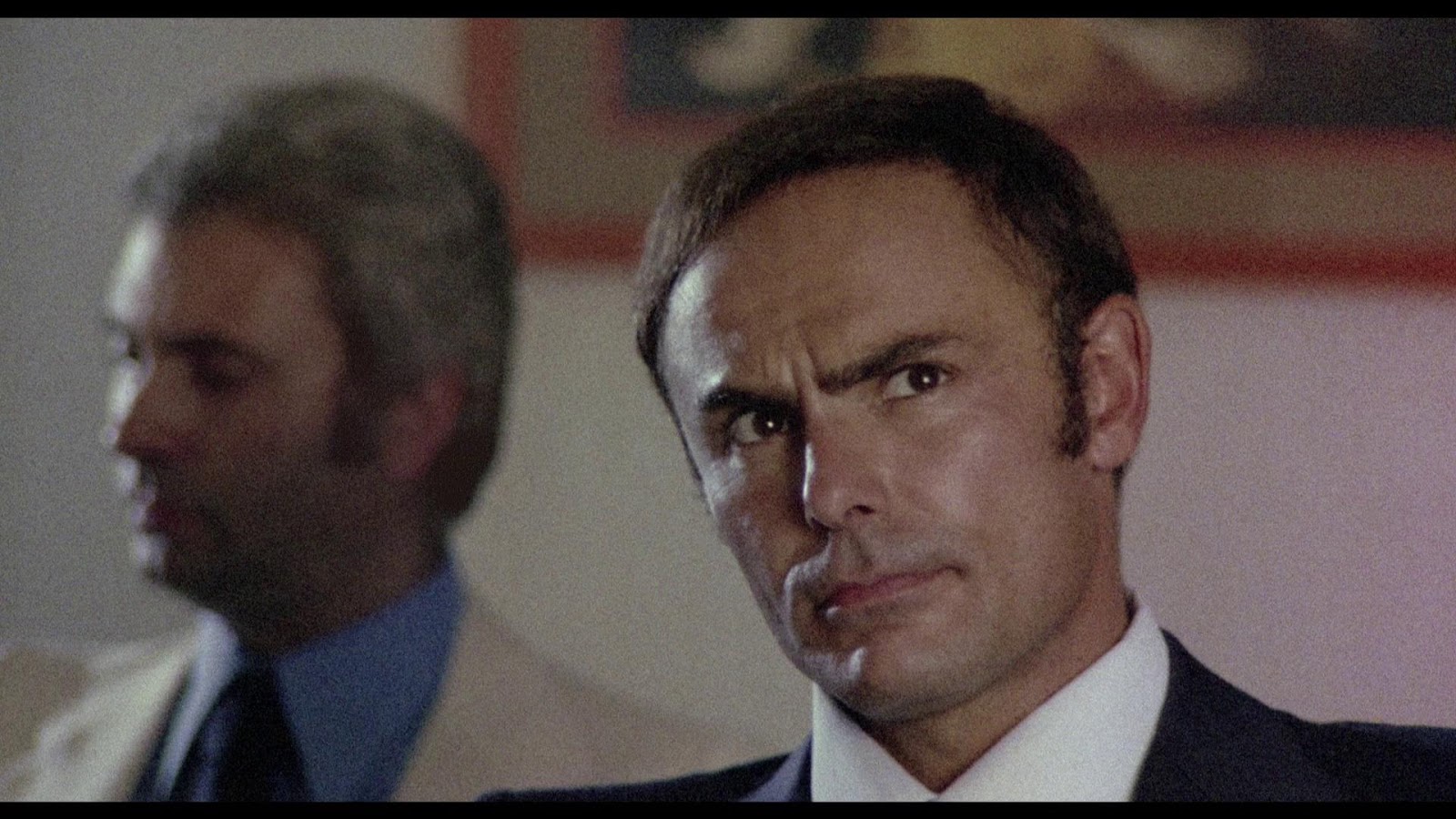
In Milan, having graduated from toy popguns to the real deal, three bored bourgeois punks – Paul Farley (Stefano Patrizi; known as Mario, or il Biondo / “Blondie” on Italo prints), Joseph (“Gio”) Edwards and Louis (“Luigi”) Mayan (the latter pair played by Benjamin Lev and Max Delys respectively) – go on a local criminal rampage in a stolen Fiat 125. In advance from Louis’ concerned girlfriend Lia (Eleonora Giorgi), a savvy police inspector (Tomas Milian) learns the location of a proposed robbery by the trio. Acting on this hot tip-off, Milian and his men stake-out the gas station in question, only to have things go horribly awry when, without provocation, Paul guns-down the manager and several cops are also killed as the kids make their reckless, bullet-strewn getaway. Still in need of cash, they then pull a bank-job – resulting in yet another murder – and make off with five-million lire; just for kicks, the robbin’ hoods end up scattering the stolen money out of the car window into the avariciously clutching hands of grateful pedestrians, who swarm upon this sudden unexpected ‘windfall’ like so many flies to you-know-what. 


Using brand-new submachineguns provided by an arms dealer named Lucky (Diego Abatantuono), the boys next stick-up a supermarket; during which Paul takes unfair advantage of the highly-charged atmosphere to eliminate the trio’s unwanted accomplices, Lucky and his gang. By this point, the only one of the three who has not yet committed murder is Louis; so just for ‘security,’ Paul decides to take Louis’ girlfriend Lia along for the joyride. Disgusted by their unauthorized disorganized crime wave, the local Milanese underworld washes its hands of the three, and renege on their original deal to provide the fugitives with fake passports. Public opinion, meanwhile, leans toward a lynch mob as angry citizens demand that justice be done. Unable to escape across the border and hemmed-in on all sides by police roadblocks as the dragnet tightens, the gang goes to ground in farmland outside the city, where their pointless crime spree ends on still another pointless note. 


To compensate for his rather lacklustre direction here, Romolo Guerrieri injects some pertinent and well-intended (albeit weak, dramatically speaking) social commentary espousing the necessity of tender loving care and healthy communication between fathers and their sons in order to avert future criminal inclinations (a valid theory that is still very much prevalent today). Rather than a violent vigilante cop typical of the period, Milian’s character here – an unnamed commissario identified only by his title – leans decidedly towards the Left while bemoaning the shortage of laws on the books (justifiably) designed to punish negligent parents for the criminality of their offspring (“Because we have to eliminate these three monsters you’ve created!”). That same year of ’76, Milian would first appear as his future iconic Nico Giraldi character in Bruno Corbucci’s comedic crime caper THE COP IN BLUE JEANS, who was as different as night from day in both his appearance and attitude from his character in the present film.


Y, V, D’s lawless punks hotwire a new car as casually as changing their underwear, and recklessly play dodgems (a.k.a. ‘bumper cars’) with police Giulias. During their inaugural armed robbery, for greenhorns – chalk it up to beginner’s luck! – they rather-too-effortlessly rub-out several experienced plainclothes cops. By far most annoying of the three is Joe, nicknamed “the village idiot” by the late (un)Lucky. Quick with the wisecracks, maniacal laughter and trigger finger, Joe models himself after a Wild West gunslinger (“The old .44, my sidekick! Billy the Kid’s on the town... look out! BANG! BANG! BANG!”). As the well-meaning but ineffectual Lia – the boys’ faint voice of conscience; their ‘feminine side,’ if you will – Giorgi looks good but mostly plays it like a whiny, self-pitying rich brat while (be it intentionally or unintentionally) fomenting in-fighting among the overaggressive males in her company. After finally being dumped-off by the roadside like so much unwanted excess baggage, Lia’s ruined young life seems to have lost all direction; another potential tangent upon which Guerrieri fails to elucidate. (Although, to be fair, her character really isn’t all that interesting as anything more than window dressing / eye candy. And, truth be told, she really doesn’t warrant that much sympathy [if any], being as how, attracted as she is to ‘bad boys’, she has voluntarily chosen to hang with the ‘wrong crowd’. On a subtextual level, it might well be argued that Lia’s very presence – an attractive female among a group of hot-headed youths – actually helps to encourage their sociopathic acts, unwittingly or not. But enough with the potential over-analysis here already!) 


Milian’s generic Inspector is never once identified by name throughout. Due to his hippy cop performance in Corbucci’s aforementioned then-recent smash-hit THE COP IN BLUE JEANS (a.k.a. Squadra antiscippo, 1976) – which had opened some six months earlier – original Italian newspaper ads for YOUNG, VIOLENT, DANGEROUS (September ’76) billed Milian prominently as ‘il poliziotto scatenato’ (“The Rebellious Cop”); which is somewhat ironic, as here – despite being a leftist – the actor sports a three-piece grey pinstripe suit and short hair while playing one of his straightest, most by-the-book policemen ever (shades of his part in Carlo Lizzani’s THE VIOLENT FOUR [Banditi a milano, 1968]). Just for the sake of diametric contrast, compare his anarchic socio/psychopath in Umberto Lenzi’s ALMOST HUMAN (a.k.a. Milano odia: la polizia non può sparare, 1974)!


While it lacks much in the way of true visceral punch, YOUNG, VIOLENT, DANGEROUS  is engaging enough for the first hour or so, then gradually runs out of gas (at almost 100 minutes long, it could easily have been 20 minutes shorter, with some judicious editing). At last precipitating the finale, the cops have the sense to call in the helicopters and tracking dogs, whereafter the insufferable Joe gets his throat torn out by an Alsatian attack dog. Also including some crazy business with mobsters at a scrap metal yard, some passable action outbursts are among this film’s few saving graces. But there are far, far worse ways to spend your time (committing armed robberies, for instance!), so if you’re in any way, shape or form a fan of the Italocrime genre, chances are you’ll derive at least some degree of entertainment value from this. Besides, in comparison to the fuzzy old second-generation VHS dupe I originally watched it on way back when, Cineploit’s brand-new BD presentation is such an infinitely superior upgrade that it can easily be viewed with ‘different eyes’, so to speak. So by all means give it a look.


Blu-ray Specs & DVD Info (by Dennis Capicik):

In what was one of the finer-looking video presentations of any Eurocrime film at that time, YOUNG, VIOLENT, DANGEROUS was released onto VHS cassette under its original export title of YOUNG, VIOLENT AND DESPERATE courtesy of Lauren Home Video, an obscure American video label that only issued a small number of titles onto to the market, most of which were Italian films (such as Ruggero Deodato’s WAVES OF LUST [1975] and Fernando di Leo’s incredible neo-noir THE BOSS [1973]). Guerrieri’s film eventually made it to Italian DVD in 2005 thanks to Raro Video, but despite the English-friendly audio option, it was not anamorphic, which left plenty of room for improvement. Unfortunately, this very same print was later utilized for Raro’s US disc debut in 2012. Luckily, the folks at Cineploit took the initiative by striking a new 2K transfer of the film, and the results look mighty fine indeed. Compared to Raro’s earlier substandard discs, this is a vast improvement, boasting much clearer overall detail, perfect colour saturation and a healthy amount of natural film grain – it really is just about perfect! Cineploit have also included DTS-HD Master Audio 2.0 audio options in German, English and Italian, with optional subtitles in German and English. 


Extras begin with Liberi, Armati, Pericolosi (15m54s), a wonderful featurette by Eugenio Ercolani, who interviews director Guerrieri, script supervisor Sylvia Petroni and actress Eleonora Giorgi. Guerrieri begins by admitting he (quote) “never managed to make the films I would have wanted”, but has plenty of good things to say about said film, including how he convinced Milian to go against type and play a commissario (“You’ve been going around with a head full of curls playing Monnezza!”) and how he tried to focus more on the human aspect of the characters. Despite his best efforts, however, he was always disappointed when many of these ‘poliziotteschi’ were (quote) “labelled as fascist” by critics. Sylvia Petroni discusses her time working for her father Giulio Petroni on the set of his politically-inclined spaghetti western TEPEPA (1967), as well as her time working with Fernando di Leo, which eventually led to her to her employment by Guerrieri. Although a fairly major presence in the film, Guerrieri was disappointed by his casting of Giorgi; the actress herself admits she was (quote) “just passing by”, and was completely uninterested in working at this stage in her career. Other extras include three separate photo galleries, the first of which highlight the film’s Italian posters and fotobustas while the second and third spotlight video artwork and some wonderful on-set photographs, respectively. As a substantial added bonus, Gianfranco Plenizio’s entire 19-track score (45m34s) is also included. 


As with Cineploit’s other releases, YOUNG, VIOLENT, DANGEROUS is once again housed in an attractive Mediabook, which  includes a handsomely-illustrated 28-page booklet, predominantly in German, although a print interview with Guerrieri conducted by Ercolani is printed in English. Order the BD from DiabolikDVD here. 

Wednesday, July 22, 2020

THE .44 SPECIALIST - BLU-RAY REVIEW

English-language export press ad-lines: “The intrigue and terror of THE THIRD MAN. The explosive violence of [DAY OF] THE CONDOR. A film you won’t easily forget.”

Under its more logical Italian release title of MARK COLPISCE ANCORA (trans: “Mark Strikes Again”), THE .44 SPECIALIST (1976) was promoted as the third (and final) entry in Stelvio Massi’s loosely-connected Marc the Narc trilogy, all of which featured former child actor and fotoromanzi heartthrob/superstar Franco Gasparri (1948-1999) as the titular rogue cop; basically a ‘prettier’ variation of Dirty Harry. In BLOOD, SWEAT AND FEAR (1975), Massi’s first and most successful film of the trilogy, Mark is described by his superiors as (quote) “a man who keeps his hair a bit too long, doesn’t give a damn about discipline and wears a gun in the pocket of his jeans, a bit like Serpico.” In what may be a possible nod to Tomas Milian’s then popular ‘Nico Giraldi’ (also heavily influenced by Serpico’s ‘unique’ look) or ‘Er Monezza’ characterizations, Mark’s ‘undercover’ appearance herein is even more noticeably disheveled with ratty clothes and far-curlier hair, but in an even more inexplicable revision, his surname is also changed from Terzi to Pasti (Patti on Italian prints), a fact which only magnifies this film’s already tenuous connection to the first two entries. So, in light of this film’s distinctive pedigree, it should come as no surprise that THE .44 SPECIALIST works well enough on its own, which turns out to be a fortuitous circumstance for first time viewers of Cineploit’s fine-looking Blu-ray, which turns out to be the first official English-friendly disc release of any Marc the Narc film. 

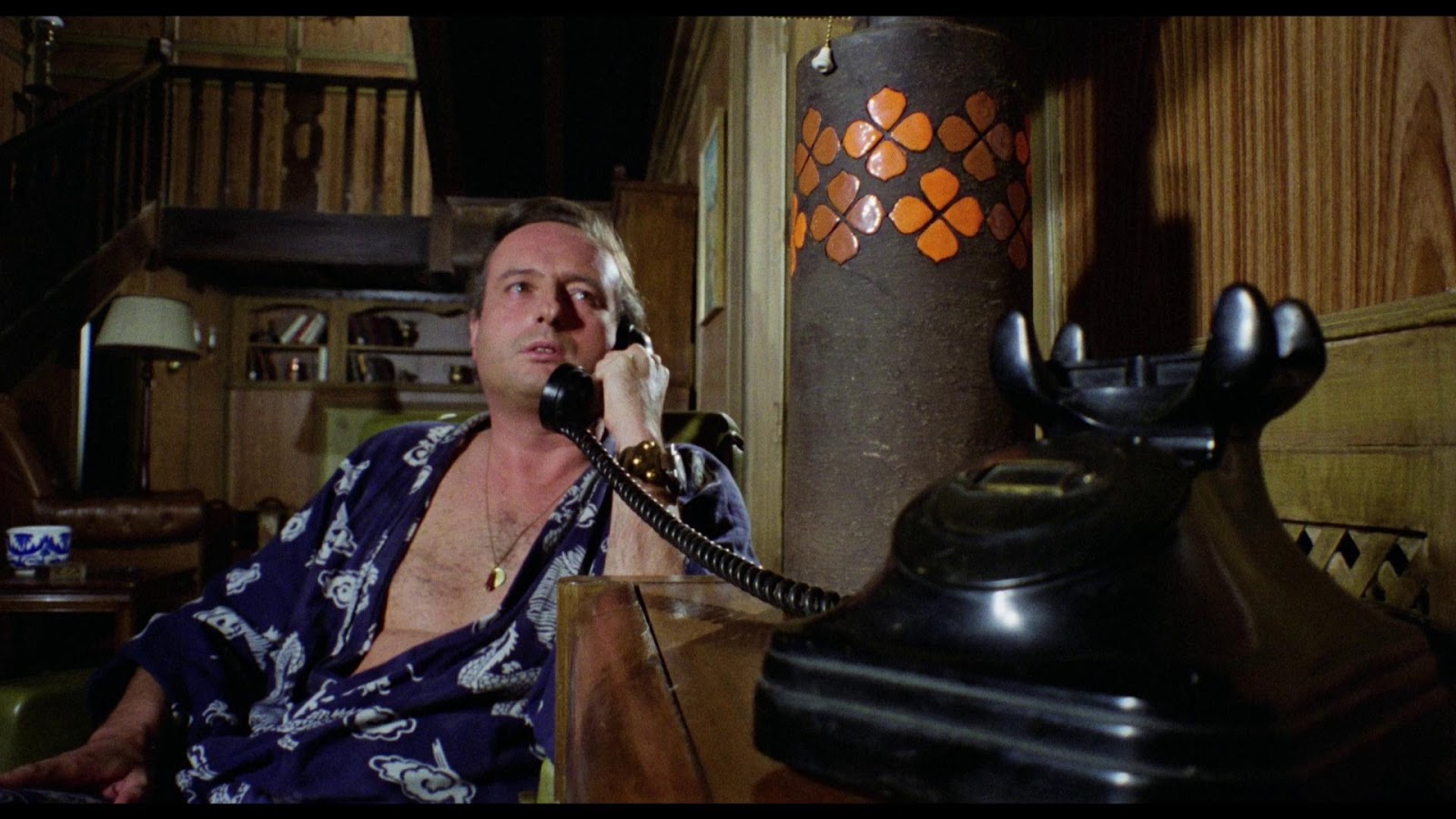
Set to Stelvio Cipriani’s always-enjoyable urban rhythms, an unidentified member of a passing motorcade is assassinated during the film’s opening credits, but in retaliation, the sniper (Claudio Zucchet) suffers a near-fatal wound. Meanwhile, Mark has been relegated by his superior officer Mantelli (Giampiero Albertini), to (quote) “clean up all the lay-abouts and troublemakers in the district”. Of course, he’d much rather go after the (quote) “big cheeses” heading the entire drug scene instead. After witnessing Mark’s undercover antics at a Roman piazza, German anarchists Paul Henkel (John Steiner) and Olga Kübe (Marcella Michelangeli) hire him to help their injured cohort from the opening (“Did somebody use a Howitzer?!”). However, despite Mantelli’s protestations, Mark embarks into the shadowy, double-dealing world of global terrorism…

In a plot that takes its cue from Sydney Pollack’s THREE DAYS OF THE CONDOR (1975), Mark finds himself ensnared in a world he knows little about, but with the help of Interpol agents Pappadato (Andrea Aureli) and Chief Altman (John Saxon) he manages – just barely – to weave his way through this secretive world of cat-and-mouse allegiances. Co-penned by Lucio De Caro and returning scribe Dardano Sacchetti (who co-wrote the first film), an attempt is made to expound on the far-reaching and highly powerful links terrorism has with certain shady government agencies. This interesting subplot isn’t given the time to fully develop, though. As Altman, Saxon’s screen time is limited to a few key scenes (thankfully, he dubs his own lines on English language prints), but he provides the film with some of its most interesting dialogue as he sneakily moves through a number of clandestine government bureaus whose motives are never, ever made known. Even as Mark builds a trustworthy rapport with both Paul and Olga, Altman suggests they are merely two cogs in a much bigger machine, which he shrugs-off as a waste of time when he confidently remarks, “Fanatics like them are a dime a dozen! If they didn’t exist, we’d invent them!” Although entertaining just the same, the film stays well within the confines of your standard poliziesco as even Mark, rather naively, demands that these killers (quote) “should be questioned and made to talk!”

In one of the film’s standout scenes (also pinched from Pollack’s aforementioned film), Mark is almost assassinated during a botched meeting in Vienna, but thanks to (quote) “pure chance”, he is luckily spared, which once again proves that people and things can never be trusted. In his continued attempts to bust Paul and Olga, he - rather confusingly - continues to aid and abet this pair of ‘fanatics’ even as they attempt to blow-up a busload of VIP’s from an energy congress. This lands Olga in jail, and Paul, being the psycho that he is, promptly hijacks a commuter train (“From this moment on, this train is my property, ya!”), threatening to kill everyone on board if Olga isn’t released. In spite of his hokey, almost-comical German accent, Steiner is wildly over-the-top as the determined revolutionist whose fanaticism knows no bounds in his quest to (quote) “Destroy ze old way to build ze new!”

Given the film’s scant home video release history (at least for English-speaking viewers, anyway), dedicated Italocrime enthusiasts had to make do with copies from any number of European VHS videocassettes back in the day via either Holland, Greece or, if you were lucky enough to score one, a nice dub from the rare Skyline UK release. Outside of the Italian Cecchi Gori disc, Massi’s film has had even less exposure on DVD, so Cineploit’s English-friendly, all-region Blu-ray is a very welcome edition, indeed. Licensed from Minerva Pictures and sporting a new 2K scan from the original camera negative, Cineploit’s Blu-ray looks excellent, and despite some instances of (quote) “severe chemical damage”, the transfer is nicely-detailed (no DNR here!), with solid black levels and a nice naturalistic color scheme. German, Italian and English DTS-HD Master Audio 2.0 mono tracks are included, with the Italian track being the most effective, boasting clear dialogue and subtly-nuanced background effects; the English track also sounds solid enough, but is mixed at a lower volume, while the German sounds hollow and canned. Both German and English subtitles are also provided, but for some strange reason, some Blu-ray players (or even Blu-ray drives on a computer) are unable to disable the German subtitles while playing the English version. 

A number of noteworthy and revealing extra features are also included, beginning with Mark, My Father and I (20m10s), an interview with Stelvio’s son Danilo Massi, conducted by Eugenio Ercolani. Having worked alongside his father even as a child, Danilo reminiscences warmly about his father Stelvio, admitting that it was he who (quote) “contaminated” him with his love for cinema. He goes on to talk about much of his early work as a highly-regarded DP and also discusses his hesitance to move into directing. Danilo Massi also happily discusses many of the actors who have worked for his father, including Luc Merenda, Tomas Milian (“A great soul…”), Maurizio Merli (with a particular emphasis on POLIZIOTTO SPRINT [1977], their first collaborative effort), plus Lee J. Cobb (name-brand American guest star of the first two Mark entries), and of course, the late Franco “Mark” Gasparri himself (who died tragically young); it’s a great interview filled with wonderful anecdotes and warm nostalgia, which, quite obviously, comes highly recommended. In Stelvio Cipriani Part 2 ([41m29s] Part 1 was included in Cineploit’s earlier Blu-ray of Luciano Ercoli’s KILLER COP [1975]), Mark Thompson Ashworth interviews the great maestro who enthusiastically discusses (and even demonstrates on his accompanying piano) many of his later Italocrime films, including his groundbreaking score for Stefano Vanzina’s THE EXECUTION SQUAD (1972) and the genesis of his marvelous theme for WHAT HAVE THEY DONE TO YOUR DAUGHTERS? (1974), as well as much of his other work is also touched-upon, including the origins of the sound of a killer octopus in Ovidio Assonitis’ TENTACLES (1977), and his much-appreciated work on James Cameron’s PIRANHA II: THE SPAWNING (1981). Finally, in Iron Commissioners (16m29s), former DP and director Roberto Girometti and Danilo Massi once again talk about Stelvio Massi’s respected stature within the industry and his (quote) “capacity to move the camera, which helped give dynamism to the actors’ performances.” Girometti in particular talks about how some of Massi’s films were (much to the late director’s chagrin) “patched-up for lack of money and time”. Danilo Massi also goes into the production side of things (he served as an assistant director on a number of his father’s films), with a specific focus on his collaborations with Merli and how he considers Massi’s THE IRON COMMISSIONER (1978) the (quote) “least-exciting to make and watch.” A short split-screen restoration demonstration (4m08s) and an extensive photo gallery (7m45s), which includes much of the film’s promotional material and rare behind-the-scenes photos of Massi, conclude the extras. 

Housed in an attractive Mediabook with a nicely-illustrated 26-page booklet, it’s no surprise that most of the text is in German, but it does contain yet another excellent English-language interview with Danilo Massi conducted by the ubiquitous and ever-welcome Eugenio Ercolani. As an added bonus, a special double-sided, fold-out poster featuring the film’s Italian artwork is also included. While it’s certainly not one of Massi’s best efforts, it’s nevertheless an undemanding and enjoyable enough slice of pulp entertainment. And not only that, but Cineploit’s Blu-ray is pretty terrific, so here’s hoping the label (or some other one, perhaps) get around to licensing the first two films in this sadly-underseen trilogy. Order it from DiabolikDVD here or here.

Tuesday, June 30, 2020

DEEP BLOOD - DVD REVIEW

The once-mighty Italian film industry was in a constant state of decline during the ’Eighties, what with home video steadily gaining popularity and big budget American films dominating the box office. Leave it to ever-lovable exploitationeer Aristide Massaccesi (best-known as Joe D’Amato, natch!), to take advantage of the opportunity to try catering to the demands of small screen audiences when he embarked on directing and producing a series of modest ‘Americanized’ movies through his prolific production company, Filmirage. Oftentimes referred to as the “Italian Roger Corman’, Massaccesi’s perseverance also provided continued employment for a number of experienced ‘old hands’, including Umberto Lenzi, Lucio Fulci and Claudio Fragasso, while a few up-and-coming directors also got a chance to helm their first films (e.g, Michele Soavi’s STAGE FRIGHT [1986] being one such example) for said production house. Unfortunately, outside of the odd spirited effort, most of the Filmirage-produced output remains unbearably bland, and nowhere is this more apparent than with “Raf Donato” / Aristide Massaccesi’s awkwardly-titled DEEP BLOOD (1989), a truly dire, late-in-the-game JAWS (1975, D: Steven Spielberg) rip-off, which is easily one of THE worst titles in the entire Filmirage catalogue.[1]And that’s really saying something!

Barring some minor (albeit head-scratching) variations, DEEP BLOOD is pretty much interchangeable with any other cheapjack imitation of Spielberg’s mega-blockbuster, but in an interesting – if exceedingly poorly-executed – sub-plot, the giant killer shark in DEEP BLOOD is depicted as a sort of Native-American god (hence the film’s original shooting title, “Wakan”, a loose interpretation of Wakan Tanka / “Wakȟáŋ Tȟáŋka”, which roughly translates to “Great Spirit” or “Great Mystery”) whose spirituality is, according to the film, irrevocably connected to us all; a unique perspective that was also explored far-more-thoughtfully in many an earlier ‘animal attack’ film, such as Michael Anderson’s ORCA (1977) and Arthur Hiller’s hauntingly unforgettable NIGHTWING (1979), whose killer bats may have been unleashed by an wrathful medicine man. Sadly, despite this potentially promising premise, Massaccesi struggles to do anything even remotely interesting with it. 

In the film’s clunky opening, four young boys barbecuing sausages on the beach are approached by a creepy old fellow (Van Jensens), who, rather unconvincingly, turns out to be a tribal chief elder (“Boys, this is a time of magic written in the sky…”) who warns them of the (quote) “great beast Wakan”, an ancient sea God that protects the oceans. Given an arrow box (a sort of talisman covered with tribal carvings) as a (quote) “seal of their pact”, Miki, John, Allan and Ben promptly bury this box in the shallow beach sand, and as Carlo Maria Cordio’s wretched, unappealing music swells on the soundtrack, the four boys swear – over a blood oath, no less! –  that they will never give up their pact. Reunited after what appears to be at least a decade, the four now-grown men, plan on spending their summer vacation together. But when John (John K. Brune) is killed by a giant shark, Miki (Frank Baroni) enlists the help of his friends Allan (Allen Cort) and Ben (Keith Kelsch) to destroy this giant beast…

As rudimentary as the plot may be, DEEP BLOOD is a hopelessly drawn-out mess whose least appealing aspect is its tendency to focus way too much time on needless and painfully mundane ‘drama’. Resembling some ABC AFTER SCHOOL SPECIAL (1972 – 1997) without any of that show’s heart or energy, the trite sub-plots herein mostly revolve around Ben’s aspirations to become a pro golfer (“What’s your story about golf?”); Allan’s reticence about attending officer training school; and Miki’s hatred towards his overworked, absentee father, the latter of which is laughably brought to light in one of the film’s most memorably embarrassing dialogue exchanges (“I hate you, man! I hate you with all my heart and all my soul!”). Many of the film’s peripheral characters are also pale imitations of characters from Spielberg’s film, including Ben’s father (Charles Brill), the local fisherman, whose take on Robert Shaw’s character Quint from JAWS also harbours many personal demons (“Since Jimmy’s death. I can’t go back out to sea again!”), a barely-touched-upon and utterly confusing sub-plot, which remains one of the most pathetic takes on Shaw’s famous U.S.S. Indianapolis speech from any JAWS imitator. 

Aside from the seemingly never-ending and overwrought narrative, the all-important shark attacks are equally pathetic, all of which lack absolutely any tension or energy whatsoever. This is further compounded by the use of mismatched stock footage of real sharks, underwater ‘inserts’ of people thrashing around in what is clearly a swimming pool, and some woefully unconvincing miniature work, which was also brazenly stolen from Enzo G. Castellari’s THE LAST SHARK (a.k.a. GREAT WHITE, 1981). Incidentally, many of these ‘borrowed’ scenes also later showed up in ‘William Snyder’ / Bruno Mattei’s CRUEL JAWS (1995), yet another appallingly bad JAWS mock-up / knockoff, which even had the audacity to steal footage from D’Amato’s meagre effort without the slightest hint of shame! (Such were the waning years of the formerly glorious Italian exploitation movie industry.) 

Unsurprisingly never released onto either U.S. or Canadian home video, Massaccesi’s hastily-thrown-together flounder of a fish-flick nonetheless managed to surface on VHS videocassette in most of Europe (in Germany it was retitled SHAKKA), but the majority of English-speaking viewers likely came across this film via dubbed-down copies taken from Shochiku Home Video’s English-language Japanese VHS, which was simply titled SHARKS. Unbelievably, the film first surfaced on DVD in the Czech Republic through sell-thru video specialists Ritka Video, a release which boasted (quote) “Adventurous horror from the depths of the sea from the famous Joe D’Amata [sic]”, and in a rare occurrence, this disc featured both Czech and English language options. However, in 2014, as part of their short-lived ‘Collection inedite’, French boutique label CrocoFilms released a Limited Edition DVD, which, despite the disc’s packaging of ‘Francaise Uniquement’ / French Only, the film’s preferred English language version is also included. Presented in a 1.33:1 screen ratio, CrocoFilms’ disc looks and sounds just fine, and is a nice improvement over the many bootlegged copies that made the rounds for years. 

Although principally tailored for French-speaking viewers, the DVD includes an on-camera interview (in French only) with Videotopsie’s David Didelot (39m13s), who enthusiastically discusses a number of ‘sharksploitation’ films, D’Amato’s career and the present title in particular, all the while showcasing a number of rare VHS releases of said films. Additional extraneous extras include Memory of the Dead (21m46s), an ambitious albeit amateurish zombie film; footage from Bloody Weekend (6m44s), a French horror convention, which also includes appearances from Caroline Munro and Luigi Cozzi; and Histoire de Requins (11m33s), a collection of cut-rate shark attack thrillers, including Virginia Stone’s EVIL IN THE DEEP (1974, [“See it BEFORE you go in the water!”]), Rene Cardona Jr.’s TINTORERA (1977), Harry Kerwin’s BARRACUDA (1978) and Enzo G. Castellari’s THE SHARK HUNTER (1979), all of which are far more enjoyable than Massaccesi’s lifeless, water-logged sinker.


[1]According to an interview with Massaccesi in Paul J. Brown’s and Trevor Barley’s aka: Joe D’Amato – The Man and his Movies (1995, Midnight Media), Massaccesi states that “Raf Donati” is in fact a real person and they worked together on his 1975 film, THE RED COATS (1975). “I recruited him because I needed somebody who was able to speak good English. I directed the film and credited it to him because that year I had directed more movies as Joe D’Amato and I didn’t want to show that I made everything.”

Saturday, May 16, 2020

FORGOTTEN GIALLI: VOLUME 1 - BLU-RAY REVIEW

As they continually diversify their already extensive catalogue, Vinegar Syndrome have recently begun to explore the world of European genre cinema more often as seen in such previously-released titles as Juan Antonio Bardem’s superb THE CORRUPTION OF CHRIS MILLER (1972), Ignacio F. Iquino’s lovably insane SECTA SINIESTRA (1982) and Andrea Bianchi’s unrepentantly sleazy MALABIMBA (1979). But with FORGOTTEN GIALLI: VOLUME 1, VS have released their most lavish Eurocentric release yet: a 3-disc box set comprising as many once-difficult-to-see gialli, all of which are making their worldwide HD debuts here. 

While Italo giallo thrillers have received plenty of coverage over the years, their Spanish counterparts, outside of an occasional title here or there (e.g., Carlos Aured’s Paul Naschy vehicle BLUE EYES OF THE BROKEN DOLL [1973]), have remained largely unseen. In what turns out to be a fitting starting point for VS’s set, León Klimovsky’s TRAUMA (1978), is just such a film – a lesser-seen, late-breaking paella giallo which not only turned out to be his final film as a director, but also remains one of his most enjoyably trashy efforts.

In his attempt to find some solitude and pursue some writing, Daniel (Henry Gregor / a.k.a. Heinrich Starhemberg) locates a lakeside guesthouse tucked-away in the Spanish countryside outside Madrid. Said establishment’s owner/operator is Veronica (Ágata Lys), who at first seems to be just another lonely spinster. However, it’s soon revealed that she is actually caring for her invalid husband, who is not only confined to his upstairs bedroom, but on occasion, even forces her to disrobe at his perverse whim (“You’ll be my bitch whenever I ask!”). Although enjoying the seclusion, Daniel’s suspicions regarding Veronica begin to escalate when a few unexpected guests fall victim to a razor-wielding killer… 

Unlike Alfred Hitchcock’s PSYCHO (1960), which turns out to be this film’s most noteworthy inspiration, TRAUMA is set in the sunny countryside, an idyllic milieu that belies the film’s oppressive and highly morbid atmosphere. In this diametrically-opposed – if no doubt intentional – bit of creativity, all of the murders also take place either outdoors in broad daylight or in brightly-lit rooms. This leaves little to the imagination as throats and bare torsos are savagely slashed to shreds. Aptly enough, the aforementioned PSYCHO’s renowned shower murder is even given brazen homage. Despite the film’s obvious mimicry of Hitchcock’s classic and its somewhat talkative narrative, Ágata Lys does a fine job in the lead here, while the script by Juan José Porto and Carlo Puerto (latter of whom also wrote and directed SATAN’S BLOOD [1978], which likewise features one of this film’s stars, Sandra Alberti) still manages to build and maintain a reasonable amount of tension. The less-than-explicable twist ending and various red herrings also amount to some of the film’s most memorable, head-scratching moments, which linger long after the film ends. 

Briefly released as a Region 2 DVD in Spain by Filmax (as part of their “Cine “S” de la Transicion Española” series), which was non-anamorphic and lacked any sort English language options, VS’s newly restored 2K transfer from the film’s camera negative is truly stunning in its crystal-clarity, and outside of the print’s slight uptick in contrast during the opening credits (possibly due to the film’s opticals?), it’s all perfectly balanced and gets the most out of the colourful image; the vividly crimson splashes of blood are suitably jarring and quite effective. The Spanish DTS-HD Master Audio mono track with optional English subtitles is also free of any noticeable hiss or distortion, and sounds just about right given the film’s lowly dubbing and limited soundscape. 

Apart from the film’s superb transfer, the other major bonus here is an audio commentary from author and film historian Troy Howarth, who admits he was rather harsh on the film in the third and final volume of his book series So Deadly So Perverse (Midnight Marquee, 2019), so he was happy to revisit it in this newly-minted incarnation. He discusses its many influences, also giving a quick primer on giallo films in general, remarking that, in certain aspects, Klimovsky’s last film is simply an “old-fashioned murder mystery”. Howarth also discusses many of the film’s awkward moments and characters, including the above-noted forced striptease, which is scored with some wholly-inappropriate (quote) “sexy-time dancing” music and just what a (quote) “robotic and weirdly-looking” lead Heinrich Starhemberg is. In addition, Troy seems just as perplexed by the film’s odd, twisty-type resolution as well. It’s an intriguing and entertaining listen, which not only helps put the film in perspective, but enables the viewer to better appreciate many of its offbeat charms. Solid work all around. A brief promotional image gallery is also included.

In the second Castilian-shot giallo comprised within VS’s set, Javier Aguirre’s significantly-more-upscale THE KILLER IS ONE OF THIRTEEN (1973) – freely adapted from Agatha Christie’s famous novel Ten Little Indians (Collins Crime Club, 1939 – later reprinted in the U.S. as And Then There Were None (Pocket Books, 1940) – focuses on a group of disparate people who are invited to a large country estate owned by the recently-widowed Lisa Mandel (Patty Shepard), but as the guests gather for dinner that night, Lisa reveals her true intentions – to try and find out who had murdered her husband two years earlier, knowing full-well that the murderer is someone among them. However, when someone begins killing the guests, Lisa quickly realizes the (quote) “game has gone too far!” 

Having written and directed both COUNT DRACULA’S GREAT LOVE (1972) and HUNCHBACK OF THE MORGUE (1972), two of Paul Naschy’s more laudable efforts, Aguirre’s film can certainly be construed as a Spanish equivalent of an Italian giallo, but its rather old-fashioned approach is also a bit of an anomaly in that it features none of the unique flair common to Italian thrillers, despite a few close-ups of black-gloved hands and some pleasingly vicious murders in the film’s final act. Lively characters and plenty of squabbling (much of it revolving around snobbery and class struggles) dominate much of the film’s running time, but interest is maintained by the twisty plot and game cast (which includes numerous other familiar faces from Spanish cinema, such as Simón Andreu, Dianik Zurakowska, May Heatherley, Jack Taylor, Eduardo Calvo and Paul Naschy, the latter three of whom also appeared in Carlos Aured’s THE MUMMY’S REVENGE [1973] the same year). Incidentally, in the special double issue of Bob Sargent’s Videooze from 1994, Naschy admitted that he (quote) “had no interest in working in it, and I did it simply to earn money”; which makes sense, given his minor role as Lisa’s chauffeur, which barely totals ten minutes.

As with TRAUMA, Aguirre’s film was also never released outside of Spain, and in 2008, it too received a Region 2 DVD release in its native country, this time as part of Filmax’s “Cine de Terror Español”, and once again that disc featured a non-anamorphic image and no English-language audio options. While the film was flatly-shot by Francisco Fraile, VS’s new 2K transfer taken from the film’s 35mm camera negative looks splendid here nonetheless, and is miles better than Filmax’s dull SD counterpart, which will undoubtedly please most viewers. The DTS-HD Master Audio  mono track, which is offered in Spanish with optional English subtitles also sounds fine, with Alfonso Santisteban’s fitting giallo-like music score sounding lush and robust.  

While it’s an obscure film to be sure, VS have thankfully commissioned author and Diabolique’s Editor-In-Chief Kat Ellinger to provide an audio commentary, so for anyone that’s listened to any of her previous informative chats (especially when related to Spanish genre cinema), her work herein is no different and features plenty of erudite observations and facts (including her discussion – and defense – of Spanish gialli), which helps us better appreciate a film that has (quote) “fallen through the cracks.”; it’s a very worthy listen, indeed! The only other extra is a brief image gallery displaying the film’s Spanish lobby card set.

Although produced in 1972, Helia Columbo’s THE POLICE ARE BLUNDERING IN THE DARK (1975) is easily one of the more obscure – and also one of the strangest– Italian gialli of the period, making for a perfect summation to VS’s set. Right in the opening scene, a young woman is gruesomely murdered on the outskirts of Rome when her car breaks down. Later, when Enrichetta Blonde (Margaret Rose Keil), a young model who had just finished a photo shoot at the surrounding Villa Eleonora, is also viciously murdered at a rundown pensione, her disappearance prompts her journalist friend Giorgio D’Amato (Joseph Arkim) to drive up from Rome and poke around this mysterious villa. There he meets Edmondo Parisi, an eccentric wheelchair-bound photographer, his neurotic wife Eleonora (Halina Zalewska) and their guarded niece, Sara (Elena Veronese), but despite their initial reservations, they invite him for dinner and even allow him to spend the night. It’s soon discovered that Edmondo has actually devised a machine that can photograph one’s thoughts (?!), which, after much ‘blundering’, eventually unveils an unlikely killer.

While it does open on a rather promising note, this strictly minor-league giallo will probably be a tough slog for more casual viewers of the form. Here hiding behind his Columbo pseudonym, this actually turned out to be Italian composer Pasquale Elio Palumbo’s one-and-only directorial effort, and despite the well-oiled machinations of its outlandish giallo plotline (which liberally borrows – and takes one step further – a key element from Dario Argento’s FOUR FLIES ON GREY VELVET [1971]), it suffers the most from its uneven, almost leisurely pacing, so when the narrative begins waxing on the more, uh, ‘philosophical’ side of things, it just about stops dead in its tracks. Thankfully, interspersed between some of the lengthy expository dialogues, it also contains enough odd touches (highlighted by Edmondo’s science-fiction-like contraption) and some well-established local atmosphere thanks to Giancarlo Pancaldi’s decent, if at times, wonky cinematography, which really comes alive during some of the surprisingly visceral murders sequences. 

As with the other films in VS’s adventurous set, this once nigh-impossible-to-see giallo has been miraculously transferred in 2K from its original 35mm camera negative, so regardless of its humbled, troubled origins, it looks wonderful here. The lush greenery of the Italian countryside and some of the film’s previously unwatchable nighttime scenes display far more detail in VS’s newly-restored edition, while some of the film’s more outrageous, gel-coloured lighting also looks well-defined and problem-free. The Italian DTS-HD Master Audio mono track is also solid enough, sounding about how you’d expect from a low-budget affair such as this, which features plenty of the usual ADR work. 

While this disc doesn’t contain a feature-length audio commentary, it does include a thorough audio essay with film historian and critic Rachael Nisbet, who covers plenty of interesting and heretofore unknown facts about the problematic production (it was originally titled, in Italian, Il giardino della lattuga [trans: “The Lettuce Garden”] before being shelved for the better part of three years), the director and some of his questionable narrative choices, plus plenty more. But be warned: watch the film beforehand, as this essay drops a number of spoilers. As with the other discs, the only extra is a brief promotional image gallery. 

While there’s no denying that some of these films may not be for everyone, this altogether impressive set with its attractive transfers, striking packaging and a host of illuminating extras easily make this a highly-recommended purchase. Order it from Vinegar Syndrome.