As they continually diversify their already extensive catalogue, Vinegar Syndrome have recently begun to explore the world of European genre cinema more often as seen in such previously-released titles as Juan Antonio Bardem’s superb THE CORRUPTION OF CHRIS MILLER (1972), Ignacio F. Iquino’s lovably insane SECTA SINIESTRA (1982) and Andrea Bianchi’s unrepentantly sleazy MALABIMBA (1979). But with FORGOTTEN GIALLI: VOLUME 1, VS have released their most lavish Eurocentric release yet: a 3-disc box set comprising as many once-difficult-to-see gialli, all of which are making their worldwide HD debuts here.
While Italo giallo thrillers have received plenty of coverage over the years, their Spanish counterparts, outside of an occasional title here or there (e.g., Carlos Aured’s Paul Naschy vehicle BLUE EYES OF THE BROKEN DOLL [1973]), have remained largely unseen. In what turns out to be a fitting starting point for VS’s set, León Klimovsky’s TRAUMA (1978), is just such a film – a lesser-seen, late-breaking paella giallo which not only turned out to be his final film as a director, but also remains one of his most enjoyably trashy efforts.

In his attempt to find some solitude and pursue some writing, Daniel (Henry Gregor / a.k.a. Heinrich Starhemberg) locates a lakeside guesthouse tucked-away in the Spanish countryside outside Madrid. Said establishment’s owner/operator is Veronica (Ágata Lys), who at first seems to be just another lonely spinster. However, it’s soon revealed that she is actually caring for her invalid husband, who is not only confined to his upstairs bedroom, but on occasion, even forces her to disrobe at his perverse whim (“You’ll be my bitch whenever I ask!”). Although enjoying the seclusion, Daniel’s suspicions regarding Veronica begin to escalate when a few unexpected guests fall victim to a razor-wielding killer…
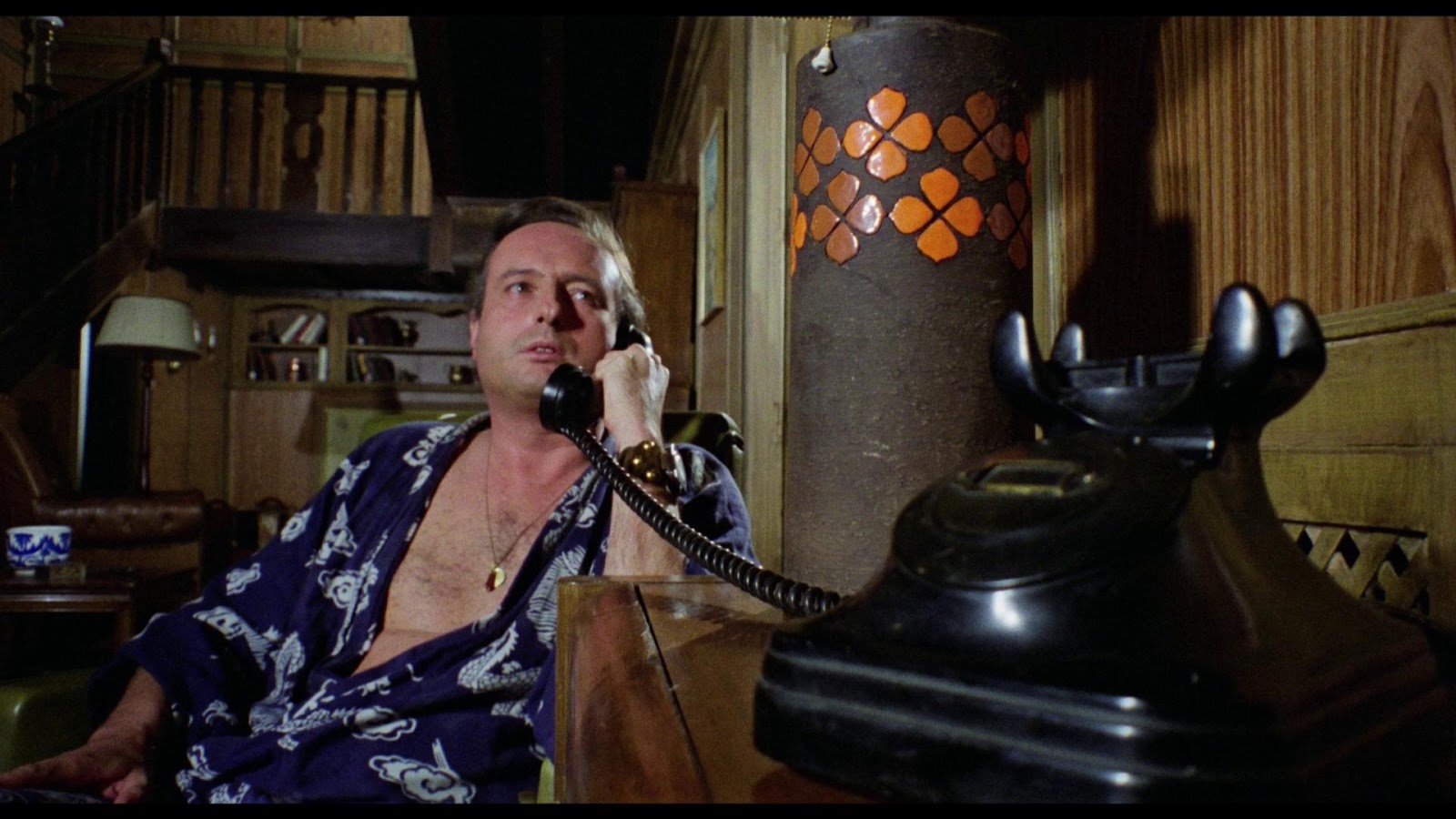
Unlike Alfred Hitchcock’s PSYCHO (1960), which turns out to be this film’s most noteworthy inspiration, TRAUMA is set in the sunny countryside, an idyllic milieu that belies the film’s oppressive and highly morbid atmosphere. In this diametrically-opposed – if no doubt intentional – bit of creativity, all of the murders also take place either outdoors in broad daylight or in brightly-lit rooms. This leaves little to the imagination as throats and bare torsos are savagely slashed to shreds. Aptly enough, the aforementioned PSYCHO’s renowned shower murder is even given brazen homage. Despite the film’s obvious mimicry of Hitchcock’s classic and its somewhat talkative narrative, Ágata Lys does a fine job in the lead here, while the script by Juan José Porto and Carlo Puerto (latter of whom also wrote and directed SATAN’S BLOOD [1978], which likewise features one of this film’s stars, Sandra Alberti) still manages to build and maintain a reasonable amount of tension. The less-than-explicable twist ending and various red herrings also amount to some of the film’s most memorable, head-scratching moments, which linger long after the film ends.

Briefly released as a Region 2 DVD in Spain by Filmax (as part of their “Cine “S” de la Transicion Española” series), which was non-anamorphic and lacked any sort English language options, VS’s newly restored 2K transfer from the film’s camera negative is truly stunning in its crystal-clarity, and outside of the print’s slight uptick in contrast during the opening credits (possibly due to the film’s opticals?), it’s all perfectly balanced and gets the most out of the colourful image; the vividly crimson splashes of blood are suitably jarring and quite effective. The Spanish DTS-HD Master Audio mono track with optional English subtitles is also free of any noticeable hiss or distortion, and sounds just about right given the film’s lowly dubbing and limited soundscape.

Apart from the film’s superb transfer, the other major bonus here is an audio commentary from author and film historian Troy Howarth, who admits he was rather harsh on the film in the third and final volume of his book series So Deadly So Perverse (Midnight Marquee, 2019), so he was happy to revisit it in this newly-minted incarnation. He discusses its many influences, also giving a quick primer on giallo films in general, remarking that, in certain aspects, Klimovsky’s last film is simply an “old-fashioned murder mystery”. Howarth also discusses many of the film’s awkward moments and characters, including the above-noted forced striptease, which is scored with some wholly-inappropriate (quote) “sexy-time dancing” music and just what a (quote) “robotic and weirdly-looking” lead Heinrich Starhemberg is. In addition, Troy seems just as perplexed by the film’s odd, twisty-type resolution as well. It’s an intriguing and entertaining listen, which not only helps put the film in perspective, but enables the viewer to better appreciate many of its offbeat charms. Solid work all around. A brief promotional image gallery is also included.

In the second Castilian-shot giallo comprised within VS’s set, Javier Aguirre’s significantly-more-upscale THE KILLER IS ONE OF THIRTEEN (1973) – freely adapted from Agatha Christie’s famous novel Ten Little Indians (Collins Crime Club, 1939 – later reprinted in the U.S. as And Then There Were None (Pocket Books, 1940) – focuses on a group of disparate people who are invited to a large country estate owned by the recently-widowed Lisa Mandel (Patty Shepard), but as the guests gather for dinner that night, Lisa reveals her true intentions – to try and find out who had murdered her husband two years earlier, knowing full-well that the murderer is someone among them. However, when someone begins killing the guests, Lisa quickly realizes the (quote) “game has gone too far!”

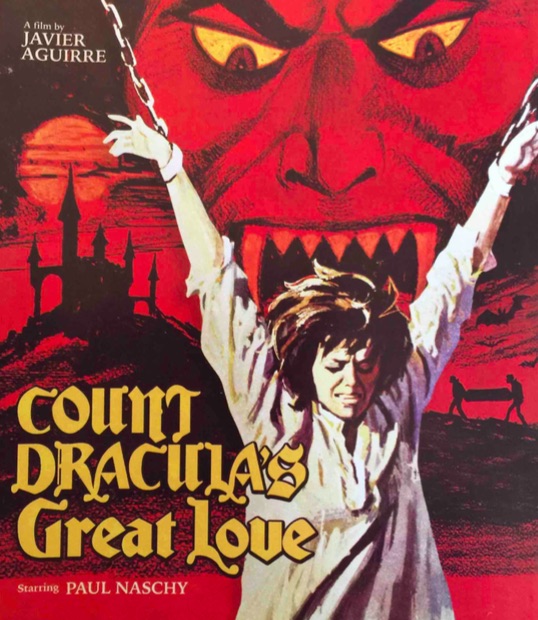
Having written and directed both COUNT DRACULA’S GREAT LOVE (1972) and HUNCHBACK OF THE MORGUE (1972), two of Paul Naschy’s more laudable efforts, Aguirre’s film can certainly be construed as a Spanish equivalent of an Italian giallo, but its rather old-fashioned approach is also a bit of an anomaly in that it features none of the unique flair common to Italian thrillers, despite a few close-ups of black-gloved hands and some pleasingly vicious murders in the film’s final act. Lively characters and plenty of squabbling (much of it revolving around snobbery and class struggles) dominate much of the film’s running time, but interest is maintained by the twisty plot and game cast (which includes numerous other familiar faces from Spanish cinema, such as Simón Andreu, Dianik Zurakowska, May Heatherley, Jack Taylor, Eduardo Calvo and Paul Naschy, the latter three of whom also appeared in Carlos Aured’s THE MUMMY’S REVENGE [1973] the same year). Incidentally, in the special double issue of Bob Sargent’s Videooze from 1994, Naschy admitted that he (quote) “had no interest in working in it, and I did it simply to earn money”; which makes sense, given his minor role as Lisa’s chauffeur, which barely totals ten minutes.

As with TRAUMA, Aguirre’s film was also never released outside of Spain, and in 2008, it too received a Region 2 DVD release in its native country, this time as part of Filmax’s “Cine de Terror Español”, and once again that disc featured a non-anamorphic image and no English-language audio options. While the film was flatly-shot by Francisco Fraile, VS’s new 2K transfer taken from the film’s 35mm camera negative looks splendid here nonetheless, and is miles better than Filmax’s dull SD counterpart, which will undoubtedly please most viewers. The DTS-HD Master Audio mono track, which is offered in Spanish with optional English subtitles also sounds fine, with Alfonso Santisteban’s fitting giallo-like music score sounding lush and robust.

While it’s an obscure film to be sure, VS have thankfully commissioned author and Diabolique’s Editor-In-Chief Kat Ellinger to provide an audio commentary, so for anyone that’s listened to any of her previous informative chats (especially when related to Spanish genre cinema), her work herein is no different and features plenty of erudite observations and facts (including her discussion – and defense – of Spanish gialli), which helps us better appreciate a film that has (quote) “fallen through the cracks.”; it’s a very worthy listen, indeed! The only other extra is a brief image gallery displaying the film’s Spanish lobby card set.

Although produced in 1972, Helia Columbo’s THE POLICE ARE BLUNDERING IN THE DARK (1975) is easily one of the more obscure – and also one of the strangest– Italian gialli of the period, making for a perfect summation to VS’s set. Right in the opening scene, a young woman is gruesomely murdered on the outskirts of Rome when her car breaks down. Later, when Enrichetta Blonde (Margaret Rose Keil), a young model who had just finished a photo shoot at the surrounding Villa Eleonora, is also viciously murdered at a rundown pensione, her disappearance prompts her journalist friend Giorgio D’Amato (Joseph Arkim) to drive up from Rome and poke around this mysterious villa. There he meets Edmondo Parisi, an eccentric wheelchair-bound photographer, his neurotic wife Eleonora (Halina Zalewska) and their guarded niece, Sara (Elena Veronese), but despite their initial reservations, they invite him for dinner and even allow him to spend the night. It’s soon discovered that Edmondo has actually devised a machine that can photograph one’s thoughts (?!), which, after much ‘blundering’, eventually unveils an unlikely killer.

While it does open on a rather promising note, this strictly minor-league giallo will probably be a tough slog for more casual viewers of the form. Here hiding behind his Columbo pseudonym, this actually turned out to be Italian composer Pasquale Elio Palumbo’s one-and-only directorial effort, and despite the well-oiled machinations of its outlandish giallo plotline (which liberally borrows – and takes one step further – a key element from Dario Argento’s FOUR FLIES ON GREY VELVET [1971]), it suffers the most from its uneven, almost leisurely pacing, so when the narrative begins waxing on the more, uh, ‘philosophical’ side of things, it just about stops dead in its tracks. Thankfully, interspersed between some of the lengthy expository dialogues, it also contains enough odd touches (highlighted by Edmondo’s science-fiction-like contraption) and some well-established local atmosphere thanks to Giancarlo Pancaldi’s decent, if at times, wonky cinematography, which really comes alive during some of the surprisingly visceral murders sequences.

As with the other films in VS’s adventurous set, this once nigh-impossible-to-see giallo has been miraculously transferred in 2K from its original 35mm camera negative, so regardless of its humbled, troubled origins, it looks wonderful here. The lush greenery of the Italian countryside and some of the film’s previously unwatchable nighttime scenes display far more detail in VS’s newly-restored edition, while some of the film’s more outrageous, gel-coloured lighting also looks well-defined and problem-free. The Italian DTS-HD Master Audio mono track is also solid enough, sounding about how you’d expect from a low-budget affair such as this, which features plenty of the usual ADR work.

While this disc doesn’t contain a feature-length audio commentary, it does include a thorough audio essay with film historian and critic Rachael Nisbet, who covers plenty of interesting and heretofore unknown facts about the problematic production (it was originally titled, in Italian, Il giardino della lattuga [trans: “The Lettuce Garden”] before being shelved for the better part of three years), the director and some of his questionable narrative choices, plus plenty more. But be warned: watch the film beforehand, as this essay drops a number of spoilers. As with the other discs, the only extra is a brief promotional image gallery.
While there’s no denying that some of these films may not be for everyone, this altogether impressive set with its attractive transfers, striking packaging and a host of illuminating extras easily make this a highly-recommended purchase. Order it from Vinegar Syndrome.