Tuesday, November 12, 2019

ZOLTAN... HOUND OF DRACULA - BLU-RAY REVIEW

It’s a cryin’ shame that this terrific and appropriately-atmospheric take on the oft-tapped Dracula legend has been routinely criticized as a ‘dog’ (pun intended) by many who have seen it. In actuality though, Albert Band’s ZOLTAN… HOUND OF DRACULA (1977) is an inventive, affectionate tip-of-the-hat to vampire films, a horror subgenre which, during the ’Seventies, was definitely going through some changes, adapting to more contemporary tastes of the time, as seen in such memorable genre entries as Stephanie Rothman’s THE VELVET VAMPIRE (1971), William Crain’s self-explanatory-titled BLACULA (1972) and, of course, Bob Kelljan’s Yorga duology, COUNT YORGA, VAMPIRE (1970) and THE RETURN OF COUNT YORGA (1971). Also known as DRACULA’S DOG, the present film’s rather-less-appealing and sillier-sounding alternate title, ZOLTAN has been lovingly resurrected thanks to Kino Lorber Studio Classics’ wonderful new Blu-ray release.  

Randomly—if effectively—jumbling-together elements from both B-grade war movies and vampire lore, ZOLTAN’s jam-packed opening sees the Romanian Army accidentally uncovering Dracula’s tomb during a routine training mission. Just one soldier (played by Dimitri Logothetis, the future director of SLAUGHTERHOUSE ROCK [1988]) is ordered to stand guard at the gravesite for the night and—you guessed it!—this lone sentry foolishly decides to remove the immobilizing wooden stake from Zoltan, Dracula’s omnipresent pet Doberman pinscher, who, albeit for centuries, proves to be merely ‘playing dead’ (pun intended). In turn, Zoltan diligently raises Dracula’s creepy undead slave Veidt Smit (Reggie Nalder), who is intent on bringing his long-dead master Dracula (Michael Pataki) back to unlife (not coincidentally, Pataki had previously sported fangs in John Hayes’ drive-in/grindhouse fave GRAVE OF THE VAMPIRE [1972]). With the help of the perceptive Major Hessel (Arlent Martel), determined Inspector Branco (José Ferrer), who is an expert in such matters (“In this part of the country, everytomb interests me!”), quickly deduces that Dracula’s last living descendent, Michael Drake (Pataki again) is now living in Los Angeles with his young family. Since Smit and Zoltan (quote) “cannot exist without their master”, Inspector Branco also travels overseas to try and stop Veidt Smit at (quote) “all costs!”

While vacationing at Lake Arrowhead with his wife (Jan Shutan), two children (John Levin and Libby Chase) as well as their pet German shepherd dogs Samson and Annie and their new litter, Michael is keen to escape the city life. However, he quickly discovers that something is amiss at their usually serene lakeside campsite… Here playing the sinister Veidt, Reggie Nalder is appropriately menacing (he even travels in an ominous black hearse, which houses Zoltan’s specially-designed coffin) as he quietly enables a number of local dogs to fall victim to Zoltan’s fanged bite (“Now he’s one of us!”); a succession of canine victims that also includes an unfortunate human tourist, in what amounts to the film’s goriest and most alarming scene. As the ‘undead’ dog-pack steadily multiplies in numbers, Band’s genre-hopping film also takes on similarities to any number of ‘nature-run-amok’ films, as the vampirized and increasingly powerful animals terrorize the entire National Park, and it’s easy to imagine that both Burt Brinckerhoff’s DOGS (1976) and Robert Clouse’s THE PACK (1977) were some sort of an influence on Band’s film.

Written by Frank Ray Perilli—who, tellingly enough, also wrote Byron Ross Chudnow’s matinee favourite THE DOBERMAN GANG (1972)—ZOLTAN… HOUND OF DRACULA also focuses much of its attention on its four-legged co-stars. This, of course, means plenty of intimidating insert shots of Zoltan baring his elongated eyeteeth while snarling ferociously into the camera (often with his eyes diabolically glowing!) while he licks his bloodied chops. Portraying a genuinely vicious servant of Dracula, the film’s ‘mad dog’ scenario is actually closer in spirit to Stephen King’s much-celebrated novel Cujo (Viking Press, 1981) and Lewis Teague’s superb 1983 filmic adaptation, and the present film’s action also includes a couple of nail-biting sieges during the film’s finale (one of which even takes place in a car, as in the ’83 CUJO filmization). While never allowing it to interfere with its many classic horror tropes, the film can also be read at the subtextual level as a condemnation of man’s narcissistic tendencies and all the innocents (i.e., children and animals) that suffer because of it, sometimes for generations to come—a point which is further stressed by the predictable if brilliantly dire twist whammy ending.

Released through their licensing deal with StudioCanal, Kino’s disc features a (quote) “brand new 4K master”, which is a definite improvement over Anchor Bay Entertainment’s no-frills 2002 DVD (which, truth be told, was an excellent release for the time). The pictorial detail of Kino’s new transfer is now virtually flawless, and this is especially evident during many of the film’s nocturnal sojourns at Lake Arrowhead, as well as in the numerous attack scenes. Equally, the DTS-HD MA 2.0 audio track also sounds perfectly fine, with no noticeable issues. For those that need them, the disc comes with SDH subtitles for the hearing-impaired.

As with their excellent audio commentary on Kino’s earlier Blu-ray of William “One-Shot” Beaudine’s much-maligned BILLY THE KID VS. DRACULA (1966), authors and film historians Lee Gambin and John Harrison return for another highly entertaining commentary, which is brimming with their usual enthusiasm and crammed with interesting and relevant factoids. The pair freely admit that ZOLTAN is a “multi-genre” film, yet another take on (quote) “vampires in the modern world”; they are also both impressed with the (quote) “organic and real” canine performances. Of course, much of the discussion revolves around renowned animal trainers Karl Lewis Miller and Lou Schumacher, whose various training techniques get the most out of their canine actors. In an interesting bit of trivia, that same year, both German shepherds also co-starred in Wes Craven’s THE HILLS HAVE EYES (1977) and Clouse’s aforementioned THE PACK. They also go on to talk about animals seen in other supernatural chillers, such as Curtis Harrington’s made-for-TV’er DEVIL DOG (1978) and Richard Donner’s theatrical blockbuster THE OMEN (1976); lastly, much of the film’s interesting cast and crew are thoroughly discussed including Nalder’s future roles as Dr. Van Helsing in Phillip Marshak’s porno parody DRACULA SUCKS (1978) and his terrifying turn as the Nosferatu-like Kurt Barlow in Tobe Hooper’s two-part TV film, SALEM’S LOT (1979), and in addition Gambin and Harrison both give special, well-deserved praise to Andrew Belling’s superb score, which brings a suitably (quote) “otherworldly, eerie effect” to the proceedings. Great work from both gentleman, so let’s hope they have more commentaries planned for the future!

Other extras include ZOLTAN’s lengthy theatrical trailer (3m21s), plus those for a number of other horror movies in the Kino library, including Sutton Roley’s CHOSEN SURVIVORS (1974) and Brice Mack’s JENNIFER (1978), a pair of other animal-centric films (the former involves vampire bats and the latter killer snakes). The disc also contains reversible artwork that highlights this thoroughly-engaging film’s alternate DRACULA’S DOG poster, all of which amounts to yet another terrific Blu-ray from the fine folks at Kino! Order it direct from Kino Lorber or from DiabolikDVD

Friday, November 8, 2019

THE MUMMY'S REVENGE - BLU-RAY REVIEW

Late, great Castilian horror king Paul Naschy (a.k.a. Jacinto Molina) was at the very height of his popularity when he wrote and starred in Carlos Aured’s THE MUMMY’S REVENGE (1973), an atmospheric and grisly take on Karl Freund’s pivotal Universal horror classic, THE MUMMY (1932). Never one to shy away from a challenge, Naschy takes on the dual roles of Amen-Ho-Tep (in both his human and monster forms) and also plays Assad Bey, his cursed descendent, who, in the interests of attaining (quote) “power, riches and eternal life” resurrects the exceedingly cruel Amen-Ho-Tep. Although this film was once readily available on Betamax/VHS videocassette during the ’80s, Unicorn Video’s master was taken from a censored, heavily-cropped TV print. And now, thanks to Scorpion Releasing’s timely Blu-ray, Naschy’s lone mummy movie has risen mightily to stride the Earth once again.

Ruling with an iron hand alongside the equally-cruel Princess Amarna (Rina Ottolina), the tyrannical Amen-Ho-Tep’s (quote) “savage rule” is vividly displayed in the film’s opening sequence, set during Egypt’s 18th Dynasty. Through the use of some solemn-but-clunky voiceover narration (at least in the English-dubbed version), we learn that the land was thrown into a (quote) “eternal nightmare of blood and horror”. However, Am-Sha (Fernando Sánchez Polack), the wily high priest of Amon-Ra, leads a plot to overthrow the despotic ruler, who is then mummified alive, to (quote) “wander in the world of the unknown forever.” This seemingly-endless length of time is efficiently rendered through the use of some simple time-lapse photography, a well-worn, but still effective technique, which segues nicely into the discovery of Amen-Ho-Tep’s tomb centuries later by archeologists Nathan Stern (Jack Taylor) and his wife Abigail (María Silva). Upon transporting their find to Sir Douglas Carter (Eduardo Calvo) at the Landsbury Foundation in London, the senior academic is elated at this (quote) “important archeological discovery”. On the downside, it also attracts the interest of the sinister Egyptian Assad Bey and his partner Sanofed (Helga Liné), who, for nefarious purposes, intend to raise Amen-Ho-Tep from the grave via the ritual sacrifice of (quote) “three young virgins”. Unfortunately, once the long-dormant mummy has arisen anew, Bey and Sanofed are then obliged to murder still another seven virgins more in order for the (quote) “dominion of the Pharaohs” to rise to full power again. But the mouldy mummy also has his eyes set on Sir Douglas’ nubile daughter, Helen (Ottolina again), who is—not unexpectedly, as per the hoary ol’ trope—a dead ringer for Amen-Ho-Tep’s long-dead beloved Amarna… 

As helmed by Carlos Aured, THE MUMMY’S REVENGE turned out to be the last film he made with Paul Naschy, capping a fruitful collaboration which had begun with HORROR RISES FROM THE TOMB (1973), another ‘vengeance-from-beyond-the-grave’ shocker that shares quite a few similarities with the current film under review. Unlike most of Naschy’s long list of filmic monsters, which were always approached with a certain empathy (best exemplified in Javier Aguirre’s COUNT DRACULA’S GREAT LOVE [1973], starring Naschy as the lonesome, lovelorn Count), Amen-Ho-Tep on the other hand is a 100% unadulterated murderous monster whose sole motivations are revenge and, ultimately, global domination (“The world will be ours!”). Sporting quite eye-catching makeup, Naschy’s mummy is also one of the most memorably gruesome creations to be found in the star’s entire monster canon, whose ruthless, violent nature is made all-the-more obvious when he viciously—and gorily!—squashes the heads of local virgins he believes are unacceptable for his use.  

While competently lensed across the boards and making the most of its humble origins, this is one of Aured’s best-looking films, which takes full advantage of its familiar London locations, and according to Troy Howarth’s excellent audio commentary, also utilized a number of leftover sets from Charlton Heston’s ANTHONY AND CLEOPATRA (1972) as well; all of which are handsomely captured by Francisco Sánchez’s exquisite scope photography. The wonderful cast also includes a number of Naschy regulars, including the ever-reliable Jack Taylor and María Silva (who was last seen as Countess Elizabeth Báthory in Carlos Aured’s CURSE OF THE DEVIL [1973]), as well as the always-superb Helga Liné, who gives one of the film’s strongest performances. Strikingly beautiful newcomer Rina Ottolina also does a fine job as both Amarna and her reincarnation Helen, and she definitely gives the gorgeous Zita Johann (who played Helen in Universal’s original 1932 version of the oft-told tale) a run for her money as the stunning love interest (much like Johann’s, Ottolina’s own movie career also proved to be short-lived when she retired in the late-’70s). 

Although THE MUMMY’S REVENGE bypassed DVD altogether in North America, Scorpion Releasing’s BD now presents two versions of the film in their attractive edition, one of which includes a scene (missing from the Spanish HD master) involving a newlywed—soon to be newlydead!—couple who get violently offed by the mummy, which was reinserted from an inferior source. Although both versions of the film retain the original 2.35:1 aspect ratio, this (quote) “extended composite cut” also includes both DTS-HD MA mono audio tracks in both English and Spanish languages, with the benefit of properly-translated English subtitles for the latter. While it is nice to have both audio tracks available, it should be mentioned that the Spanish track has far-superior audio fidelity to the tinny—and exceedingly hissy—English audio track, which was probably overdubbed from an old VHS source. The (quote) “shorter version” only comes with English audio.

An audio commentary from Human Beasts: The Films of Paul Naschy (WK Books, 2018) author Troy Howarth is the disc’s sole significant extra, but as usual, it’s a very welcome one. He goes over plenty of details related to the production, including its now-almost-mythic ‘unclothed’ version, which hasn’t turned-up anywhere as yet; the English dubbing on many Spanish films from the era and how they were (quote) “rather difficult to stomach”; much of the film’s pilfered score from the CAM libraries; the obvious onscreen chemistry between Naschy and Liné (this was their final collaboration); Miguel Sesé’s impressive makeup F/X; Carlos Aured’s solid understanding of the (quote) “basic innerworkings” of the genre, and how most of his films with Naschy are (quote) “smoother and refined” compared to the work of Leon Klimovsky; and finally, some background about the film’s distribution woes. It’s most certainly an engaging listen, loaded with plenty of insight into this film and Naschy’s work in general. Excellent stuff, indeed! The film’s rarely-seen Avco Embassy trailer is also included (“A jarring shock every moment!”), as are trailers for José María Zabalza’s THE FURY OF THE WOLFMAN (1972, coming soon from Scorpion) and José Luis Madrid’s THE HANGING WOMAN (1973). In addition, the inner sleeve contains informative liner notes from Naschy expert Mirek Lipinski, who also provides some interesting background info on the mysterious Ms. Ottolina. 

Polished and technically assured, it’s great to have this once-difficult-to-see Naschy title finally available on Blu-ray, which can be ordered from Ronin Flix and DiabolikDVD, both of which include a limited slipcover.

Saturday, October 19, 2019

THE TOUGH ONES - BLU-RAY REVIEW

One year previous, Maurizio Merli had starred in “Franco Martinelli”/Marino Girolami’s highly-profitable Italocrime meller VIOLENT ROME (1975), but despite his immediate popularity with audiences in such films, his initial casting was solely based on his similar-looking appearance to Franco Nero from Enzo G. Castellari’s (Marino Girolami’s son Enzo) HIGH CRIME (1973), one of the trailblazers of the entire Italocrime genre. In their review of the present film from April 1976, Variety reported: “The market in Italy is being partially glutted with crimeland action pix where either a tough but honest police commissioner takes justice into his own hands or the private citizen does.” While Umberto Lenzi had already explored gritty urban settings with a quartet of modern-day, film-noir-inspired films—GANG WAR IN MILAN (1973), ALMOST HUMAN ([1974] featuring a truly scene-stealing role for its star, Tomas Milian), MANHUNT IN THE CITY (1975) and SYNDICATE SADISTS (1975)—it was the director’s THE TOUGH ONES (released in Italy under the memorably defiant title ROMA A MANO ARMATA / trans: “Rome Armed to the Teeth” [1976]) that really solidified his reputation as a master of the genre. Following their initial press announcement from what seems like a decade ago, Grindhouse Releasing at long last released this Italocrime classic earlier this year in a staggering 3-disc Deluxe Edition, which was obviously well worth the wait. 

In the wake of his career-defining role as Inspector Betti in Girolami’s aforementioned VIOLENT ROME, Merli this time stars as Inspector Leonardo “Leo” Tanzi, a virtually interchangeable hot-headed, no-nonsense cop, who is once again frustrated by the current sorry state of affairs within the criminal justice system (“If we stick to the book, we’ve had it!”). Tanzi, who is part of the Anti-Gang Squad, is obsessed with capturing Ferender, an exceptionally elusive French criminal mastermind, who controls most of the Eternal City’s underworld, and with the help of Sgt. Pogliana (Aldo Barberito) and his trusted, far-more-composed partner, Caputo (Giampiero Albertini), they attempt to arrest—in the process even going so far as to break the law themselves!—some heavyweight associates of his, including Savelli (Biagio Pelligra), who’s been involved in a number of violent bank robberies, and Vincenzo “The Hunchback” Moretto (Tomas Milian), a belligerent, smart-assed gangster (unforgettably dubbed in the English version by veteran voice-actor, Frank von Kuegelgen), who, after numerous highly-colourful interrogations, vows revenge (“He’s gonna crap in his long-johns before I kill him!”) as he precipitously rises among the criminal ranks. 

As with most of Lenzi’s successive Italocrimers, the crux of the film is offset with a number of intermittent, almost cursory set-pieces involving a tight-knit group of bank robbers; an illegal gambling-den; purse-snatching teenagers; a rather disturbing gang-rape (“Hey boys, how ‘bout a big wooden dildo?!”); and a protracted scene involving Tony Parenzo (Ivan Rassimov), a heartless drug pusher who injects his girlfriend (Gabriella Lepori) with a lethal overdose of heroin; all of which illustrate the far-reaching span of the underworld’s Octopus-like tentacles. Swiftly-paced and culminating with an extensive, elaborately-choreographed car chase involving a stolen ambulance, Lenzi’s film rarely lets up, and whenever it does, Tanzi is seen (and heard!) angrily voicing his opposition to the impossible odds he is facing (“They make us sweat to bring ’em in, but before the ink’s dry, some idiot says they can go!”), anger which is mostly directed at his CO, Police Commissioner Ruini (Arthur Kennedy), who merely reaffirms that “The Law is the Law!” 

While Merli is his usual laconic best in a typecast role he continued to play virtually verbatim for the better part of his career, it’s Tomas Milian as the hunchbacked Moretto – known as il Gobbo on Italian prints – who steals every scene in which he appears. Beyond his frequent appearances as Nico Giraldi in a number of latter-day – and increasingly comedic – polizieschi, the ‘hunchback’ is one of Milian’s most eccentric, over-the-top characters to ever grace an Italocrime film. So much so that Lenzi and Milian both returned for BROTHERS TILL WE DIE (1977), an unrelated follow-up, which featured a dual role for the actor where he also played Monnezza (trans: “Trash”), yet another recurring (and incredibly popular) character. First seen gutting a large steer at a slaughterhouse, Moretto’s smart-ass rhetoric is quickly silenced when he’s unfairly kicked in the balls courtesy of the impatient Tanzi (“It ain’t enough I’m a hunchback, you ruin my eggs as well!”), who, adding insult to injury, plants some smack in his shiny lime-green Porsche. It’s here, back at police headquarters, that Moretto’s true psychosis manifests itself (“Miserable sons-of-bitches! I piss on you! I piss on you! Pigs! Pigs! Pigs!!!You sons-of-whores!”) as he angrily slashes his own wrist to avoid further interrogation. Looking for payback, Moretto has a couple of his ‘men’ (stuntman extraordinaire Riccardo Petrazzi and veteran character actor Luciano Pigozzi) abduct and scare the hell out of his girlfriend Anna (Maria Rosaria Omaggio), a government social worker who is the film’s sole politically left-leaning character and who becomes the constant victim of Tanzi’s sociopathic scorn.  

Perhaps even surpassing the established sounds of Guido and Maurizio De Angelis’ energetic scores for both HIGH CRIME and VIOLENT ROME, Franco Micalizzi’s tremendous score here is surely one of the film’s many highlights: a dynamic, brass-infused work of dazzling intensity, which not only underscores the fast-paced, turbulent mean streets of Rome, but became – as did most of Micalizzi’s subsequent polizieschi scores – synonymous with Italocrime in general. 

Those even slightly entertained by the genre will have a hard time containing their excitement with Grindhouse Releasing’s exhaustive Blu-ray set, which is as much a celebration of Umberto Lenzi’s four-decades-long career as it is of the present film. Spread out over two Blu-rays, disc one includes a stunning 4K scan of the film itself, an incredible bit of restoration that is sure to leave you gobsmacked after suffering through International Video Entertainment (IVE)’s long out-of-print Betamax/VHS videocassette (released under the auspices of Sybil Danning’s popular ‘Adventure Video’ series), which was edited, grainy and heavily-cropped. Retaining its original – and absolutely integral – 2-perf scope compositions, Grindhouse’s flawless transfer is well-defined and surprisingly vibrant. Of course, as with the immaculate visuals, the DTS-HD mono audio also sounds right-on-target in both the English and Italian versions, and while it’s no surprise that the Italian version is a more accurate representation of the vernacular (which once again features Tomas Milian’s Italian voice actor of choice, Ferruccio Amendola), the English version is, as demonstrated by the quotations above, likewise undeniably entertaining. 

The comprehensive extras begin with a feature-length audio commentary from Mike Malloy, director of the essential doc, EUROCRIME! THE ITALIAN COP AND GANGSTER FILM THAT RULED THE ’70s, who commends the (quote) “Eurocrime triumvirate” of Lenzi, Merli and Micalizzi, and for the uninitiated, he gives a brief overview of the genre’s history; how Merli (quote) “pounded his fist on a lot of desks” during his career; and just how many of these films were directly or indirectly interconnected through their various characters, follow-ups and sequels, which he believes could even use a handy (quote) “flow-chart”. After listening to his enthusiastic, well-informed commentary, you’ll want to check-out or even revisit a number of the genre’s key titles. The other significant extra on disc one is Calum Waddell’s All Eyes on Lenzi – The Life and Times of the Italian Exploitation Titan (84m04s), which covers the late director’s career from the late-’Sixties onwards via archival interviews with Lenzi himself, as well as a number of new interviews with contemporary film critics and historians (who pay special attention to many of his giallo and horror titles), but the doc also includes some choice bits about this (quote) “cinematic chameleon’s” Italocrime career too. In Murder for Mayhem (33m12s), an on-camera interview recorded on July 26th, 2010, Lenzi and Micalizzi reminiscence about their extensive collaborations, which is, as expected, a wonderful listen. In the archival Full-Frontal City: The Urban Geography of Rome Armed to the Teeth (22m01s), many of the film’s locations are revisited for the purposes of ‘then-and-now’ comparison. An extensive collection of trailers for all of Grindhouse Releasing’s current and upcoming product finishes-off disc one’s extras.

Packed-to-the-hilt with even more substantial extras, disc two begins with Freak-O-Rama’s Umberto (55m31s), yet another overview of Lenzi’s wide-ranging career, which compliments the doc from disc one rather nicely, as it focuses a lot on Lenzi’s early beginnings. In the exhaustive Tomas Milian: The Rebel Within (88m50s), Milian discusses his entire career, including his early, complicated life in Cuba before immigrating to the U.S., getting his start at the famed The Actor’s Studio, and eventually making his way to Italy, where he remained for the better part of his career before returning back to the U.S. and (quote) “starting all over again”. Inspirational and funny, yet at times quite melancholic, this is an utterly fascinating, must-see interview. In the archival doc The Merli Connection (44m39s), his son and a number of actors and directors who knew and worked with him talk about Maurizio Merli’s career and huge influence on the genre; in the short Back Story (5m54s), Milian once again discusses his outrageous Gobbo / Hunchback character. For the remaining interviews, Federico Caddeo and his production company Freak-O-Rama Productions truly outdo themselves with a number of terrific interview segments, including: Beauty and the Beasts (29m31s), in which Maria Rosaria Omaggio talks about both her start in the business and Lenzi’s (quote) “sweet Tuscan toughness”; in the lengthy Corrado Armed to the Teeth (45m17s), character actor Corrado Solari talks about his impromptu audition for Lenzi’s aforementioned MANHUNT IN THE CITY, as well as his excellent working relationship with Milian and how Lenzi was (quote) “distrustful, cautious and careful”; the once-popular Maria Rosaria Riuzzi turns up in Brutal City (14m12s) to discuss her career, with a particular emphasis on Dino Risi’s PROFUMO DI DONNA (1974); in The Rebel and the Bourgeois (19m05s), costume designer and sometime actor Sandra Cardini talks about her time working on the film; and then prolific screenwriter Dardano Sacchetti gets his turn in front of the camera in Vodka, Cigarettes and Burroughs (39m31s), and also discusses his collaboration with Lenzi; plus, in The Godfather of Rhythm (36m14s), famed composer Franco Micalizzi also goes into details about his lengthy career. Of course, the disc also comes with a few Easter Eggs, which are well searching out.

In addition to packaging this impressive BD set in an eye-catching slipcover, Grindhouse have also seen fit to include a wonderful 12-page booklet (whose cover reproduces the film’s U.S. one-sheet poster, retitled BRUTAL JUSTICE [which screams, “Inspector Tanzi makes Dirty Harry look like Mr. Clean!”]), containing a superb, nicely-illustrated, in-depth essay from genre expert Roberto Curti. As an added bonus, the package also includes the film’s entire soundtrack CD, and for those still lucky enough to locate a copy, the first 2500 copies even come with a collectible ‘bullet-pen’! An absolutely incredible release, Grindhouse Releasing’s extraordinarily thorough Blu-ray is not only a perfect introduction to the addictive pleasures of the Italocrime genre, but is, hands-down, absolutely one of the finest releases of the year. Order it from DiabolikDVD 

Tuesday, October 8, 2019

THE HILLS HAVE EYES PART II - BLU-RAY REVIEW

Definitely a good deal more engaging than its usually-slandered and vilified reputation would lead you to believe, Wes Craven’s THE HILLS HAVE EYES PART II (1984) is far from Craven’s best, but, if taken as an undemanding ’80s slash-’em-up, it works just fine. Thanks to Arrow Video, this oft-derided sequel has finally been given some much-needed appreciation care of their new Limited Edition Blu-ray.

Attesting to this film’s hastily-structured status, it opens with Bobby (Robert Houston) – one of the few survivors from Craven’s THE HILLS HAVE EYES (1977) – discussing his ordeal from eight years previous with his psychiatrist (David Nichols), which sets-up a rather-too-convenient flashback to the rousing finale from THHE. As the charge-by-the-minute shrink glances at his watch impatiently, he offers Bobby a vote of confidence by suggesting, “Go thumb your nose at the desert. The boogeyman is dead!” Attempting to do just that, Bobby plans to test his newly-developed ‘Super Formula’ fuel for his motocross team in an upcoming race. However, unlucky for him, this event takes place at a remote desert location. Suffering a complete breakdown at the thought of venturing out into these desolate wilds yet again, he is unable to heed his psychiatrist’s advice to confront and conquer his fears, so Bobby’s girlfriend Rachel (Janus Blythe) reluctantly volunteers to escort his team to compete in this all-important competition. 

Comprising many of the ‘usual suspects’ to be found in any number of slasher films – including Cassandra (Tamara Stafford), a blind girl with possible psychic abilities – the teammates excitedly pack their makeshift school bus and head off to the race-site. Naturally, while en route to their final destination, Harry (Peter Frechette), the group’s mandatory smartass prankster, ‘entertains’ everyone with urban legends of the first film’s dreaded cannibal clan and, as Rachel dozes-off, the sequel’s second lengthy flashback occurs. Recycling additional pre-existing footage from Craven’s original THHE, it comes as no surprise to us at all that the so-called “Rachel” is in actual fact Ruby, who, all those years before, had turned against her own (quote) “wild family of cannibals” to help the previous protagonist Bobby and his remaining family members escape; even Beast, the heroic German shepherd from the original film is, once again, also along for the ride. Sure enough, through a succession of highly-contrived yet somewhat forgivable sets of circumstances, our new group of characters wind up taking a shortcut across the open desert, thereafter coming to the grim realization that some of Ruby’s cannibalistic clan may still be alive… and are hungry for more tender city-slicker flesh! 

Unlike Craven’s grim-’n’-gritty originator, this cut-rate sequel is quite the departure in both tone and style. Whether this stylistic change was entirely intentional or simply a fortuitous evolutionary development, this time around Craven’s approach to the timeworn material is much more playful and, quite frankly, this different approach is actually quite refreshing (it was made seven years later, after all, so perhaps the director just felt like a change of pace?). Hurriedly-developed following his entertaining-if-poorly-received DC Comics adaptation SWAMP THING (1982), and originating as it does from the tail-end of the ’80s slasher boom, THHE 2 is so cliché-ridden that it might easily be read as Craven’s sly attempt to poke good-natured fun at this once exceedingly overcrowded horror subgenre. Despite the script’s trivialities, it’s great to have Michael Berryman return as Pluto, who, in keeping with his familial devotion and psychotic tenacity, provides the strongest connection to the original THHE, and he easily overshadows the towering John Bloom (BRAIN OF BLOOD [1971], THE DARK [1979], HARRY AND THE HENDERSONS [1987], etc.) as “The Reaper”, the present film’s new clan-leader, who it turns out is none other than the late Pluto’s long-lost uncle (!?), a revelation which makes for one of THHE 2’s numerous enjoyably silly developments.  

While it’s fairly certain that, even in this optimal new presentation, THE HILLS HAVE EYES PART II won’t convert too many of its legion of vehement detractors, the team at Arrow Video nevertheless give it their best shot with this Limited Edition Blu-ray, which not only looks terrific but also includes a number of highly-substantial extras to help put everything about this financially-troubled production into their proper context. THHE 2 has been kept regularly available ever since its initial Thorn/EMI domestic Betamax/VHS videocassette release in 1986, and for their BD edition, Arrow utilized a (quote) “brand new 2K restoration from original film elements”, and even though this transfer still features some minor dirt and light scratches inherent in the original elements (which is especially evident during the opening credits), quality-wise this new edition appears sharply-detailed with excellent, true-to-life colours; and for once, the claustrophobic climactic scenes in the abandoned mine reveal more pictorial details than ever before. The (quote) “original uncompressed mono audio” also sounds fine, and it gives further prominence to Harry Manfredini’s all-too familiar FRIDAY THE 13TH-styled score. 

Commencing with a feature-length audio commentary from those knowledgeable folks at The Hysteria Continues, our (quote) “slasher-loving movie” podcasters leave no stone unturned in their discussion of this (quote) “controversial” film, including its (quote) “perceived use of excessive flashbacks”; THHE 2’s exceedingly limited U.S. theatrical run; the superb desert locations, which they feel are (quote) “ripe” for a comeback; a broad selection of the cast and crew members; how The Hysteria Continues all appreciate slashers that don’t stray too far from the (quote) “tried-and-tested rules”; as well as, of course, how the film can—and indeed should be—regarded as (quote) “more of a black comedy”. Complementing the easygoing-yet-admirable commentary, the most-significant extra herein is Red Shirt Pictures’ superb making-of doc, Blood, Sand and Fire: The Making of The Hills Have EyesPart 2 (31m16s), which includes interviews with producer Peter Locke (or, as he jokily refers to himself as, the (quote) “reluctant financier”); star Michael Berryman; unit production manager/first assistant director John Callas; production designer Dominick Bruno; the score’s composer Manfredini; and star Janus Blythe, all of whom, first and foremost, discuss the film’s really low budget (“Two nickels and a quarter!”) and the various issues this caused. They also praise the wonderful Joshua tree locations, what an asset they were to the production, also mentioning how many of the young cast members had to (quote) “learn their trade on his [i.e., Craven’s] dime”. A quite extensive stills gallery (6m52s) and THHE 2’s theatrical trailer finish off the extras.

Beautifully packaged in one of Arrow Video’s sturdy slipcases, this Limited Edition set includes a two-sided fold-out poster, 6 collectible postcards, reversible cover art and a wonderful 40-page booklet featuring an essay by the talented Amanda Reyes on the merits of this neglected film and a vintage on-set report from Johnny Legend taken from an early issue of Fangoria magazine. All this adds up to another marvellous release from Arrow Video and proves—as the original theatrical trailer boldly proclaimed—that Wes Craven’s minor career-blip does in fact still have eyes. Order it from DiabolikDVD, or for you Canadian readers, Suspect Video

Thursday, September 12, 2019

DEATH WEEKEND - BLU-RAY REVIEW

Produced by future Hollywood royalty Ivan Reitman and purportedly based on a real-life incident, William Fruet’s DEATH WEEKEND (1976) is just one of the many Canadian productions to take advantage of the government’s generous ‘tax shelter’ incentives during the ’70s and ’80s, which not only saw an increased level of film production in Canada, but also opened the door for a number of ‘up-’n’-coming’ new filmmakers as well, of whom David Cronenberg is undoubtedly the most notable. In spite of its stellar reputation among fans of Canadian genre cinema (affectionately known to some as “Canuxploitation”!), DEATH WEEKEND has proved difficult to see during the digital age—until earlier this year, that is, and for those dedicated enough to venture across the pond (either figuratively or literally!) to grab a copy, Germany’s NSM Records have premiered a very nice, uncut edition of the film on Blu-ray. 

Harry (Chuck Shamata), an affluent-but-conceited dentist, has, under false pretenses, invited Diane (Brenda Vaccaro), a self-assured fashion model, for a weekend getaway with friends at his expansive ‘cottage’, situated out in the bush just north of Toronto. After Harry espouses the merits of his convertible Corvette (“When I cut into the supercharger, I can get it up to 140!”), Diane also reveals her love of cars thanks to a former boyfriend who was a (quote) “Formula Driver”. Although apprehensive at first, Harry half-heartedly agrees to let her drive (“This car is fantastic! Can I open her up?!”), but she quickly proves her mettle when they are accosted by a group of men in a souped-up Camaro; like Harry, they’re also put-off by the thought of a woman out-driving them. “I’m gonna ram that supercharger up her ass!” exclaims Lep (Don Stroud), the undisputed leader of this ragtag bunch of miscreants. After an exciting, well-choreographed car chase, Lep and his buddies get ingloriously sideswiped into a creek. Vowing their revenge, this eventually leads them to Harry’s isolated lakeside house…

Because it follows a fairly predictable pattern, while it would be easy to dismiss Fruet’s film as yet another imitative offshoot of either Sam Peckinpah’s incendiary STRAW DOGS (1971) or Wes Craven’s highly-influential LAST HOUSE ON THE LEFT (1972), DEATH WEEKEND is actually far more thought-provoking than you might initially anticipate. Simplistic in its approach, yet impressively-mounted, the film never waivers in generating suspense, this mostly care of a trio of committed, multifaceted performances highlighting the disparities of the so-called ‘haves’ and ‘have-nots’, as well as gender inequality too. Ever-resourceful as Diane, Brenda Vaccaro is superb as the husky-voiced heroine, whose sex appeal lies in her confidence and ability to level the playing field or—even outright outdo her male counterparts; which is what triggered this whole unfortunate chain of events to begin with. Diane’s strong disposition is seen as a threat by all the male characters, including Harry, who at one point even flippantly remarks, “I’ve never met a woman that can fix a carburetor and drive like you can!” In Harry’s mind, Diane is merely another conquest, and even though he equates success with money and power (“That’s what it’s all about!”), he can’t win her over with his flashy car, expensive home and fine art pieces, empty material possessions which he uses to mask his own insecurities. Women are merely objects to Harry, and in one of the film’s many uneasy moments, he even uses a specially-designed two-way mirror to spy on Diane as she takes a shower, snapping photos along the way to add to his ‘collection’. Unlike Harry, whose insecure demeanour is no match for Diane, Lep on the other hand is also threatened but equally as impressed—and even turned-on—by Diane (“That bitch can drive!”), but since he only knows how to relate to people using intimidation and fear, his only outlet is to take Diane by force (“Nuthin’ gets me off quicker than a bitch who fights!”). When she no longer resists his brutish advances, however, he confusedly asks, “Why did ya stop?”; simply not knowing any other way to interact sexually with a female. 

When released onto VHS / Beta videocassette by the mighty Vestron Video all the way back in 1985, this was the slightly-edited U.S. version, whose master removed a couple of instances of violence: namely a vicious throat-slashing, and the after-effects of a gruesome immolation. Never released on DVD in North America, it did get a belated DVD release in Sweden from Studio S Entertainment, but it was apparently taken from a full-screen master. Then, earlier this year, Germany’s NSM Records surprised everybody with their unexpected Blu-ray of this highly-requested film, and, while it is a very nice release indeed, don’t go expecting a brand new 2K or 4K restoration. Unfolding under its rather ridiculous, in-your-face German title, PARTY DES GRAUENS—DIE VERGEWALTIGUNG (trans: “Horror Party – The Rape”) and presented in the now customary 1.78:1 aspect ratio, NSM’s Blu looks pretty good for the most part, nicely emphasizing the autumnal colours of the rural location’s surrounding areas. At the same time, though, the image suffers from a tad too much contrast (as evidenced in a couple of shots from the film’s opening car chase) while some dirt and occasional vertical scratches are also noticeable from time to time; nothing too distracting at all, really, so until some intrepid Blu-ray label puts up the cash for a new-and-improved scan of the film, this will do just fine in the interim. The DTS-HD Master Audio 2.0 is available in both German and English, and thankfully, the English audio is far punchier than the rather tinny German track. NSM have also included both German and English subtitles, so for a completely oddball and surreal viewing experience, it can also be watched in German with English subtitles (which, alas, are simply translated verbatim from the original English audio itself). 

Other than for its U.S. theatrical trailer by A.I.P.—who, for their American release, retitled the film THE HOUSE BY THE LAKE (“A house of secrets! A house of evil! A house of pain! A house of death!”)—the limited extras are not English-friendly. Just for the record, they include a feature-length audio commentary from Marco Erdmann of Wicked Vision magazine, and, in DEATH WEEKEND’s Mediabook packaging, a 16-page booklet with liner notes from Lars Dreyer-Winkelmann; but no matter, it’s just great to finally have this terrific film back in circulation, as it remains one of William Fruet’s grittiest and best. Order it from DiabolikDVD

Friday, August 30, 2019

BILLY THE KID VERSUS DRACULA - BLU-RAY REVIEW

Arguably best-known to many for directing the Sammy Petrillo and Duke Mitchell cult oddity BELA LUGOSI MEETS A BROOKLYN GORILLA (1952), William Beaudine (1892-1970) had an extremely prolific career—he directed well over 200 films!—that stretched all the way back to the silent era, spanning just about every commercial genre of film, with a particular emphasis on B-western programmers. Following his role as Count Dracula (alias “Baron Latos”) in Erle C. Kenton’s monster mash-up HOUSE OF DRACULA (1945), the equally-prolific John Carradine re-donned the cape yet again for BILLY THE KID VERSUS DRACULA (1966), one of Beaudine’s very last films, a cost-conscious if highly-entertaining ‘horror western’ quickie (shot back-to-back with the same director’s JESSE JAMES MEETS FRANKENSTEIN’S DAUGHTER), which has recently made its worldwide Blu-ray debut thanks to the efforts of Kino Lorber Studio Classics.

Fluttering through the night as a giant vampire bat, ‘Dracula’ (Carradine) has been quietly terrorizing the wild west, and in the film’s opening, under the cover of night, he sneakily takes a bite out of a young woman whose parents, Eva (Virginia Christine) and Franz Oster (Walter Janovitz), become convinced the perpetrator was a vampire. Following a simplistic-yet-imaginative credit sequence, which perfectly sets the appropriate tone, our titular bloodsucker boards a stagecoach and is immediately smitten by a photo of Mrs. Bentley’s (Marjorie Bennett) daughter Betty (Melinda Plowman), about whom he boldly remarks, “She’s eighteen andso beautiful!” In need of a quick plan, he incenses a group of usually peaceful Indians after he kills one of their own and, as a result, they attack the stage and kill everyone on board, a development which allows the canny vampire to assume the guise of James Underhill (William Forrest), Betty’s long-absent uncle and the owner of the family ranch. Upon his arrival, he is dismayed to learn that Betty is actually engaged to William Bonney (Chuck Courtney), Mrs. Bentley’s ranch-hand, who is better-known to most as Billy the Kid (“Marry a notorious gunslinger! I won’t hear of it!”). After he assumes control of the ranch, the locals begin to cast suspicion on ‘Mr. Underhill’, which is exacerbated by the arrival of Eva and Franz, the immigrant couple from the film’s opening.

In what is much more of a western than a traditional horror film, Carradine’s vampire, contrary to the film’s spirited title, is never actually referred to as Dracula, nor does he ever even sprout the usual fangs, either. In what was most likely a budgetary constraint or a glaring continuity error, he also parades around in complete daylight, but at the same time, the ol’ bloodsucker is always in need of sleep (“I’m very tired. I may sleep all day!”), and occasionally catches some ZZZ’s at an abandoned silver mine on the outskirts of town. In yet another bizarre ‘revisionist’ touch, however, he doesn’t sleep in a coffin, but rather a neatly-made queen-size bed instead (with fittingly blood-red sheets). Perhaps toying with the established vampire lore, Beaudine and scriptwriter Carl Hittleman also further break the ‘rules’ by allowing their eponymous menace to be staked with an iron spike instead of the usual wooden stake, but at the same time, such traditional means as holy crosses and wolfbane seem to repel him as well.

Regardless of its many inconsistencies, Beaudine’s film remains a whole lot of fun just the same, which commentators Lee Gambin and John Harrison lovingly refer to as part of the “weird western” subgenre, a smattering of genre-hopping westerns that includes Edward Nassour’s and Ismael Rodríguez’s THE BEAST OF HOLLOW MOUNTAIN (1956), James O’Connelly’s THE VALLEY OF GWANGI (1969) and Larry G. Spangler’s A KNIFE FOR THE LADIES (1974), latter of which featured a Jack the Ripper-style killer set against a western backdrop. Worn-out and emaciated, John Carradine’s vampire remains exhausted-looking despite putting the bite on a number of women, apparently having a hard time assimilating into the harsh – and barren – landscape of the west as opposed to his usual European stomping grounds. Virginia Christine, who, like Carradine, also starred in a couple of Universal horror films from the ’Forties (including Leslie Goodwins’ THE MUMMY’S CURSE [1944]), adds a nice European touch to the proceedings as she casts her suspicions on this mysterious visitor, while veteran screen actor Olive Carey (also seen in John Ford’s THE SEARCHERS [1956] andTWO RODE TOGETHER [1961]) is wonderful as the straightforward, no-nonsense Dr. Henrietta Hull, who, in one of the film’s many rudimentary in-camera effects, discovers Mr. Underhill’s secret when she notices that he casts no reflection in a mirror (yet another traditional aspect of vampire lore that was retained). In an interesting role for Chuck Courtney, the star of yet another “weird western”, Jacques R. Marquette’s TEENAGE MONSTER (1958), Courtney imbues plenty of sympathetic traits into his performance as Billy the Kid, the infamous gunslinger, who is trying to change his trigger-happy ways, but who nonetheless draws his guns during the film’s unique, seemingly almost improvised, finale.

Released onto Beta / VHS videocassettes (“Billy the Kid is down for the “Count”!”) by Embassy Home Entertainment in 1986, BILLY THE KID VERSUS DRACULA seemed to bypass DVD altogether with the exception of a few bootleg editions from the likes of Cheezy Flicks, which were nothing more than VHS-rips. Following their massive licensing deal with StudioCanal, Kino Lorber Studio Classics finally give Beaudine’s little film a much-needed upgrade, which is superior in every way. Looking far more detailed and colourful than ever before (the fun opening credits look especially nice in HD), some scenes do still remain a little on the ‘soft’ side, but this is clearly a by-product of the actual physical film stock itself and not a result of the transfer, which is spot-on. The DTS-HD MA 2.0 audio also sounds perfect, which really draws attention to Raoul Kraushaar’s wonderful score. 

The big – and very welcome – extra is an audio commentary with authors and film historians Lee Gambin and John Harrison, who profess early on that they have a lot to discuss over the film’s short running time of 75 minutes, which they do admirably. They talk a lot about westerns and the (quote) “changing period of the genre”, and how this particular film was a (quote) “throwback to the classic genre”, which also leads into a lengthy discussion about the history of Billy the Kid on screen. Of course, they also go on to discuss both William Beaudine’s and John Carradine’s highly extensive filmographies, which leads to all sorts of delightful tangents as both of them bounce titles around. Lastly, they also discuss Kraushaar’s music and some of the borrowed cues, including stuff from Spencer G. Bennett’s 15-part serial THE PURPLE MONSTER STRIKES (1945) and Edgar G. Ulmer’s DAUGHTER OF DR. JEKYLL (1957). It’s a jam-packed, entertaining listen from a pair of knowledgeable and enthusiastic film lovers, who cap things off with their personal favourite “weird western” selection.

Unfortunately, no trailer for the film is included on the disc, but Kino has included a number of other horror trailers, including Reginald Le Borg’s THE BLACK SLEEP (1956), Ted V. Mikels’ THE ASTRO-ZOMBIES (1968) and Pete Walker’s THE HOUSE OF LONG SHADOWS (1983), which also star the wonderful John Carradine, and all of which are available from Kino. Order it direct from Kino or DiabolikDVD.

Wednesday, August 28, 2019

THE BEAST IN HEAT - BLU-RAY REVIEW

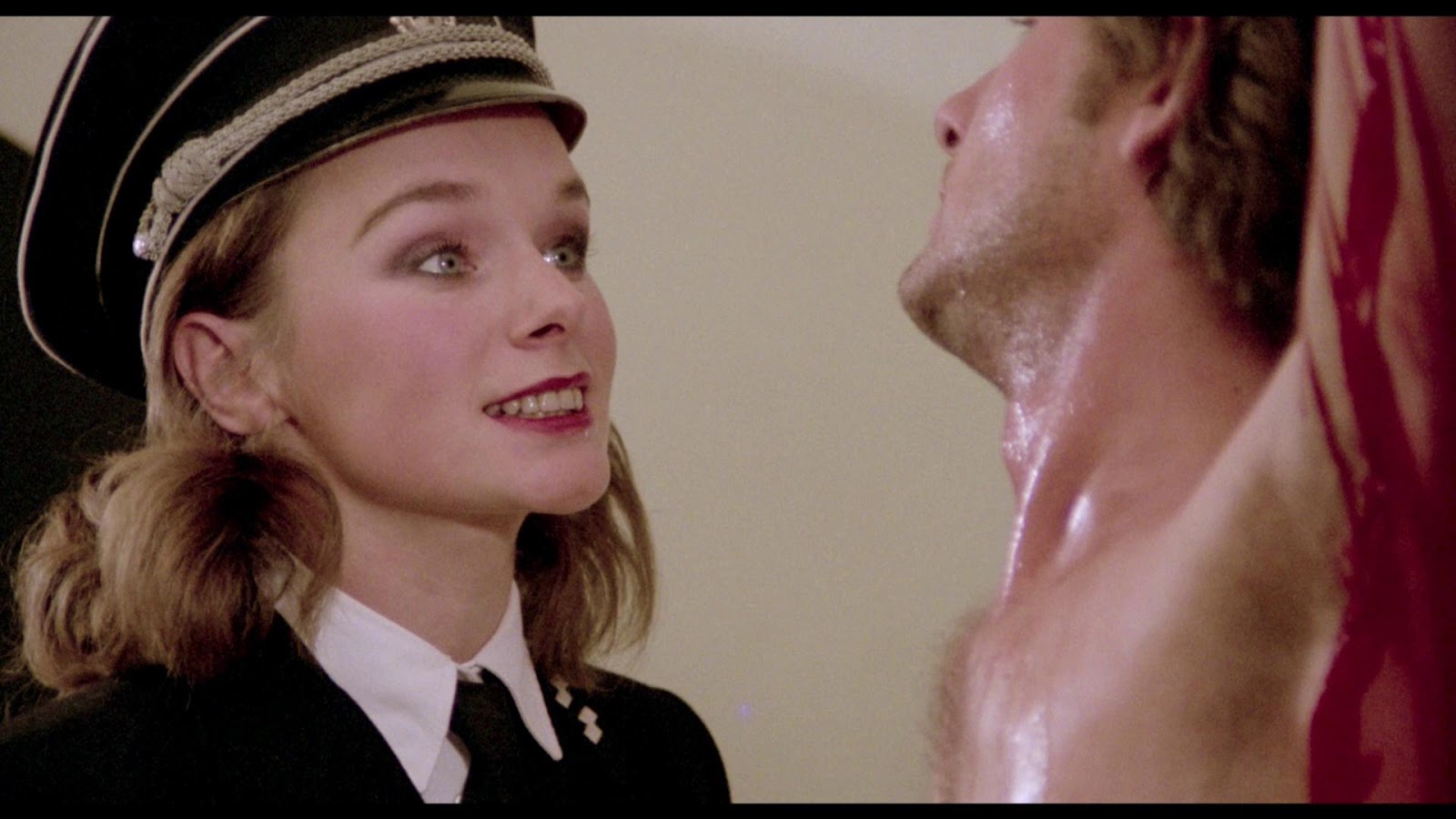
In their pursuit to try and issue as many current and former ‘Video Nasties’ onto Blu-ray, Severin Films have chosen to release one of the nastiest nasties of them all: namely Luigi Batzella’s THE BEAST IN HEAT (1977), an infamous patchwork concoction which represents the absolute nadir of an already suspect subgenre. One of a handful of Nazi-themed exploitation pictures (hence the inevitable catch-all term “Nazisploitation”), Batzella’s lowly offering to the form gets quite the deluxe overhaul indeed with a brand new 2K scan taken from (quote) “35mm negative elements”, and in spite (perhaps even because) of the film’s humble origins, the results are quite remarkable.

Clearly an imitation of Dyanne Thorne’s now-legendary “Ilsa” character from Don Edmonds’ ILSA: SHE WOLF OF THE SS (1974) and its two ‘official’ sequels, in BEAST Dr. Ellen Kratsch (Macha Magall) is finalizing her (quote) “creation of an artificial master race”, which is nothing more than a caged, primordial-looking beast (the aptly-named “Sal Boris” / a.k.a. Salvatore Baccaro) that gleefully rapes most of her female captives. In a ridiculous bit of post-synched dubbing, Dr. Kratsch hilariously promises her in-house brute will (quote) “make the God Eros go green with envy!” Meanwhile, due to the careless efforts of one Captain Hardinghafser (Kim Gatti / a.k.a. Edilio Kim), local partisans led by Moreno (Alfredo Rizzo) and munitions expert Drago (John Braun / a.k.a. Gino Turini) successfully blow-up a tactically important bridge, an act which enrages the Nazi top brass (“As you can see, it is not easy dealing with half-vits!”), who then order Dr. Kratsch to assist in both the capture and torture of the partisans and their womenfolk.

Accentuated by the film’s quickie cash-in status and downright ludicrous – often verging on cartoonish – English dubbing, Batzella’s film is impossible to take seriously, despite its many grisly, uh, ‘highlights’. These include flagellation, fingernail-yanking, electro-shock treatments, and ‘flesh-eating rats’ (in actuality only harmless domesticated guinea pigs [?!]). Then there’s “The Beast” itself, that in one over-the-top scene even resorts to some impromptu cannibalism. Also seen in Bruno Mattei’s tawdry SALON KITTY (1976) rip-off SS GIRLS (a.k.a. PRIVATE HOUSE OF THE SS, 1976), Macha Magall ticks all the appropriate boxes with her pulpy portrayal of a sadistic, leering dominatrix (“You’re just a bitch on heat!”) and she remains the dubious highlight of the film. However, interspersed amidst all the lowest-common-denominator exploitable elements, we get a tired and rather-too-convoluted narrative involving the Italian resistance movement, double-crosses and even dissention among the ranks (“I’m bored of this war!” exclaims one partisan). These less-interesting subplots take up much of the film, and are actually merely redubbed / repurposed footage from Batzella’s earlier – equally meagre – WWII flick, WHEN THE BELL TOLLS (1970). This ‘creative recycling’ of pre-existing scenes also explains the uncredited reappearance in BEAST (presumably without either his knowledge or remuneration) of ex-peplum strongman and usual total badass Brad Harris in an atypical role as a sympathetic priest named Don Lorenzo; other familiar Eurotrash supporting players to look out for include Brigitte Skay as a local prostitute, Xiro Papas (probably best-remembered as the fedora-wearing, sex-starved manster in Mario Mancini’s FRANKENSTEIN ’80 [1972]) as yet another partisan leader, as well as stuntman / bit-parter Benito Pacifico in a tertiary capacity. 

Although most of the notoriety heaped upon this film stems from its early ’Eighties U.K. videocassette release, Batzella’s film also garnered an uncut U.S. home video release in 1985 courtesy of notorious sleaze merchants Video City Productions (box-blurb: “Helpless victims caught in a mad quest for power!”), whose now-hard-to-find Beta/VHS edition featured some truly eye-popping cover art. The film was released yet again in 1987, this time by Mogul Communications (retitled SS EXPERIMENT CAMP PART 2), but this heavily-edited version ran approximately 10 minutes shorter than VCP’s aforementioned version. In 2004, BEAST finally made its DVD debut courtesy of Media Blasters’ Exploitation Digital line, and while it looked good for the time, the interlaced transfer hasn’t dated very well. Extras were limited to an archive of promotional materials, a slightly reedited export trailer and, for the film’s first pressing, a liner notes booklet was included. 

Opening with THE BEAST IN HEAT’s grammatically incorrect English-language export title, HORRIFYING EXPERIMENTS OF S.S. LAST DAYS [sic!], Severin’s new Blu-ray is quite stunning to behold in its crystal-clarity, with nary a blemish in sight during much of the film’s newly-shot footage, or the rearranged scenes from Batzella’s earlier film, WHEN THE BELL TOLLS. However, the meagre production also made use of some additional stock footage from yet another unidentified, bigger-budget war film, which is in considerably rougher shape, so due to the film’s new transfer, this abrupt shift in picture quality is even more jarring than before. In an interesting comparison to Exploitation Digital’s earlier DVD, the initial demolition of the bridge and the climactic siege upon the Nazi compound utilized some cheap day-for-night blue filters, which are absent on Severin’s new transfer, and it actually looks the better for it. Regardless of the laughable English dub track, the DTS-HD MA mono audio sounds great given BEAST’s obvious post-production limitations. English SDH subtitles are also provided.

Along with their excellent transfer of the film, Severin have also provided a batch of worthwhile extras, beginning with Naomi Holwill’s feature-length documentary, Fascism On a Thread: The Strange Story of Nazisploitation Cinema (91m29s), which covers the genre’s rather curious origins, its obvious controversies and its short-lived history beginning with such masterworks as Luchino Visconti’s THE DAMNED (1969) and Liliana Cavani’s THE NIGHT PORTER (1974), and of course, that (quote) “weirdly influential trash movie” ILSA: SHE WOLF OF THE SS (1974), while film critic Kim Newman also points out the genre’s debt to the many (quote) “sensationalist 1950s paperbacks” on the theme as well. It’s a thorough, well-researched doc, which also includes newly-filmed and archival interviews with many of the films’ personnel. Next up, Stephen Thrower provides his thoughts on both the genre in general and BEAST in particular in Nazi Nasty (30m18s), whose primary motivation was to (quote) “shock and outrage jaded consumers”, and notes how Batzella’s film in particular is (quote) “genuinely, startlingly disgusting in many details”. He also points out the film’s sheer absurdity and describes its (quote) “bathos” as shocking, yet recognizes the memorable contributions of both Magall and “Sal Boris”, latter of whose suitably bestial and (quote) “unrestrained” performance is one of the most memorable aspects of the entire production; the influence of adult comic books (or fumetti in the Italian vernacular); and even the attempted – and subsequent failure – to successfully meld eroticism and horror into a moneymaking potpourri of sleazy sex-and-violence; and of course, he also goes on to discuss its release in the U.K. and the ensuing ‘Video Nasties’ outrage it garnered. Finishing-off the extras is BEAST’s lurid theatrical trailer (bearing the film’s French title card HOLOCAUSTE NAZI), which includes some alternate footage not seen in the main feature itself. In a nice added touch, Severin have also provided a reproduction of the film’s original Video Nasty cover art with the package.

As a film,THE BEAST IN HEAT may be cheap, crude, crass and tasteless, but Severin’s top-drawer Blu-ray presentation is anything but, a fact which should please most fans of boundary-pushing, scuzzed-out shock-erotica. Order it from Severin Films here or as part of their June Bundle, and for you Canadian readers, order it from Suspect Video.