Tuesday, October 4, 2016

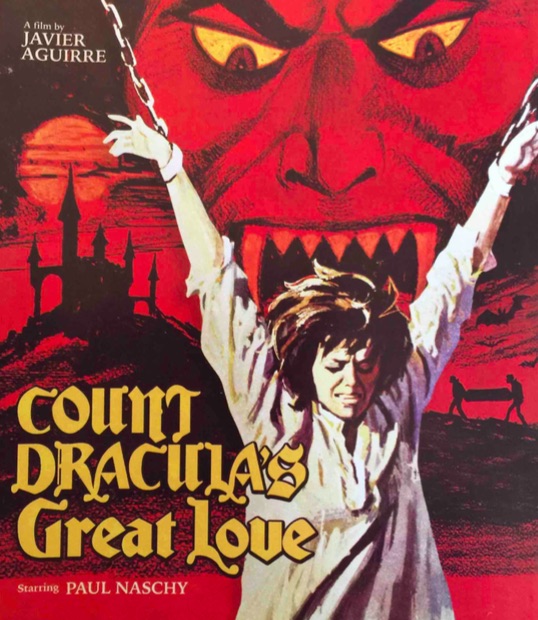
COUNT DRACULA'S GREAT LOVE - BLU-RAY REVIEW

As COUNT DRACULA’S GREAT LOVE opens, you know you’re in for something different, something special, as two men attempt to deliver a coffin to the Kargos Klinik, a dilapidated but beautifully eerie gothic setting in what is meant to be rural Transylvania.  Shortly, having been tempted by the possible riches which may be housed within their cargo, they are killed for their curiosity by some mysterious individual: one has his throat gorily torn apart while the other gets an axe buried in his forehead.  As the latter’s limp body tumbles down the nearby stairs, this sequence is repeatedly played behind the opening credits in what seems like a never-ending loop. Whether or not this repetitive image was used simply due to budgetary constraints, it certainly sets up the wholly unique nature of the entire production aptly enough. 

Directed by the always reliable Javier Aguirre, COUNT DRACULA’S GREAT LOVE is Naschy’s only vampire outing, which, in spite of his long and varied filmography, remains one of his standout efforts.  Readily available since the dawn of video from a variety of labels, usually under a multitude of titles, the transfer prints of most, if not all of them, came either incomplete, pan-and-scanned or were sourced from badly battered-and-tattered prints (typically heavily cut TV versions); which very much makes Vinegar Syndrome’s highly welcome Blu-ray / DVD combo both quite the revelation and definitive, putting to shame any and all versions which have gone before. 

While we’re still trying to comprehend and get out from under the film’s hallucinatory opening, the film begins proper. In the countryside surrounding the sanatorium, Imre (Vic Winner) is chaperoning four young ladies, Marlene (Ingrid Garbo), Senta (Rossana Yanni), Elke (Mirta Miller) and Karen (Haydee Politoff), as they travel through the Borgo Pass.  As their carriage passes the old Kargos sanatorium, Imre tells stories of a “killer prince” who used to run the place and assures them that “Count Dracula existed.”  Naturally, their carriage is sidetracked when it loses a wheel, and the resulting commotion causes the horses to get spooked, an unforeseen chain of events which consequently causes the death of their coachman.  As the storm approaches, the stranded wayfarers seek shelter at the seemingly abandoned sanatorium, where, much to their surprise, they are warmly greeted by Dr. Wendell Marlowe (Naschy).  Grateful for his hospitality, Imre is soon overcome by one of the “dead” delivery men from the opening (who has since become turned into a vampire), whereupon Dr. Marlowe eventually reveals his true identity, who, as – yes, you guessed it! – Dracula, not only wishes to reincarnate his dead sister Rodna, but also to attain the eternal love of a woman… if hopefully presumably one other than his own sister!

Predominantly associated with his incredibly popular Waldemar Daninsky character, Paul Naschy’s Dracula is yet another one of his agonized ‘monsters’ wrestling with his destiny, who, in the end, is merely pining to be loved (“The love of a woman changed the destiny of Dracula”). Even though he does have an underlying and quite sinister motive, Dr. Marlowe is always presented in a very sympathetically melancholic light as he roams the ever-decaying sanatorium he calls home.  On a few occasions, as he seeks the amorous attention of Karen, they philosophize about life and death (“The power of the unknown goes beyond death”) and the fact that he’s (quote) “never been in love.”  What could well have come across as overly sentimental, much of this admittedly lackluster dialogue – at least in the English-dubbed version - actually works in the film’s favour, which is especially evident when Dr. Marlowe is revealed to be Dracula, following which the film abruptly shifts gears and escalates to become one of the more daring and gruesome Dracula pictures of the time, which culminates with a surprising and unusually poetic conclusion.

Needless to say, this being a Spanish horror film from the ’70s, it’s high on atmosphere, boasting everything from slow-motion vampire attacks, an eerie surrounding countryside – nicely captured by DP Raúl Pérez Cubero – and some very strong set-pieces.  In one of the film’s more controversial scenes, Marlene and Elke – as voracious vampire brides – lick and claw at the bloodied breasts of their friend Senta; which is just one of the many scenes that raised more than one censor’s eyebrow.  Alongside some of these memorably eye-opening scenes, one of the film’s stronger assets, that adds immensely to the overall atmosphere, is Carmelo Bernaola’s rather minimalist and highly repetitive music, which effectively emphasizes both the sudden outbursts of gory horror – of which there are plenty – as well as underscoring the somewhat despondent, lonesome count’s empty existence with its jarring piano and quieter, organ-driven passages.

As per their normal high standards, Vinegar Syndrome’s Blu-ray / DVD combo is a crisp, colourful transfer that is actually quite astonishing to behold.  Taken from an uncut 35mm inter-negative provided by its long-ago American theatrical distributor, International Amusement Corporation, VS has given the film a fresh 2K scan which retains the film’s original 1.85:1 aspect ratio.  Natural grain is well-preserved, while darker scenes have much more consistent black levels compared to earlier editions, which seemed washed-out and suffered from a compromised colour palette.  Regardless of the wonky dubbing on the English version – for instance, most of the supposedly Romanian locals are given perplexing southern American “hillbilly” accents (!!) that seem to have strayed in from one of Harry Novak’s sleazy ’70s hixploitation films – the audio registers clear and robust, making this version the best viewing choice by far.  And yet, as an added bonus, the VS Blu-ray also includes a Spanish audio track with optional English subtitles, which isn’t quite as strong, but makes for a nice inclusion just the same.  However, the most substantial extra is an audio commentary with Naschy and Aguirre, which was conducted in Spanish and accompanied by English subtitles.  They discuss the genesis of the project (even referring to it as “Love and Dracula”), as well as some of their influences, such as casting, the various difficulties they experienced with certain cast members, plus censorship issues and some of film’s rather challenging locations.  Naturally, it’s a solid listen, and a real must for any fan of Naschy’s work.  Other extras include an interview with actress Mirta Miller, who also talks about some of the difficulties of the shoot, such as the cold weather and her preference of Aguirre’s directorial style over that of León Klimovsky.  The once-difficult-to-find theatrical trailer and a generous still gallery are additional inclusions and, unlike most of their releases, VS has also included an 8-page booklet with thorough liner notes from Naschy expert Mirek Lipinski.  Keen-eyed viewers will also notice that the reversible artwork features an image which was also utilized for Jess Franco’s EROTIKILL (1973), the alternate horror version of FEMALE VAMPIRE (1973), which was most commonly seen on Force Video’s big box VHS videocassette from the 1980s.


An absolutely stellar release, Vinegar Syndrome’s Blu-ray / DVD combo of this exceptional Paul Naschy film can and should be regarded as one of finest European genre releases of the year.  Order it at Vinegar Syndrome or DiabolikDVD.

Wednesday, July 20, 2016

A CAT IN THE BRAIN - BLU-RAY REVIEW

In the same general period as the Italian film industry was imploding in on itself due to a lack of budgets and enthusiasm, director Lucio Fulci decided to try something different: a self-reflexive look back over the latter part of his career as a famed horror director.  While the end results have divided even some of his most hardened fans, Fulci’s A CAT IN THE BRAIN (1990) is certainly a novel concept – in terms of Italian horror films, at least – plus, taking his Hitchcockian cameos to the next level, Fulci casts himself in the lead role as a tormented director who is beginning to blur the line between his excessively gory filmic output and everyday reality.

Sometimes referred to as “Dr. Fulci”, first seen is his now trademark woolen cap and matching hunter’s lumber-jacket, he is suffering from terrible hallucinations (“a woman hacked to death with an axe”) that, according to him, feels akin to a ‘cat in his brain’, which is hilariously depicted by a ferocious feline – an obvious hand-puppet – ripping apart the inside of his grey matter.  Sandwiched between numerous gore scenes from late-entry Italian splatter flicks – including many of his own – Fulci’s violent hallucinations are very easily triggered, even as he performs the most mundane of daily activities, so he seeks the help of psychiatrist Egon Swharz (David L. Thompson) to help quell his ever-increasing loss of reality.  Unfortunately for Fulci, his psychiatrist merely uses him as a pawn to continue indulging in his very own – and very real – murder spree.

Directed a year after his much-touted, but decidedly meager, ‘comeback’ film DEMONIA (1989), Fulci decided to really let loose and try something entirely different, and while this is yet another very low-budget effort, it’s considerably more memorable and even – gasp! – rather audacious for the once-fiery director.  Like Fulci himself, by the end of the film, most people will also be tired (or bored?) by the seemingly unending stream of gore and realize it’s closer in spirit to a comedy than a horror film.  Even much of the ‘borrowed” footage consists of Fulci’s TOUCH OF DEATH (1988), a darkly comic, and equally gory, look at a modern-day Bluebeard as portrayed by Brett Halsey, who, in A CAT IN THE BRAIN, is merely credited as “the monster.”  In actuality, much of this footage plays quite well alongside A CAT IN THE BRAIN’s original material as Fulci becomes paranoid of eating steak tartar, a man chopping wood, a microwave oven, or even a young girl in wheelchair, scenes which are always punctuated by some sort of splattery nightmare. However, as the film progresses, the gimmick does begin to wear-out its welcome, which may well have been Fulci’s original intent; to try and smother the viewer with as much gore as possible until it no longer resonates and leaves viewers inured to its effects from simple repetition.  It’s a fitting close to one of Fulci’s most popular periods in his 40+-year career.

Despite the heaping amounts of squishy gore on display, it’s left up to the cast to inject any real substance into this “Fulci’s Greatest Hits” package, and aside from the novelty of Fulci as the lead (adequately dubbed in the English version by Larry Dolgin), most of the cast is only amateurish at best.  As the psychotic shrink, Thompson doesn’t exhibit any acting range whatsoever, and comes across almost like a caricature of all those ’70s gialli killers.  On the other hand, it’s always nice to see Malisa Longo (credited here as Melissa Lang), star of countless ’70s Italian ‘sexy’ films, who here appears as the bitchy, unfulfilled psychiatrist’s wife and meets a particularly nasty end.   

A popular title among Grindhouse Releasing’s catalogue since the laserdisc days, A CAT IN THE BRAIN first appeared on DVD in 2006 as a 2-disc Special Edition (the initial batch even had a nifty lenticular cover), which was loaded with extras, but if you’ve never seen this film or are possibly considering an upgrade, then Grindhouse’s newest 3-disc set, which houses 2 Blu-rays and one soundtrack CD of the complete 15-track Fabio Frizzi score, is yet another incredible set well worthy of the double-dip.  Due to the film’s low-budget origins, A CAT IN THE BRAIN would never be considered demo material, but the team at Grindhouse have, as per their usual standards, created yet another small miracle with their latest Blu-ray; it’s hard to imagine it looking any better than it does here. 

Presented in its customary English language version as NIGHTMARE CONCERT (the film’s alternate English language export title), Grindhouse have also provided the Italian language track with removable English subtitles.  All the extras from the earlier DVD are reinstated, including “Genre Terrorist” and “The Television Years”, a massive two-part interview with the late director.  Further interviews with Halsey, Longo, Sacha Maria Darwin and Joffrey Kennedy are also included alongside new interviews with director of photography Sandro Grossi, composer Frizzi, co-writer Antonio Tentori and poster artist Enzo Sciotti.  More extras include hidden Easter eggs, the obligatory Grindhouse trailers – and even a few for some of Fulci’s rarer films, which are located in the filmography section of the disc – and poster galleries.  An excellent booklet with essays from Antonella Fulci, Eli Roth, David J. Schow and Martin Beine, who gives a great rundown of the ALL the borrowed footage that appears throughout the film, is also included.  Lastly, the first 3000 units come with a portrait of Fulci, which is supplied as a thick insert card. 

Definitely not for everyone, Grindhouse has nonetheless put together another incredible, praiseworthy Blu-ray, which continues their impeccably high standards.  An absolute must-have for any Fulci fan!  Order it from DiabolikDVD. 

Monday, July 11, 2016

JUST DESSERTS - THE MAKING OF CREEPSHOW - BLU-RAY REVIEW

Produced through his prolific Red Shirt Pictures, director Michael Felsher has enhanced many a DVD and Blu-ray over the years with his numerous documentaries and special features, but JUST DESSERTS, in my humble opinion, is his magnum opus, a beautifully-constructed and fascinating look into the making of George A. Romero’s CREEPSHOW (1982), the much-beloved – and rightfully so – ’80s horror classic.  Originally conceived for Universal’s 2-disc, U.K.-only DVD released in 2007, this documentary, unfortunately, never made it to the domestic DVD or Blu-ray, but because Universal owned the rights to CREEPSHOW solely in the U.K., this caveat enabled Felsher to retain the rights for the rest of the world.  Thankfully, in conjunction with the good folks at Synapse Films, he has decided to release this magnificent doc as an extras-stuffed, stand-alone Blu-ray, which, even if you own either the 2-disc DVD or the more recent U.K. Blu-ray from Second Sight, Synapse’s Blu-ray contains numerous extra goodies to warrant a double-dip.  

Much like the film it celebrates, JUST DESSERTS unfolds like an anthology, with various chapters dedicated to film’s development and production, and in “The Monster Man”, an entire chapter is devoted to Tom Savini’s incredible special makeup effects.  In the first chapter, cheekily entitled “An E.C. Way to Start”, Romero talks about the influence of the now-infamous E.C. horror comics from the ’50s, as well as the film’s initial conception, including Romero’s first meeting with Stephen King to discuss the possible filming of King’s novel Salem’s Lot.  At the time, both he and King, along with Richard P. Rubenstein – Romero’s producing partner and co-owner of Laurel Entertainment – were considering developing King’s epic novel The Stand as a major motion picture, but they didn’t have the necessary budget, or (quote) “clout”, so the idea was abandoned. They were thankfully doggedly determined to work together, however.  Their love for E.C. Comics became the genesis of CREEPSHOW and, as promised, 60 days later, Stephen King delivered his screenplay to Rubenstein. 

Some of the other chapters herein include: “Acting Scared”, “A Comic Book World”, “Creepy Crawlies”, “Anthology Unleashed” and “25 Years Later”, which cover virtually every facet of the film’s production, reception and ongoing popularity, and which are peppered with superb interviews from the likes of Romero, Rubenstein, Savini, composer and assistant director John Harrison, editor Pasquale Buba, artist Bernie Wrightson, plus ones with cast members Ed Harris, Adrienne Barbeau, Tom Atkins, and many others besides.  Of course, Romero and Savini dominate the bulk of the screen time, and as the documentary unfolds, we see that Romero and his crew were, quite obviously, consummate professionals, yet at the same time they were obviously excited to be working with such a stellar cast; even Romero himself at one point expresses his (quote) “intimidation” about working with some of these seasoned Hollywood veterans – including Hal Holbrook, Fritz Weaver and E.G. Marshall – while Savini relates a story about his admiration for star Vivica Lindfors and her role as Queen Margaret in Vincent Sherman’s Errol Flynn vehicle The ADVENTURES OF DON JUAN (1948). But, still more importantly, JUST DESSERTS captures a sense of the incomparable camaraderie felt by participants throughout the shoot, which seems almost impossible to recreate in these hectic and increasingly profit-driven days; as Romero calmly states at one point, “It was a wonderful experience.”  Interspersed throughout the interviews are tons of excellent, rarely seen behind-the-scenes photos and on-set video footage courtesy of Savini, and, thanks to John Harrison, it’s all scored with his highly compelling and memorable CREEPSHOW score, an absolutely inseparable blend of piano and synth, which is just as effective today as it was 34 years ago.

Nothing but praise should be given to Synapse and their remarkable Blu-ray, which is absolutely filled-to-the-brim with extra features, including two separate commentary tracks.  The first commentary features Felsher discussing his overall career, beginning at Anchor Bay, and then covers the logistical complexities of putting together this doc.  The second commentary brings together John Amplas (who played the rotting zombie Nathan Grantham in the “Father’s Day” episode, as well as the title character of Romero’s own MARTIN [1977]), property master Bruce Alan Miller and special makeup effects assistant Darryl Ferrucci, none of whom were available for comment during the actual filming of JUST DESSERTS, so it’s always interesting to hear even more anecdotes related to the filming.  Speaking of which, in “Creepshow Days”, one of the many other extras included on the disc, director of photography Michael Gornick also gets his say on the nature of the production.  Other extras include extended interviews with Romero, Savini and Wrightson; “Horror’s Hallowed Grounds”, with host Sean Clark, follows Clark as he conducts a guided tour of the many Pennsylvanian locations, and we also get a 1982 Evening Magazine segment shot on the set of the film.  However, the real icing on the cake, and one of this generous package’s most significant extras, is SCREAM GREATS VOLUME 1 – TOM SAVINI, a Fangoria-produced documentary from 1986, which has been absent on U.S. home video for far too long.  But even that isn’t all we get! As an extra added bonus, this documentary also features an additional audio commentary with Felsher and Savini. 

Beautifully packaged, including a cool rendition of Paul R. Gagne’s – author of the 1987 book on George A. Romero’s career The Zombies That Ate Pittsburgh - original cover photo from a 1982 issue of Cinefantastique, Synapse Films’ beaut of a Blu-ray is a true labour of love, and one which any discerning fan of CREEPSHOW shouldn’t be without.  By all means, don’t hesitate to pick this up!  Order it from DiabolikDVD.