Saturday, June 17, 2023

FRANKENSTEIN ’80 - BLU-RAY REVIEW

Outside of some dubious DVD bootlegs and pricey European imports, directorial one-timer Mario Mancini’s lowly, schlocky splatter flick FRANKENSTEIN ’80 (1972) has – during this the still-ongoing digital age, at least – remained conspicuously absent in anything even close to resembling a passably watchable version. But now, thanks to Cauldron Films, this unabashedly seedy, skeezy and sleazy Italo-horror finally gets a real first-class presentation with their superb new Blu-ray. 


Top surgeon Dr. Rudolf Schwarz (Bob Fiz) has developed a revolutionary anti-lymphocytic serum, which is supposed to help “modify the morphological picture and avoid rejection” during organ transplants. Apparently, this serum – which looks a lot like blue mouthwash, and quite possibly was! – is so innovative that it’s the only one of its kind in the entire world (!); and which, of course, shortly gets stolen from Schwarz’s office by a mysterious nocturnal intruder, right when the good doctor – and especially his current patient – needs it most. Enter Karl Schein (John Richardson). Karl is a reporter assigned to the “crime news desk” at some unspecified local newspaper, and is visiting his terminally-ill sister at the hospital, who is awaiting an urgent heart transplant c/o of Doc Schwarz, and will surely soon die without one.  Due to that mysterious third party having absconded with Schwarz’s crucial serum the night before, Karl’s sister dies not long after her operation when her incompatible physiognomy rejects the donated heart, so her grieving brother – who doesn’t really seem all that bothered by her ‘tragic’ demise, quite frankly (chalk it up to underacting ‘star’ Richardson’s bored lack of interest in the material!) – is put on the “Schwarz serum case”. This special enquiry leads him to the hospital’s head pathologist, Dr. Otto Frankenstein (Gordon Mitchell) and his misshapen, stitched-together – and sexually voracious – monster, whom/which his creator has dubbed Mosaic (Xiro Papas). Incidentally, you’d think that any hospital which would hire-on an employee named Frankenstein, which also gave him free access to all the dead patients’ body parts might at least be suspicious of his motives and keep an eye on him, especially after hours… but apparently not!


Bearing some passing similarities to Mel Welles’ vastly superior LADY FRANKENSTEIN (1971), this micro-budgeted modern-day retelling of Mary Shelley’s most famous work is every bit as piecemeal as Frankenstein’s human jigsaw puzzle Mosaic in the film. As intriguing/puzzling as its ‘futuristic’ title is, most of this film’s running time is devoted to Mosaic its ‘Modern Prometheus’ simply roaming the streets of an unspecified European city (in what was evidently intended to be Germany, judging by the excess of Teutonic names in the cast of characters; although an olive-green Giulia polizia cruiser pegs the true location as being a whole lot closer to home in Mamma Italia). Rather than merely wandering aimlessly, Mosaic goes off searching for women and fresh body parts, much to his master’s chagrin. “You’ve got to stop killing! I’ll get you the organs you need! exclaims Dr. Frankenstein, alarmed by his cobbled-together creation’s increasingly murderous and uncontrollable behavior. Bald-pated, with big bushy eyebrows and sporting fresh surgery scars all over his face and body – as an ill-fated, short-lived hooker discovers, much to her horror – Mosaic also wears a Gestapo-like black leather trench-coat and black fedora hat (and a rather goofy one at that!) which makes him look like some wannabe ’40s-era hoodlum with a leather fetish. Unable to speak beyond uttering a few unintelligible grunts and groans here and there, he somehow still manages to pick up the odd unwary prostitute (“What’s the matter with you, eh?” asks one. “You made-up for Halloween?”), who definitely get more than they bargained for when they take this ‘john’ home to their bedsit. 
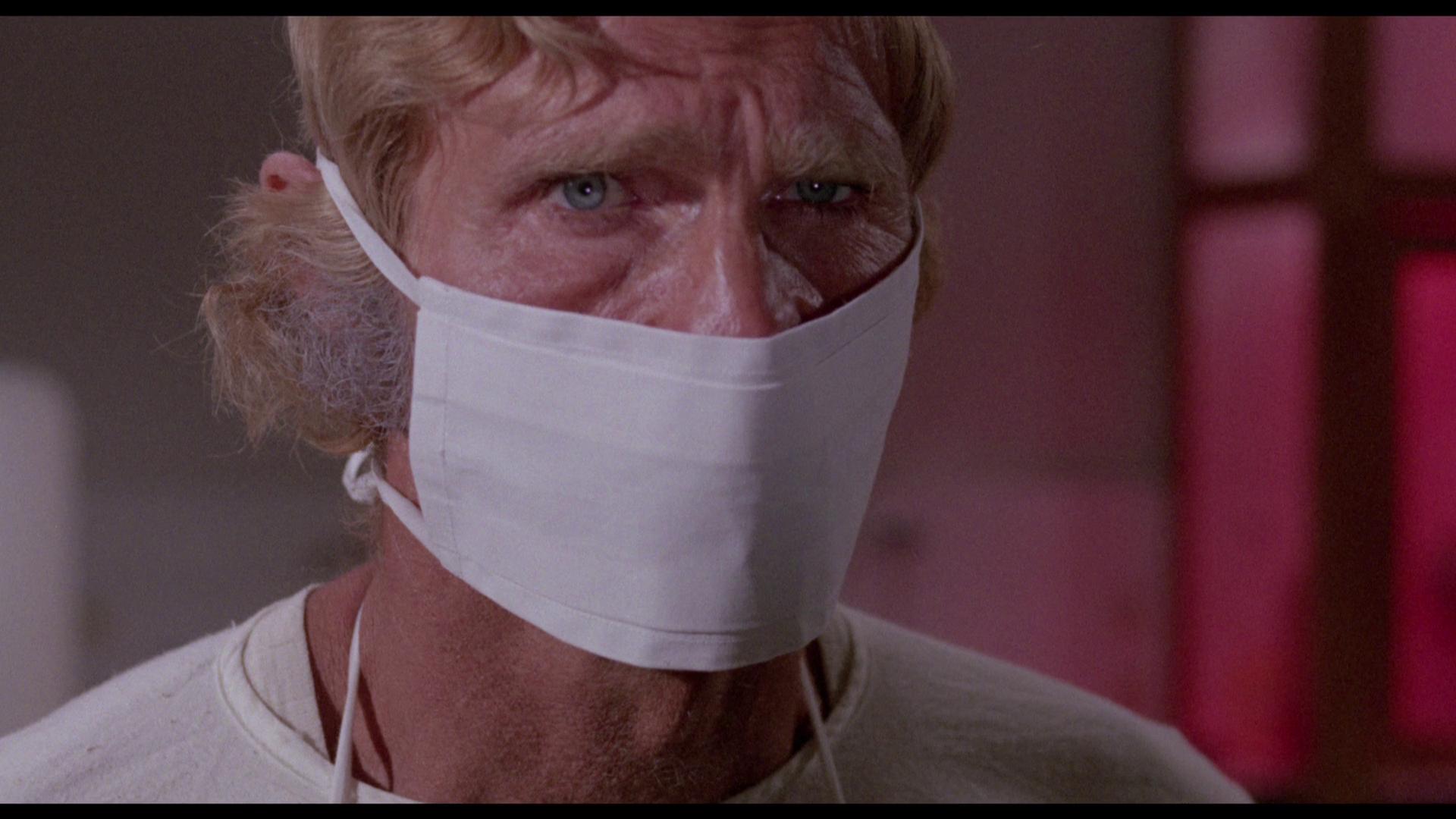
 

Like the protagonist of some third-rate giallo, our disinterested hero Karl snoops about both figuratively and literally in the dark, and along with Schneider (Renato Romano), a very frustrated police Inspector (“Give me the essence of it! The juice, ya know?!”), they discover Dr. Frankenstein’s laboratory, which is secretly – laughably enough – hidden behind a swinging partition within the very hospital itself. In the meantime, Mosaic goes on a continuous killing spree while the police sit back twiddling their thumbs and biding their time, if nothing else doing their bit to pad the film out to an, um, ‘respectable’ running length. Another purely extraneous bit of business involves ‘special guest star’ Luigi “Gigi” Bonos, the then-sole-surviving brother of the once-popular Fratelli Bonos acting trio (he too passed away in the year 2000). A seasoned specialist at playing stock comedic characters, Bonos herein cameos without saying a word as a grubby old vagabond who has a particularly unpleasant (and fatal) encounter with the man-made monster and a large, heavy car part in an auto graveyard after dark.


Clumsily-executed across the boards and strung-together with only the flimsiest of plotlines – albeit still highly entertaining nevertheless – FRANKENSTEIN ’80 represents usual cinematographer Mancini’s sole endeavour as a director. He was actually a fairly prolific DP on many a low-budget Italian film and, again in 1972, he also worked in that capacity on F.L. Morris’ (a.k.a. Ferdinando Merighi) equally shoddy gialloTHE FRENCH SEX MURDERS (1972); it too features the same economical and garish lighting schemes, which comes as quite the surprise in the case of the present film, since it was shot by no less than Emilio Varriano, one of Mario Bava’s most trusted camera operators (who, two years later, went on to lens Bava’s claustrophobic, nail-bitingly suspenseful crime thriller RABID DOGS [1974]). Talented composer Daniele Patucchi also provides a fun, if wholly appropriate, piano-driven score, but he also reuses a cue from his languid, easy-listening score to Elò Pannaccio’s IL SESSO DELLA STREGA (1972). Following a drawn-out peeler act at a stripclub, bits of Patucchi’s score for Carlo Croccolo’s low-end Klaus Kinski spaghetti western BLACK KILLER (1971) can also be heard. 


Making its HD debut in 2017 via Germany’s Region B Blu-ray/DVD Mediabook courtesy of ’84 Entertainment, this nicely-packaged edition began with a disclaimer about their somewhat compromised HD transfer, which specified that “short scenes were no longer available on 35mm film and had to be inserted from an inferior source”, in this case a grainy VHS videocassette. Apart from these thankfully-only-brief inserted scenes (including longer-lingering extra bits of nudity and gore), which jar quite noticeably with the bulk of the film’s transfer print proper, ’84 Entertainment’s Blu-ray was definitely worth the upgrade, and miles better than any other version on the market, especially to anyone familiar with Gorgon’s long-out-of-print and badly pan-and-scanned fullscreen VHS tape. This is also the first time (at least to English-language viewers) that the film had been made available in its original widescreen aspect ratio, which made for a far-less-confining and claustrophobically constricting viewing experience all round. The LPCM 2.0 audio was also available in both German and English language options, although the English track featured some audible hiss, but overall sounded just fine in light of the film’s obvious relatively primitive technical attributes.


Extras included a fairly beat-up, but most-welcome original trailer, with some brief German narration; alternate opening credits from the U.S. and German (as MIDNIGHT HORROR) VHS versions (3m30s); a brief gallery (1m07s) of the entire set of Italian fotobuste; plus ‘lost film scenes’, which were all the extra inserted scenes, including surrounding context (3m55s). Apart from one extra brief artwork gallery (57s) of video and promotional art present only on the DVD, both discs included the same transfer and extras. 


Earlier this year, Cauldron Films finally released the film’s first official — and only true uncut presentation — on Blu-ray, which was scanned in 2K from “the original camera negative in Rome, Italy by Variety Films.” Detail on the Blu is first-rate, and will serve as a real revelation to anyone only familiar with Gorgon’s VHS tape (“He had a bone to pick…”) or Cheezy Flicks VHS-sourced DVD. Many of the film’s previously problematic day-for-night scenes come through just fine here, and the robust colours help better accentuate all the glistening viscera and stage blood on display. The disc also includes a pair of DTS-HD master audio 2.0 mono tracks in English and Italian (with properly translated English subtitles), which sound very good with no discernible issues whatsoever. Incidentally, the Italian audio track differs ever so slightly, so keen viewers may want to give both a listen. 


Extras on Cauldron’s disc begin with an audio commentary from film historian Heather Drain who discusses the film’s “pretzel logic”, and plenty of background on the film along with several much-welcome digressions; the simplistic but effective F/X work of Carlo Rambaldi, Mario Mancini’s long career as a camera operator, the many “spiritual heirs” to FRANKENSTEIN ’80, and her love of Italian horror films in general. It’s an easy-going, fact-filled listen, which compliments this schlocky film perfectly. In Dalila Forever (27m46s), Andrea Meroni and Eugenio Ercolani provide a terrific career-spanning audio interview with Dalila Di Lazzaro (an on-camera interview was not possible due to health reasons) wherein she discusses her early inspirations, her stern upbringing, her time working in Rome and many of her first roles including Luigi Comencini’s LO SCOPONE SCIENTIFICO (1972) alongside Alberto Sordi, Joseph Cotton, and Bette Davis, Paul Morrissey’s FLESH FOR FRANKENSTEIN (1973), and of course, FRANKENSTEIN ’80. In Little Frankensteins (38m20s), film historian Domenico Monetti discusses Frankenstein within Italian cinema, and how the “true nature” of Mary Shelley’s work was changed “Italian-style”, covering such films as Tulio Demicheli’s ASSIGNMENT TERROR (1970), Robert H. Oliver’s FRANKENSTEIN’S CASTLE OF FREAKS (1974), the aforementioned Paul Morrissey film, FRANKENSTEIN ’80 of course, and even Aristide Massaccesi’s late-entry poverty-row stinker FRANKENSTEIN 2000 (a.k.a., RETURN FROM DEATH, 1992).


Although already sold out, the limited Blu-ray with slipcase also included a 23-page booklet on The Art of Frankenstein ’80, which featured poster art, fotobuste, and other miscellaneous stills supplied by Cinema Arcana’s Bruce Holecheck, a double-sided fold-out poster featuring the work of Justin Coffee (he also supplied the disc’s beautiful cover art) and “Putrid” Matt Carr, and a nice collectible slipcase for those that care  about such collectible ephemera. Order the standard release Cauldron Films or DiabolikDVD.

Monday, January 2, 2023

UNPOPPED CINEMA'S TOP 25 BEST DISCS OF 2022

It’s that time of year again, and sure enough, it’s the boutique labels that need a serious round of applause for their dedication and hard-work, releasing several heretofore ignored, unseen and/or highly-requested films onto disc. Although it must be said that as much as I enjoy putting these lists together, it’s becoming more and more difficult to compile a thorough list without leaving something off, which may confound, frustrate or even anger some voracious film fan out there as they contemplate my choices. But that’s half the fun isn’t it? So, without further delay, let’s take a look at some of my favourites.

ALLIGATOR [1980] (Scream Factory) – Seamlessly blending tongue-in-cheek dialogue and gruesome horror, this is one of the very best ‘animal attack’ films, which finally made its long-belated UHD/Blu-ray debut with this stunning 3-disc special edition. Interviews with director Lewis Teague, writer John Sayles, and even Bryan Cranston (he served as one of the film’s many production assistants) are just a few of the excellent bonus features on this stellar release, which was definitely worth the wait. 


BLOOD AND DIAMONDS [1977] (88 Films) – It was a great year for fans of director Fernando Di Leo, which saw quality HD releases of NICK THE STING (1976), THE VIOLENT BREED (1984), and this, his last great Italocrime film, a tough-as-nails tale of betrayal and revenge starring Claudio Cassinelli, Martin Balsam and Barbara Bouchet. This beautiful 4K restoration, which also included Italian and English language options, looked fantastic, and also came fully-stacked with extras beginning with a comprehensive and highly-entertaining audio commentary from author and film historian Troy Howarth and Mondo Digital's Nathaniel Thompson, a feature-length documentary on Di Leo, on-camera interviews and more! Slick packaging and a superb booklet with writing from Francesco Massaccesi, Andrew Graves and Rachael Nisbet was also included. 


BLOOD DELIRIUM [1988] (Vinegar Syndrome) – Here’s an unexpectedly demented late-entry Italo horror from director Sergio Bergonzelli (best known for directing the equally outrageous giallo, IN THE FOLDS OF THE FLESH [1970]), an entertaining take on Herschell Gordon Lewis’ COLOR ME BLOOD RED (1965), which also jumbles together trace elements from ’60s Italian gothics alongside a whole heap of gore and perversions. John Philip Law, Euro vet Gordon Mitchell, Brigitte Christensen and porn starlet Olinka Hardiman star in this unforgettable film, which not only made its worldwide Blu-ray debut, but also featured the long-sought after uncut version! This is a trashy, must-have jewel in the vast Vinegar Syndrome catalogue.


CENTIPEDE HORROR & RED SPELL SPELLS RED [1983] (Error_4444) – Punctuated by several gross out moments, these insane Hong Kong films have definitely earned a place in the cinematic horror canon, and these new 2K restorations of the uncut versions are massive improvements in every way. Extras aren’t extensive, but include excellent booklets with writing from the late Travis Crawford, trailers, and “animal cruelty-free” versions for those that can’t stomach such nastiness.


CONTRABAND [1980] (Cauldron Films) – Lucio Fulci’s Eurocrime splatter classic has been a victim of shoddy transfers for far too long, which made Cauldron’s new disc all the more appealing. This worldwide Blu-ray debut was a real sight for sore eyes, which featured a new superlative “4K scan of the negative” that put all previous releases to shame. Plus, it was loaded with tons of extra features including a great audio commentary from Cinema Arcana’s Bruce Holecheck, Nathaniel Thompson and Troy Howarth, as well as several on-camera interviews with much of the cast and crew courtesy of Eugenio Ercolani. And for those that snagged the limited edition, the entire Fabio Frizzi score was also included on a separate CD. Highly recommended! Read review.


DEATH GAME [1977] (Grindhouse Releasing) – A casualty of several inferior home video releases on both VHS and DVD, Peter S. Traynor’s feverish and darkly perverse home invasion film finally got its due with this staggering 2-disc set. Thanks to Grindhouse Releasing’s usual high standards, this new transfer was a real stunner, which reinstates David Worth’s scope photography with a sharpness and depth of field unseen in any previous release. Of course, GR also provided an abundance of special features, which will keep you entertained for hours, in what is easily one of the best home video releases of the year!


DORIS WISHMAN: THE TWILIGHT YEARS / THE MOONLIGHT YEARS / THE DAYLIGHT YEARS [1960 – 1977] (AGFA / Something Weird Video) – Even though these are three individual releases, it’s kind of difficult to separate them; besides, the nifty magnetic packaging allows them to nicely attach together. Spread out over 9 discs (!), these sets showcase a total of 22 films from different key eras of Wishman’s lengthy career, and are bursting with extra features including audio commentaries, trailers, and plenty more! These are fantastic sets, and a real delight for fans and newcomers alike. 


DR. LAMB [1992] (Unearthed Films) – Boldly stylistic yet brutally violent, this Cat III Hong Kong shocker is a real mixed bag, adding plenty of perversity and even a dash of oddly-placed comedy, all of which is held together by Simon Yam’s intense central performance as the psychotic serial killer. Much like Herman Yau’s THE UNTOLD STORY (1993) and THE EBOLA SYNDROME (1996), a pair of equally disturbing Cat III films released last year, this is another major cinematic recovery, which is nicely supplemented with several extras including an audio commentary with Bruce Holecheck and Ultra Violent’s Art Ettinger. 


DRAGUSE / LE BIJOU D’AMOUR [1976 / 1978] (Vinegar Syndrome / Peekarama) – Straddling the line between the highly individualistic films of Jean Rollin and the crass budget-conscious works of Eurociné, this double feature from French director Patrice Rhomm showcased a pair of forgotten, horror-tinged sex oddities, which were a real surprise, even to the most jaded of Eurotrash enthusiasts. Beautiful uncut transfers and some nice extras only sweetened the package. Read review.


FACELESS [1988] (Severin Films) – An irresistible and colourfully outrageous Eurohorror, this is a Jess Franco film for those that hate Jess Franco films! It’s slick, gory and highly entertaining, and Severin Films have finally given this film its due with this gorgeous UHD/BD combo, which included a picture-perfect 4K transfer and a host of amazing extra features! Read review


FOUR FLIES ON GREY VELVET [1971] (Severin Films) – Given the amount of outstanding titles Severin had already released throughout 2022, they performed a small miracle when they announced this much-sought-after, definitive edition of Dario Argento’s stunning giallo. Among the consistently engaging special features on this stunning 4-disc (!) UHD/BD combo are an audio commentary with Nathaniel Thompson and Troy Howarth, a glut of interviews with just about every living participant involved with the film, as well as Profondo Argento author and film critic Alan Jones, and as an added bonus, Ennio Morricone’s entire score on a separate CD! This is a truly impressive, meticulously assembled package, and possibly of the most important home video releases of the year!


GOTHIC FANTASTICO: FOUR ITALIAN TALES OF TERROR [1963 – 1966] (Arrow Video) – Made during the Golden Age of Italian Horror, this collection of beautifully curated black-and-white gothics easily ranks as one of the best Arrow releases of the year, which included impeccable 2K restorations of Massimo Pupillo’s LADY MORGAN’S VENGEANCE (1965), Mino Guerrini’s THE THIRD EYE (1966), Alberto De Martino’s THE BLANCHEVILLE MONSTER (1965) and Damiano Damiani’s THE WITCH (1966). The preceding two films also made their worldwide English-friendly Blu-ray debuts, with Arrow even unearthing THE THIRD EYE’s never-before-released English audio track! As expected, this lavishly-packaged box set also included a host of outstanding extra features from several authors and film historians, which included Mark Thompson Ashworth, Miranda Corcoran, Kat Ellinger, Alexandra Heller-Nicolas, Rachel Nisbet, and several others. And for those that splurged on the limited edition set, a handsome 75-page booklet is also included with writing from Rod Barnett, Roberto Curti, Kimberly Lindbergs, Jerome Reuter, and Rob Talbot. 


THE HEAD [1959] (Anolis Entertainment) – Finally separated  from the public domain ghetto, this is one of the more uniquely bizarre West German films you’ll likely to encounter. Victor Trivas’ film never ceases to entertain with its trashy scenario, interesting visual touches, and Horst Frank’s key role as the obsessive doctor. This “weltpremiere in HD qualitat” looks and sounds fantastic, and includes both the German and English versions, and for English-speaking viewers, Video Watchdog’s Tim Lucas provides another one of his highly-detailed audio commentaries, which sheds plenty of light on this extraordinary Eurohorror.


HOUSE OF PSYCHOTIC WOMEN: THE RARETIES COLLECTION [1972 – 1986] (Severin Films) – Released in conjunction with Kier-La Janisse’s updated, must-have book House of Psychotic Women, this stunningly curated collection featured a quartet of visually and emotionally unforgettable films, which, like her book explore “visions of female madness.” Giuseppe Patroni Griffi’s IDENTIKIT (a.k.a. THE DRIVER’S SEAT, 1974) with Elizabeth Taylor, Grzegorz Warchol’s I LIKE BATS (1986), Luigi Bazzoni’s incredible FOOTPRINTS (a.k.a. PRIMAL IMPULSE, 1975) and Jane Arden’s wholly unique THE OTHER SIDE OF THE UNDERNEATH (1972) are all accompanied by several revealing special features. This was one of the most rewarding surprises of the year!


THE INCREDIBLY STRANGE FILMS OF RAY DENNIS STECKLER [1962 – 2008] (Severin Films) – Following their extraordinary Al Adamson and Andy Milligan collections, Severin stunned just about everyone with the release of this colossal 10-disc, 20-film (!) magnum opus, which comprises everything from WILD GUITAR (1962) up until his zero-budget, swan song ONE MORE TIME (2008), even including many of his… um, colourfully-titled porno films. Packed with a wealth of bonus features and an outstanding 100-page book with writing from Zach Carlson and Charles Devlin, this tremendous box set presented the perfect opportunity to discover, or possibly reacquaint yourself with this very unusual cult filmmaker in great detail. 


LIBIDO [1965] (Severin Films) – Never released in the English-speaking market, this cornerstone giallo from directors Ernesto Gastaldi (who went on to become one the most prolific scriptwriters of Italian gialli) and Vittorio Salerno was yet another worldwide Blu-ray debut. Beautifully shot by Romolo Garroni in moody black-and-white, and featuring all the usual gialli tropes, Severin’s disc was a real knockout, which not only featured several worthwhile extras (including a sharp and astute audio commentary from Diabolique's Kat Ellinger that focused primarily on Gastaldi’s career and influence), but also the film’s unreleased English audio track! This should be at the top of every giallo lover’s list.


LOVE BRIDES OF THE BLOOD MUMMY [1973] (Mondo Macabro) – Arriving a couple of months within each other via MM’s spectacular BD and Le Chat qui Fume’s equally gorgeous UHD/BD combo, this once exceedingly rare Spanish/French co-production arrived on official home video in fine style, indeed. Featuring a new 4K restoration of the uncut version, both discs included a wealth of alternate scenes and the French and English trailers, but the MM disc bettered the UHD with additional special features including an audio commentary with David Flint, a rare 8mm version from the UK, alternate credit sequences and a very welcome still and poster gallery. The now OOP ‘Red Case’ edition of the film also included a terrific liner notes booklet on the mystery of director ‘Ken Ruder’ as well as 5 double-sided postcards that reproduced the Spanish lobbycards. Highly recommended!


MOON OF THE WOLF [1972] (Vinegar Syndrome Archive) – A public domain mainstay for years, this tight, well-paced TV movie from director Daniel Petrie has been restored at long last. Featuring plenty of great atmosphere and suspense, this new 2K scan was a vast improvement in every way, but the disc also included a well-informed audio commentary from TV movie expert and Are You in the House Alone? author Amanda Reyes, and author and film historian Daniel R. Budnik. Further enlivened by a terrific cast including David Janssen, Barbara Rush, Bradford Dillman, Geoffrey Lewis and Royal Dano, this comes highly recommended!


NATURAL ENEMIES [1979] (Fun City Editions) – Oftentimes as unpleasant as it is thoroughly engaging, Hal Holbrook stars as Paul Steward, a successful magazine publisher who intends to kill his entire family and himself by the end of the day. Based on a novel by Julius Horwitz, writer and director Jeff Kanew is the real star here, handling the tricky material with a mature sincerity in this disquieting immersion into depression and loneliness. Long out of circulation, Fun City’s new 2K restoration came from “the best-surviving element”, which wasn’t perfect, but still looked infinitely better than the old VHS tapes. A very welcome – and highly-detailed - audio commentary from Bill Ackerman of the Supporting Characters podcast was the real standout among the bonus features, which also included a two-part video interview with the director, an alternate ending, and the film’s trailer. A superb release in every way, NATURAL ENEMIES is a haunting and unforgettable experience. 


THE OTHER SIDE OF THE MIRROR [1974] (Mondo Macabro) – Dreamlike and compellingly structured, this easily ranks as one of Jess Franco’s very best films, which was finally given the proper release it so richly deserves, and it’s a beautiful restoration to boot. Outside of the new 4K transfer of the original, full-length Spanish version, MM have provided several exemplary bonus features, which included a comprehensive audio commentary from I’m in a Jess Franco State of Mind’s Robert Monell and Naschycast’s Rod Barnett, an almost hour-long on-camera interview with Franco expert Stephen Thrower, and more! The now OOP ‘red case’ edition also includes a 20-page booklet with writing from Francisco Cesari and Roberto Curti. 


THE SEVENTH CURSE [1986] (88 Films) – Blending intense action, black magic, great monsters, and lots of over-the-top gore, this is a Hong Kong film like no other! Gloriously trashy from start to finish, 88 Films spared no expense bringing this insanity to Blu-ray, which included two versions of the film (both 2K restorations), an 80-page book, posters, and tons more besides! A beautiful, must-have set that is not to be missed!


SHAWSCOPE VOLUME 2 [1978 – 1993] (Arrow Video) – Focusing on the studio giant’s late-’70s and ’80s output, this sophomore effort collected together 14 newly restored films including everything from such classics as Lau Kar-leung’s THE 36TH CHAMBER OF SHAOLIN (a.k.a. MASTER KILLER, 1978) and Chang Cheh’s TEN TIGERS OF KWANGTUNG (1980) to obscurities like Wong Jing’s action film MERCENARIES FROM HONG KONG (1982) and Kuei Chih-hung’s outrageous horror film THE BOXER’S OMEN (1983)! Overflowing with so many extras (including a couple of soundtrack CDs!) to adequately list here, it may realistically take you a better part of the year to get through them! 


SHRIEK OF THE MUTILATED [1974] (Vinegar Syndrome) – Wildly diverse in tone and sporting one of the all-time great titles in exploitation movie history, Michael and Roberta Findlay’s schizo backyard Bigfoot film is a wonderfully chaotic mess, which has been in dire need of a proper release for decades. This new disc obliterates all of the crummy, compromised home video releases that came before it with a brand-new eye-popping 4K transfer (taken from the film’s OCN, no less!), which is astonishing in its clarity and detail. VS also includes several illuminating bonus features including a superb audio commentary with Roberta Findlay and Casey Scott, on-camera interviews with Findlay and writer/producer Ed Adlum, a cool location tour, and more. 


THE SWORD AND THE SORCERER [1982] (Scream Factory) – At long last, Albert Pyun’s much-requested CONAN THE BARBARIAN (1982) clone made its HD debut this year in a stunning UHD/BD combo, which did wonders with Joseph Mangine’s colourful, atmospheric photography. Outside of this “new 2021 4K scan from the original negative,” Scream also assembled an impressive roster of informative interviews. Co-writer/co-director John Stuckmeyer, actress Kathleen Beller, editor Marshall Harvey, F/X artist Allan Apone, and the late director Albert Pyun were among the participants.  


TOMBS OF THE BLIND DEAD [1971] (Synapse Films) – Making its U.S. Blu-ray debut, this memorably atmospheric Spanish horror film introduced the blind Templar Knights, a group of undead ghouls who hunt their prey by sound alone. The story is rudimentary, but the creepy visuals and unsettling sound design are enough alone to elevate this into one of the more haunting zombie films ever made. As per their usual high-standards, Synapse’s 3-disc set looks and sounds fantastic, and is stuffed with a wide variety of special features, which adequately analyze the indelible mark director Amando De Ossorio left on Spanish fantastic cinema. 


And here are the HIGHLY HONOURABLE MENTIONS, which are also very worthy of your time!


ALL DECEASED… EXCEPT THE DEAD (88 Films), ANTS! (Kino Lorber), BARFLY (Imprint Films), CALIGULA AND MESSLINA (Severin Films), CALIGULA THE UNTOLD STORY (Severin Films), CREATURE FROM BLACK LAKE (Synapse Films), THE DEVIL’S GAME (Severin Films), THE FIVE DAYS (Severin Films), FORGOTTEN GIALLI VOLUME 4 (Vinegar Syndrome), FORGOTTEN GIALLI VOLUME 5 (Vinegar Syndrome), GOD TOLD ME TO (Blue Underground UHD), A HAUNTED TURKISH BATHHOUSE (Mondo Macabro), THE HORRIBLE SEXY VAMPIRE (Mondo Macabro), I MISS YOU, HUGS AND KISSES (Severin Films), JE BRÛLE DE PARTOUT (Pulse Video), MOONCHILD (Visual Vengeance), OUT OF THE BLUE (Severin Films), PINK FLAMINGOS (Criterion Collection), SAMSON AND THE 7 MIRACLES OF THE WORLD (Kino Lorber), SEAGULLS FLY LOW (Cineploit Records & Discs), SHANGHAI JOE (Cauldron Films), SHOCK (Arrow Video), SON OF SAMSON (Kino Lorber), TALES TO KEEP YOU AWAKE (Severin Films), TARANTULAS: THE DEADLY CARGO (Kino Lorber), TENEBRAE (Synapse Films UHD), TERROR OUT OF THE SKY (Kino Lorber), THRILLER – A CRUEL PICTURE (Vinegar Syndrome UHD), THE WARRIORS (Imprint Films), WEREWOLF VS. THE VAMPIRE WOMAN (Vinegar Syndrome UHD). 

Wednesday, December 21, 2022

SEAGULLS FLY LOW - BLU-RAY REVIEW

One of the more elusive entries in Maurizio Merli’s extensive Italocrime filmography, Giorgio Cristallini’s SEAGULLS FLY LOW (1978) unfolds at a decidedly leisurely pace, and has more in common with film noirs than the more traditional vigilante cop shoot-’em-ups Merli usually inhabits. A long-time victim of shoddy VHS releases, Cineploit Records & Discs’ new “worldwide 2K Blu-ray premiere” is yet another first-rate disc in their ever-growing catalogue of Euro Cult releases. 

Looking disheveled, and sporting a thick handlebar moustache under a mop of matted hair, Merli stars as Jeff Jacobson, a Vietnam deserter who occasionally resorts to murder due to economic circumstance. Often referred to as “The Mechanic”, Jeff arrives in Rome after he is blackmailed to do a “job” for corrupt industrialist Roberto Micheli (Mel Ferrer, in a part originally envisioned for Ray Milland), by killing Mauro Martini, one of his business associates who “wanted to testify before the commission”. Following a long, suspense-filled drive from the airport wherein two of Micheli’s associates (including the always charismatic Franco Garofalo) keep a close eye on him, Jeff fulfills his contract quickly and efficiently, but a sudden ’Nam flashback (cheaply executed through stock footage of war atrocities tinged with a blood-red filter) exposes his vulnerability. Later that day at the airport, his jittery disposition comes to fruition when he is spooked during a routine passport check and flees. He promptly returns to Roberto who begrudgingly helps him create a new identity (he basically cuts his hair and shaves his mustache) and arranges yet another passport for him, this time under the name Albert Morgan.


But then Micheli’s other business partner, Giorgio Calvi (Andrea Esterhazy) becomes increasingly paranoid, and as a protective measure, orders a hit on both Jeff and Micheli. While eluding his killers, Jeff must also try and track down his new passport, which not only leads him to Umparo (Dagmar Lassander), one of of Micheli’s many influential friends, but also Isabelle Michereau (Nathalie Delon), a shopkeeper who agrees to help him… 


Obviously taking a cue from Jean Pierre Melville’s masterpiece LE SAMOURAÏ (1967), and even sharing that film’s co-star, much of  SEAGULLS FLY LOW mid-section concerns itself with the lead character’s psychological stress and mounting paranoia, with Merli giving a highly credible performance as the nervous hitman; a nice change of pace for the usually typecast actor. The rest of the cast also give fine performances including the always gorgeous Nathalie Delon, but as predicted in this quickie, name-brand co-stars Mel Ferrer (who at least dubs his own voice on English prints) and Eurotrash sex kitten Dagmar Lassander are rationed out rather frugally. As the self-proclaimed real brains behind the operation, the former hides behind the trappings of respectability, but makes no moral distinctions when it comes to his interests, especially in this world that seems to be constantly moving in cagey circles. 


Overall, everything is handled convincingly enough, but it does spend a little too much time on Merli’s and Delon’s burgeoning romance. At one point, our smitten couple observe the title scavenging shithawks (“They’re always looking for something more to eat, and this sea of garbage is their only happiness”), which is subsequently followed by one of the film’s low points: a bout of tender lovemaking in a cheap motel, which is mercifully short and hilariously intercut alongside Isabelle’s panting dog! Shrewder pacing would have been a plus, but the film’s gritty tone aptly conveys the dog-eat-dog existence of the criminal world, adding plenty of authenticity.


A real obscurity, SEAGULLS FLY LOW did appear on Italian and German VHS videocassettes in the eighties but for English speaking viewers, the Greek videotape from Video Alsen was the only worthwhile edition, that is, if you could find it. Like most Greek tapes, it was annoyingly cropped and the picture quality was average at best, but it was in English, and that was all that really mattered. Never issued on DVD, Cineploit’s new Region B Blu-ray is a very welcome release of this once-difficult-to-see film, which looks fantastic. Film textures look authentic with lots of shadowy detail, realistic colours and some nice depth, although a few interior scenes appear a little less crisp, which may be true of Gino Santini’s original photography. The DTS-HD 2.0 audio includes tracks in German, Italian and English, with the Italian and German ones sounding the strongest (which also includes accurately translated subtitles). The very welcome English audio is occasionally hissy and not quite as robust, but honestly, this isn’t much of a distraction at all. 


Given the film’s rarity, Cineploit have included several very worthwhile extras beginning with Maurizio Merli: A Lethal Hunter of Subtle Variation (29m), a terrific look at Merli’s less-talked about Eurocrime roles with tough-guy film expert Mike Malloy. He discusses Merli’s numerous attempts to “branch out” beginning with Stelvio Massi’s HIGHWAY RACER (1977) right on through to Gianni Siragusa’s VULTURES OVER THE CITY (1980), and freely admits that many of these roles are “only minor variations of the same tough-guy mold.” It’s a wonderfully produced featurette with a keen eye for detail, which not only showcases some terrific promotional material, but is a perfect primer for anyone looking to broaden their appreciation into some of the more obscure Eurocrime films that are beginning to surface on disc. Other extras include alternate German and English opening credit sequences (2m22s) sourced from VHS, a brief poster and vidart gallery (25s) and the film’s exceptional soundtrack (57m01s) as composed by Roberto Pregadio and Carlo Cristallini. As with all of Cineploit’s releases, it’s beautifully packaged in a slick mediabook (available in four different cover variations at the following links: cover A, cover B, cover C, and cover D), which also includes a nicely illustrated liner notes booklet with writing by Udo Rotenberg, and with English translations by Matt Thompson.


Even if the film lacks the true visceral punch and driving tabloid dynamism of Maurizio Merli’s other, more infamous Eurocrime films such as Umberto Lenzi’s THE TOUGH ONES (1976), SEAGULLS FLY LOW remains engaging nonetheless, especially via Cineploit’s superb new Blu-ray. 

Tuesday, November 15, 2022

THE CROSS OF THE 7 JEWELS BLU-RAY REVIEW

As an ambitious theatre actor, present director Marco Antonio Andolfi had previously appeared in a few downscale Italian films including Luigi Russo’s and Enzo Doria’s rather baffling Adam & Eve story BLUE PARADISE (1983). With THE CROSS OF THE 7 JEWELS (1987) however, his first—and only—directorial effort, he not only directs, but also acts, writes, edits, and even handles the special effects! Difficult to classify, let alone understand, Andolfi’s wannabe werewolf picture is wildly overplotted and completely inept, which no doubt helped earn the film its deserved obscurity. That said, you still have to admire Andolfi’s enthusiasm (or just marvel at his perceived self-importance!), a fact which Italy’s Tetrovideo happily praises with their recent eye-catching, extras-filled Blu-ray. 


Hidden away in a dingy basement, a satanic mass is underway, which is presided over by a chanting high priest (Gordon Mitchell), as he and his oversexed followers attempt to resurrect Aborym. Having seen one of his disciples unexpectedly transform into a hulking, shaggy-haired monster (who we assume must be the worshipped Aborym), the always-charismatic Mitchell begins to overact wildly. “Aborym! We are your slaves!” he cries. “Show yourself to me!” Abruptly and inexplicably, the film shifts to Naples where Marco Sartori (director Andolfi hiding behind his Eddy Endolf alias) has just arrived from Rome and meets with his cousin Carmela. As they stroll through the sunny city streets making small talk, a pair of scippatori (purse-snatching thieves) steal a special jeweled cross from around his neck. Determined to track down this vitally important piece of jewelry, Marco befriends Maria (Annie Belle) at a chintzy nightclub, and with her help, they scour the Naples underworld in search of his precious pendant, even rubbing shoulders with high-ranking Camorra bosses and Sicilian Mafiosi (one of whom is played by former leading man, Giorgio Ardisson), which allows Andolfi to introduce several unnecessary plot threads, most of which rapidly go nowhere. 


During the film’s first reveal of the so-called werewolf, director Andolfi confirms your conviction at the absurdity of what is unfolding before your very eyes. When Marco questions a lowlife, ornery fence about the whereabouts of his jeweled cross, he is quickly dismissed (“Calm down or you’ll give me a heart attack!”), but as the clock strikes midnight, Marco changes into something not entirely human, which consists of an overstuffed furry pelt on his head, hairy mitts with claw-like fingernails, some conveniently placed ‘fur’ covering his crotch, and nothing more. As Marco proceeds to foolishly grin and grind his teeth at the camera, he telekinetically (!?) melts the fence’s face into a big pile of goop, which makes for a fun and cheap effect, even if it is just a wax head being liquefied by an out-of-frame blowtorch.  


Although what it lacks in sophistication, Andolfi’s film more than makes up for in demented gusto, which also includes several poorly choreographed punch-ups with local Camorra thugs, corrupt politicians, and plenty of low-level criminality, which makes it come across like some sort of ersatz crime actioner masquerading as a horror film. In one prolonged scene, which includes a laughably out-of-date—and painfully slow—transformation scene wherein he only grows a few months’ worth of facial hair, he proceeds to wipe out an entire syndicate (“No need for an ambulance. They are all dead!” Mutters one commissario as he fatalistically shrugs his shoulders). In his haste to pursue all possible leads in the search for his cross, our decidedly unconventional hero eventually finds himself back in Rome where he visits Madame Armesia (Italian porn starlet Zaira Zoccheddu), a flamboyant fortune teller, which not only precipitates the film’s sleaziest scene, but also a rather head-scratching, anticlimactic confrontation. 


Adding to the film’s elusive nature, THE CROSS OF THE 7 JEWELS never saw a home video release in North America or even Italy for that matter. Andolfi’s film first appeared on Japanese VHS videocassette in 1987 courtesy of Sony Video Software, and even though it was in English and nicely letterboxed (with burned-in Japanese subtitles, of course), it also suffered from the usual digital censorship, which awkwardly obscured all below the waist nudity. Outside of the grey market, this once highly-collectible VHS tape pretty much remained the only legitimate release of the film until Tetrovideo’s 2022 Blu-ray. Featuring an all-new 4K scan taken from the film’s original camera negative, this is a massive improvement over its VHS counterparts, and while the image does appear to have a certain softness at times (a product of the original haphazard photography), it still manages to include an ample amount of finer detail with true colours and nice depth. The LPCM 2.0 Italian audio track does what it can with the source material, but it isn’t overly dynamic, and of course, the post-sync dubbing is still very noticeable. Optional English subtitles are also included, which are well-timed and fairly well-translated, save for the occasional grammatical error. Unfortunately, the film’s hilarious English audio track, which features prolific voice talent artists such as Ted Rusoff, Robert Sommer and Pat Starke, is strangely absent, so keep that Japanese tape if you own it! For those viewers that need it, optional French and German subtitles are also included. An audio commentary with filmmakers Luca Ruocco and Ivan Talarico is also offered for those viewers that can  understand Italian. 


Not to worry though, there are still plenty of English-friendly special features (all of which are in SD) contained on the disc beginning with Luca Ruocco’s Riassumendo Marco Antonio Andolfi (trans: Summing up Marco Antonio Andolfi, 19m18s), which gives a thorough overview of Andolfi’s humble beginnings assembling his theatre company Artisti Riuniti, his migration into securing some bit parts (and missed opportunities) in films, and eventually helming his vanity project (and its subsequent iterations), which dominated the rest of his spotty career. Next up, we get Ruocco’s short film JEKYLL/HIDE (2005, 23m53s), which includes a brief ’30s-style horror intro from Andolfi, but seeing as it’s only in Italian, most English viewers will undoubtedly just skim through it. Having established a working relationship with Ruocco, Andolfi decided to helm RIECCO ABORYM (2008, 29m42s), a VERY belated sequel of sorts to TCOT7J, which has an ageing Marco (referred to here as “Eddy”) recollecting his troubled past to his girlfriend (Margherita Di Sarno) after a clumsily executed bout of lovemaking. Even with English subtitles, interminable scenes of actors doing or saying practically nothing – even when they are saying something – fill the running time, during which Andolfi pads the film out with reconstituted scenes from TCOT7J, which only serves to further elaborate his continued narcissism and make this nigh on unwatchable. A brief making-of documentary entitled Riecco Aborym: il backstage (14m33s) is also included, and is actually more interesting than the film itself. An Italian language “Super VHS version” (80m15s) of TCOT7J also turns up, which seems wholly unnecessary, but it’s here just the same for those that enjoy such things.


In 1995, Andolfi released TALISMAN (87m27s), a substantially re-edited and re-scored edition of TCOT7J, which now opens in 1962 and talks of a “precious talisman that radiated well-being”, which was stolen from the “heart of Africa”, and then brought about “world famines, war and disaster.” Lazily expanded with newsreels and documentary footage as well as a few stolen scenes from Hollywood blockbusters, Andolfi further tweaks this new edition with some bizarre—and completely useless—video effects to try and give everything a grander, more up-to-date scale. Despite its disjointed and excessively reworked narrative, which makes for a confusing time, it’s an interesting inclusion just the same, if not merely for the fact of seeing how to further cheapen (i.e., ruin) an already cheap and trashy film! 


Other extras include a brief deleted scene (1m31s), part of which originally served as a sepia-toned nightmare sequence that ran for 4m10s in the aforementioned English-language export version released in Japan, and which isn’t included in any of the versions on this disc. The extensive extras conclude with two different trailers for TCOT7J (1m04s and 1m27s), an overly-long TALISMAN (6m08s) trailer, and a trio of photo galleries. Incidentally, in a rather sloppy bit of disc authoring, all of the extras play out in one continuous file, but can, at the very least, be accessed separately by returning to the special features menu. The Limited Edition Mediabook, which included a 20-page booklet and an oversized slipcover reproducing the Japanese vidart has since sold out, but the standard edition (which includes all the same extras) is still available from either Tetrovideo or DiabolikDVD.


Even if THE CROSS OF THE 7 JEWELS has the dubious arguable distinction of being one of the poorest Italian horror films ever made, there is no denying Tetrovideo’s excellent restoration and handsomely packaged Blu-ray, which should please most fans of grade-Z Italian cinema.